Showing posts with label garbage patch. Show all posts

Sunday, July 29, 2012

Curtis Cove Report - Jul 27, 2012

Friday July 27, 1PM. Curtis Cove. And the beach roses are in bloom.
Temps were in the 70s, with heavy clouds & heavier air. The skies threatened a couple times, but at best pelted the ground with a few small drizzles.
Lunar landscape
I've always wanted to see how long it really takes debris to return to the sand here. It had only been 4 days since my July 23 collection. What would the beach hold? Well.... a lot of this:
A wrack line of seaweed and plastic
Depressing -- and eye-opening. After an hour or so on the beach, here's what I pulled up from my 150-foot zone.
38 pcs of rope, about 35 ft total
573 pcs of non-rope debris
611 finds:
  • Bldg material/furniture: 3 (2 vinyl floormat scraps, vinyl upholstery scrap)
  • Foam/Styrofoam: 0
  • Fishing rope/net: 38 (all rope)
  • Fishing trap gear: 396 (383 vinyl trap scraps, 11 bumpers, 2 bait bags)
  • Fishing misc.: 45 (1 fishing line, 44 claw bands)
  • Food-related plastics: 32 (26 #6 cup scraps, 3 bottle-cap o-rings, 2 candy wrappers, 1 bread tie)
  • Food-related glass/metal: 2 (can scraps)
  • Nonfood/unknown plastics: 15 (1 bandaid, 1 comb fragment, 1 toy sticker, 7 cable ties, 1 windshield washer bottlecap, 1 medicine blister pack, 1 'impatiens' plant ID tag, 1 rubber cord, 1 "DENT PIK")
  • Scrap plastics: 71 (20 >1", 51 scraps <1")
  • Paper/wood: 0
  • Non-plastic misc./unique: 9 (1 glove, 8 fabric pieces)
611, in just 4 days. Crazy! And of course tilted extremely heavily toward lobstering debris, including another insane haul of vinyl trap flecks. But the waves also brought many things that had no business being in the sea. Including:
A faded sticker from a toy
Windshield washer fluid bottle cap
'Impatiens' tag from planter/garden
Battered comb -- where's the rest?
"DENT PIK"?  Not even in Google!
Vinyl flooring scrap
Vinyl upholstery scrap
And of course poignant reminders of why plastics don't belong in the ocean in any amount:
Sealife-nibbled/poked cup scrap
Of all the finds on Friday, exactly one -- a candy wrapper -- was a local drop. Everything else came from the ocean. It was there because everything we use -- and lose -- is now plastic.

Running YTD counts:
  • Total pcs of litter -- 6396
  • Pcs fishing rope -- 1650
  • Vinyl lobster-trap scraps -- 2779

Friday, August 19, 2011

Collection Report Aug 4, 2011

Thursday, August 4, 7:22 AM. Seagulls crying in the distance. Flipflops left by the lifeguard tower, a ratty beach chair folded up & stowed away. (Forgotten?) Fog slowly burning off. Welcome to Bay View, Saco, Maine:
Still love seeing a beach like this
The week brought a little more energy to Bay View. Recent tides had crept higher up the shore, a few bits tumbled in from the deep ocean. But in general, the word of this day was still "dull." In fact, the above is the only picture I took while out and about. This had basically been another busy beach week, with busy-beach trash. Here's Zone N:
229 finds:
  • Building materials: 4 (asphalt chunks)
  • Foam/Styrofoam: 15
  • Fishing misc.: 17 (4 rope, 8 pieces of rope twine unfurled from impromptu "art" on shore, 4 claw bands, 1 trap tag)
  • Food-related plastics: 32 (15 food wrappers, 3 fresh fruit stickers, 7 straw wrappers, 4 bottle caps, straw, chewing gum, spoon scrap)
  • Food-related metal/glass: 10 (burned tin can, 4 bottle caps, 2 foil wrappers, 2 sea glass, pull tab)
  • Nonfood/unknown plastics: 32 (9 bags/scraps, balloon, 2 bandaids, flosser, watergun stopper, sunglasses, rubberband, tie strap, pen cap, twist-tie, 5 ribbon bits, dessicant, 7 scraps <1")
  • Cigarette filters/plastics: 93 (89 cigarettes, 4 plastics)
  • Paper/wood: 21 (13 paper scraps, 7 firecracker sticks, popsicle stick)
  • Misc./unique: 5 fabric scraps
Going on the record here, I hate these things:
Fresh fruit, now with more plastic!
I know, of all the things to hate. But it's so unnecessary. Even a person trying to be healthy, eating an unpackaged piece of fresh fruit -- instead of corn syrup, salt, and modified food starch -- ends up with plastic at the end of their snack. Why, and how, did we do this in just a couple generations?

The other thing I hate:
I have 2100 more at home
The cigarette numbers have been lower on the beach than last year. I hate that I'm kind of happy to "only" find 89 of these in a week. And the parking lot that I scoured in June is utterly trashed with them again. (But I have exciting news on that front, which I'll only tease with here. Maybe somebody will take the Bait?)

Anyway, food packs, cigarettes, And a quick view of Zone S:
31 finds:
  • Building materials: 1 (fence slat)
  • Foam/Styrofoam: 4
  • Fishing misc.: 5 (fishing rope twine, from another decayed bit of art)
  • Food-related plastics: 3 (food wrapper scrap, straw wrapper, gum)
  • Food-related metal/glass: 2 (can scrap, sea glass)
  • Nonfood/unknown plastics: 7 (firecracker, tape, 1 scrap >1", 4 scraps <1")
  • Cigarette filters/plastics: 6
  • Paper/wood: 2 (popsicle stick, firework stick)
  • Misc./unique: 1 (tiny scrap of fabric)
Wow. There is just nothing to say about this. Wouldn't it be nice to think that a long stretch of Saco Bay really stayed this relatively clean week after week?

Friday, March 25, 2011

What's In a Name?

(Condensed version of this post available here as a FaceBook note.)

This week's 5th International Marine Debris Conference got me thinking.

I used to tell friends that I was concerned about "marine debris." Their eyes would glaze over. They were lost, before the conversation even started. You see, the term doesn't sound like the problem. "Marine debris" sounds like driftwood, kelp. A river choked by fallen trees from a landslide. The term fails at its #1 job: naming. We put names on things to make them real, to make them understandable. To make them fixable. How do you fix "marine debris"?

Another term exists: "plastic pollution." 70-90% of the manmade waste that washes up on beaches is some kind of plastic (see p. 26 of the report). Daily life revolves around plastic; thus, most of what ends up in the ocean is plastic.

More critically, the material that will persist in the ocean is plastic. Cotton, wool, paper, and wood rot. Aluminum & steel oxidize, returning to the building blocks of bedrock. Glass, too, breaks down. Its surface hydrates. The molecules that bond the silica together are replaced by hydrogen, and eventually it breaks back down to silica -- sand.

Plastics don't break down. They break up, into ever smaller shards. Nothing in nature is known to break down plastic. Alkalis don't. Acids don't. Microbes don't. Sunlight doesn't. Oxygen doesn't. Quite simply, plastic persists. For centuries, millennia -- nobody knows. Worse, much plastic is buoyant -- especially #2, #4, #5, and styrofoam (which is simply puffed-out #6 plastic). It looks like food to marine life, and is ingested as food by marine life. Such as the turtle that ingested this:
All of this was found in -one- dead turtle
http://www.seaturtle.org/imagelib/?photo=5456
The "great garbage patches" in the world aren't a swirl of tin cans. Or library books. Or car engines. They're a swirl of plastic. Plastic that kills animals by the hundreds of thousands. Plastic that collects hydrophobic (water-hating) toxins such as persistent organic pollutants in the ocean, concentrating them at up to one million times the concentration of the surrounding seawater.

So, why wasn't this conference called the International Plastic Pollution Conference? For some insight, look at the list of sponsors:
In the highest bracket of sponsorship is none other than the American Chemistry Council -- the plastics industry. The plastics industry has links with websites like Save the Plastic Bag, which misrepresent facts to downplay the environmental impact of single-use plastics. The industry spends millions of dollars fighting laws that would even slightly tax & oversee use of plastic bags. The industry came up with the use of the "chasing arrows" symbol to make plastic recycling look like a closed loop, when it's nothing of the sort. The industry is now suing a maker of sustainable, organic shopping bags (Andy Keller, see "other bag news" section) for daring to lay out the facts.

The ACC does not gain by the term "plastic pollution" becoming forefront in people's minds. It doesn't gain by having to support any of the burden for the safe & responsible end of its products' lives. It doesn't gain when consumers use less single-use plastic. The ACC does gain by shaping the discussion in its favor.*

NOAA and UNEP seem to agree. Thus, the 5th International Marine Debris Conference. A place where, in the words of Plastic Pollution Coalition co-founder Daniella Russo, "there is the one who Must Not Be Named... Plastic Pollution."^

A second top-tier sponsor of the conference was Coca-Cola. In 2010, Coca-Cola Amatil, which runs operations in much of the South Pacific, celebrated a large rise in plastic-bottle sales to Indonesia (see p. 11 of report). They also touted a 30% increased capacity to supply Indonesia with more of the plastic bottles. Indonesia has no waste management infrastructure capable of dealing with the increase. It can't handle what it already has. The picture below is the Citarum River in Indonesia, from late 2008.
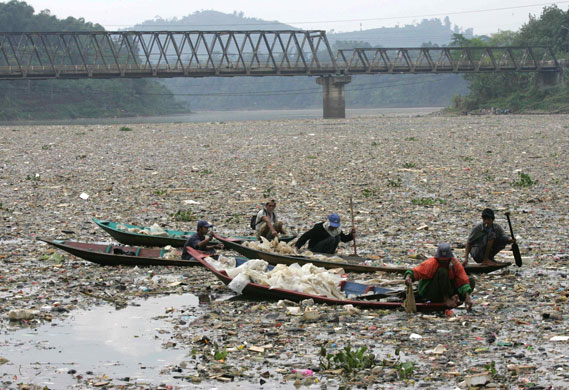
From the Guardian newspaper photo essay found at:
http://www.guardian.co.uk/environment/gallery/2008/
dec/05/water-pollution-citarum-river
What is that? Marine debris, or plastic pollution? Who is shaping the very words that we use to understand & describe what is happening to our world?

* For an impressive, and well-researched article on the reach of the plastics industry, it would be hard to beat "Is the Plastic Industry the New Tobacco Industry," by Amy Westervelt, published March 23, 2011.

^ This quote was reported by the Plastic Pollution Coalition's Facebook page on March 24, 2011.

Monday, January 10, 2011

Collection Report Dec 29, 2010

Here at last, long-delayed. December 29, two days after the fabled "Christmas storm." Though the mid-Atlantic was hit hard, Maine saw an average -- even light -- nor'easter. I arrived at Bay View beach late morning, low tide, to this:
A long morning - kelp beds carry far more than kelp
This report will have limited commentary. The pictures are enough. Keep in mind, this is from tide line, a few hundred feet of beach in southern Maine, in 28 degrees F. The same stretch of beach I've cleaned fastidiously nearly every week since June.

First, "Zone N" - the northerly of the two sections I clean, closest to the public access, and more populated during the summer months.
341 finds:
  • Building materials: 3
  • Foam/Styrofoam: 3
  • Fishing misc.: 75 (36 lobster claw bands, 14 bits of vinyl trap coating, lure, "Lunker Fishing" packet scrap, 1 webbed basket, sinker bead, 2 monofilaments, 19 bits of rope)
  • Food-related plastics: 55 (11 scraps of #6 drinking cup, 17 bits of cutlery, 13 bottlecap seals, 1 "medium-well" steak tag, 2 bread tags, 11 misc.)
  • Food-related metal/glass: 9 (7 can scraps, 2 bottle caps)
  • Non-food/unknown plastics: 180 (you name it, it's there)
  • Cigarette filters/plastics: 1
  • Paper/wood: 1 (golf tee)
  • Misc./unique: 14 (13 fabric scraps, 1 piece of cord)
Summer's fare, lurking offshore til the storm
Misc. confetti of modern life
Closeup of some misc. plastic
Shovels, pail bits, umbrella bases, etc.
Broken ruler helps size other flotsam
Whither the missing comb teeth?
Aluminum cans degrading
The cost of a robust fishing economy
Many bands had apparent bite marks
On to "Zone S" -- the southern zone, separated from Zone N by a private patio built out slightly onto the beach, and thus much quieter & less-traveled in summertime:
137 finds:
  • Building materials: 1
  • Foam/Styrofoam: 0
  • Fishing misc.: 21 (12 claw bands, 3 vinyl trap coating bits, 1 shotgun shell, 5 bits of rope)
  • Food-related plastics: 15 (7 bottlecap seals, 3 bread wrapper tags, bottle cap, spoon, fork tine, 2 scraps of drinking cup)
  • Food-related metal/glass: 9 (can scraps)
  • Non-food/unknown plastics: 89 (a little of everything)
  • Cigarette filters/plastics: 2 (1 cigarette and one plastic cigar end)
  • Paper/wood: 0
  • Misc./unique: 0
More confetti
More fishing debris
July 19, what year?
Recycling doesn't close the loop;
it restarts it
My highest weekly total ever. 478 pieces of trash washed up from one storm. And it's simply not possible that I got it all - the kelp was too thick and sandy to turn over every last bit of it, try as I might.


An aside:

Last week there was a dustup when a researcher in Oregon suggested that the extent of plastic pollution was exaggerated. Here's how you can really find the truth. Look down at your feet. That's all you have to do.

Maine is nowhere near a great ocean gyre. Its currents are fed from the north by waters that flow along the least populated parts of the Atlantic Ocean. And yet here is the waste of modern life washing around me. Nearly 500 pieces of plastic along 500 feet of beach, when Maine's tidal shoreline is 3,500 miles.

So fine; it's true that the plastic doesn't swirl in a vortex twice the size of Texas.

It swirls everywhere.