Showing posts with label vinyl. Show all posts

Sunday, November 3, 2013

Collection Report - September 23, 2013

Monday, September 23. 8:30AM. Right at low-tide. Bright sun. 55 degrees. Colors of the bushes along the backshore starting to change as fall begins to take hold. Still pink, purple, red, & white blooms on the beach roses.

This day I saw some erosion at back of foreshore. Heavier bits of seaweed had been tossed up & clumped there. And a small cliff had formed from waves pounding into back of foreshore and dragging back some of the softer sand.
The low-foreshore rocks had a pretty unsorted/jumbled look to them. August's cusps & mounds had been smeared and flattened out. There was lots of larger tossed-up wrack. And amidst that I found new pieces of rope, the first bits of newly washed-in rope that I'd seen in some months. That only seems to happen here when there's been true energy coming in. That same energy seems to have been what's scoured the sand back. Things changing as summer turns to autumn.

And as summer forage turned to autumn fruits, out have come the deer!
I tracked out four sets of deer prints on the beach! Pressed deeply & freshly into the soft sand at the backshore. Two large prints, two small prints. Sometime just overnight judging by how fresh the tracks were. I love this beach.

Someone else loves this beach. I found the carapace of a cooked lobster amid a rock ring. Looking at its shell, I see why it was cooked.
This lobster has the dreaded "shell disease" -- a parasite that damages lobster shells but leaves the meat untainted. It's still fit to eat, but nobody would want to buy a lobster that looked like that. The lobsterman who caught this possibly cooked it up for his family.

Shell disease decimated southern New England's lobster fishery starting in 1999. It's creeping northward. If it hits the Gulf of Maine with full force, the lobster industry is in real trouble.

Well, the higher energy this week would usually mean less debris left behind than in recent weeks. Did it?
50 pcs of rope, about 50 ft total
326 pcs of nonrope debris
376 finds:
  • Bldg material/furniture: 0
  • Foam/styrofoam: 0
  • Fishing rope/net: 50
  • Fishing misc.: 253 (237 vinyl lobster trap coating scraps, 4 trap parts, bait bag, bumper, 10 clawbands)
  • Food-related plastics: 23 (2 bottlecap seals, 18 cup scraps, 2 bread tags, straw)
  • Food-related glass/metal: 2 (aluminum can scraps)
  • Nonfood/unknown plastics: 14 (cigarette, bandaid, 6 cable ties, 2 cords, 4 anchors)
  • Scrap plastics: 34 ( 11 > 1" , 23 < 1" )
  • Paper/wood: 0
  • Non-plastic misc./unique: 0
Disturbingly, 243 pieces of lobster trap was indeed far less than what I'd been averaging for the previous month. 326 pieces of garbage coming off an untouristed beach. And that's a "good day."

Running YTD counts:
  • Total pcs of litter -- 9320
  • Pcs fishing rope -- 1862
  • Vinyl lobster-trap scraps -- 5667

Tuesday, October 29, 2013

Collection Report - September 15, 2013

Saturday September 15. 1:15PM, near low tide. Mid-60s, nice seabreeze. Mostly sunny. Fall-like crisp air.
Beach looking still a lot like September 7. If maybe a bit more "unkempt." The live algae down low on the foreshore was still there -- though getting more muddled & ripped up. The low foreshore a jumble of cobbles & pebbles & boulders.

Higher against back of foreshore August's clusters & clumps of pebble-sized rocks were still there. But matted down. "Aging." Smushing themselves back down, unrestored by the late summer's weak waves.

Sadly those weak waves brought their payload of vinyl lobster trap bits again.
This time instead of up against the back of the foreshore, the bulk was strewn amid the standing water and boulders of the live-algae zone. A one-day slightly higher tide seems to have had enough energy to first spill over the foreshore berm, and then partially drag some of the vinyl load back down.

But again, there was no energy for bringing in large & heavy things like rope. It was another zero-rope day. And another sobering day.

1151 pcs of nonrope debris
1151 finds:
  • Bldg material/furniture: 0
  • Foam/styrofoam: 0
  • Fishing rope/net: 0
  • Fishing misc.: 1043 (979 vinyl lobster trap coating scraps, 5 bumpers, 5 trap parts, 54 claw bands)
  • Food-related plastics: 30 (bottlecap, 3 bottlecap o-rings, 24 cup scraps, cutlery scrap, straw scrap)
  • Food-related glass/metal: 2 (aluminum can scraps)
  • Nonfood/unknown plastics: 11 (balloon, PhoneMate clip, Nifty Magnetic SpaceSaver Binder scrap, cord, cable tie, 2 plant stakes, anchor, 3 ring seals)
  • Scrap plastics: 64 ( 16 > 1" , 48 < 1" )
  • Paper/wood: 0
  • Non-plastic misc./unique: 1 (tile scrap)
A couple of the wash-ins were kind of cool. An ancient phone clip from an old PhoneMate answering machine system:
And a very worn & aged scrap from a "Nifty Magnetic SpaceSaver Binder":
Neither of these makes sense as ocean debris. Yet both were in the ocean. Probably from either an accidental trash-bag rip near a gutter, or debris from a violent coastal storm years ago.

But of course, the story this week, as many weeks running, is the lobster trap debris:
979 pieces of vinyl. A record.

That's barely enough to recreate one lost lobster trap. In the hour & a half that I was picking these pieces up at least 6 more lobster traps were lost in the waters of the Gulf of Maine.

That's not sustainable.

Running YTD counts:
  • Total pcs of litter -- 8991
  • Pcs fishing rope -- 1812
  • Vinyl lobster-trap scraps -- 5424

Monday, December 3, 2012

Fishing Industry Debris Clogs Gulf of Maine

A warm "thank-you" to the Portland Press Herald / Maine Sunday Telegram for running the op-ed I wrote about the debris I'm finding at Curtis Cove yesterday in the Sunday newspaper. This cove, a "protected" wildlife habitat, is an incredible open-air laboratory of so much of what's currently going wrong in the Gulf of Maine. And in a sense, the wider world.
76.1% of the plastic I pull from the beach there is directly related to lobstering. There have to be other ways to do this work. If there aren't, we'll just continue to finish off the complex web of life in the sea that sustains us.
Below is the original text of the op-ed that I wrote. 99% of it made it into the Press Herald, but I wanted it documented as originally written. As hopefully a pathway into a conversation that we in the state need to have, and that will in the end hopefully benefit all.

Curtis Cove, a deep, horseshoe-shaped nook, lies at the southern tip of Biddeford’s coastline. There, gentle waters lap against pebbles and fine gray sand. Rocky tide pools teem with life. Beach roses bloom among the rip-rap. It’s protected space, set aside as vital habitat for great annual seabird migrations.

Unmolested, untouristed. Supposedly free from the modern world.

Yet the modern world swirls in on every tide.

Along the wrack line, the eye catches them. Little flecks of unnatural green, bright yellow. See one, and you can’t help but see more. A few blue, a white fleck, a red one.

They’re the colors of lobster traps, like those seen stacked in front yards and docks and postcards. Except these aren’t lobster traps anymore. They’re part of what happens when a lobster trap dies.

The Great Pacific Garbage Patch is old news. The Gulf of Maine is its own plastic garbage patch. Much of our marine litter rolls and bounces along the sea floor, washing up at places like Curtis Cove. That litter includes countless scraps of nondegradable vinyl coating, burst from countless derelict lobster traps rotting on the Gulf of Maine seabed.

I visit the cove weekly, collecting and cataloging what washes in. Along just 150 feet of it I have collected 10,617 pieces of man-made garbage since late winter.

Of course it isn’t all lobster-trap bits. I have found plant pots, fiberglass siding, a car arm rest, carpet scraps, a saw handle, a crate lid, half of a coathook, part of an outdoor thermometer, even an antique clay pipe.

But sadly, most of what washes up here is directly related to lobstering. 8,076 pieces, 76.1% of everything I’ve found. 477 lobster claw bands; 144 trap bumpers; 119 bait bags; 2487 fishing rope scraps -- some 4/5 mile total length. Various other scraps of traps, buoys, etc.

And 4563 flecks of lobster trap vinyl coating.

All from 150 feet of protected cove, in a state with over 3,000 miles of coastline.

It’s ugly, of course. It’s litter. It shouldn’t be there. But beyond that, plastics in the ocean adsorb terrible toxins. They kill sealife and shore dwellers. Many of the claw bands (lost overboard as lobsters are being banded) have fish bite marks all over them -- possibly from young cunner. The harder vinyl trap coatings could be swallowed whole, tear an animal up, and survive intact to kill again.

Maine’s Department of Marine Resources licenses 3 million lobster traps each year. How many have been lost? Nobody knows. From the time that the first trap was put into Maine waters all the way up to 2009, DMR kept no record.

Now they require lobstermen to submit a request in order to get replacement tags. From 2009-2011, they received about 38,000 requests per year -- which of course doesn’t account for undeclared losses.

Fishing with rope & traps means losing gear. That’s reality. When it was biodegradable, it mattered less. But around 1980 vinyl-coated steel traps and plastic bait bags/rope became the gear of choice. Because it seemed cheaper, both in cost and effort.

30+ years at 38,000+ lost traps a year means, conservatively, one million derelict plastic-coated lobster traps on the seafloor by now.

Of course a few wash up. Every beach and island has its wrecked traps. Others are grappled and removed by nonprofits, fishermen, & volunteers. But most sit hidden in the deep, rot, and shed their plastic bits over decades.

Fact: One of the state’s largest industries uses a business model that plans for losing hundreds of tons of nondegradable plastic into the Gulf annually -- and offers no mitigation! Industry’s debris, our great-grandchildren’s problem.

It’s well past time to drop the myth of “cheap” plastic. Plastic gear’s costs are very insidious and very real. Besides, the frenzied rush of “more, cheaper, more” has proven to benefit very few. And it leaves a growing legacy of dangerous, persistent pollution that washes up all around us.

It’s time to stop, look at the sand at our feet, and really see what’s there. We must treat our resources with respect. Return to degradable gear, demand a fair price for fishing responsibly, and promote the industry internationally as a model of a conscientious and sustainable fishery.

Whatever we do today, our descendants will still find scraps of yesterday’s “cheap” fishing gear on their shores and inside their sealife for decades. But if we change the game now, maybe at least they’ll look back on us and not shake their heads.

Tuesday, October 23, 2012

Curtis Cove Report - Oct 11, 2012

Thursday October 11. 1:30PM. 55 degrees, bright skies, mild gusts. A real autumn feel.
This was another beautiful day. The Little River marsh behind the cove was awash in rust & ochre:
On the beach, the power of the ocean had pulled down a lot of older sand, revealing once-buried rope chunks. It also carved out nice cliffs amid the high sands and wrack:
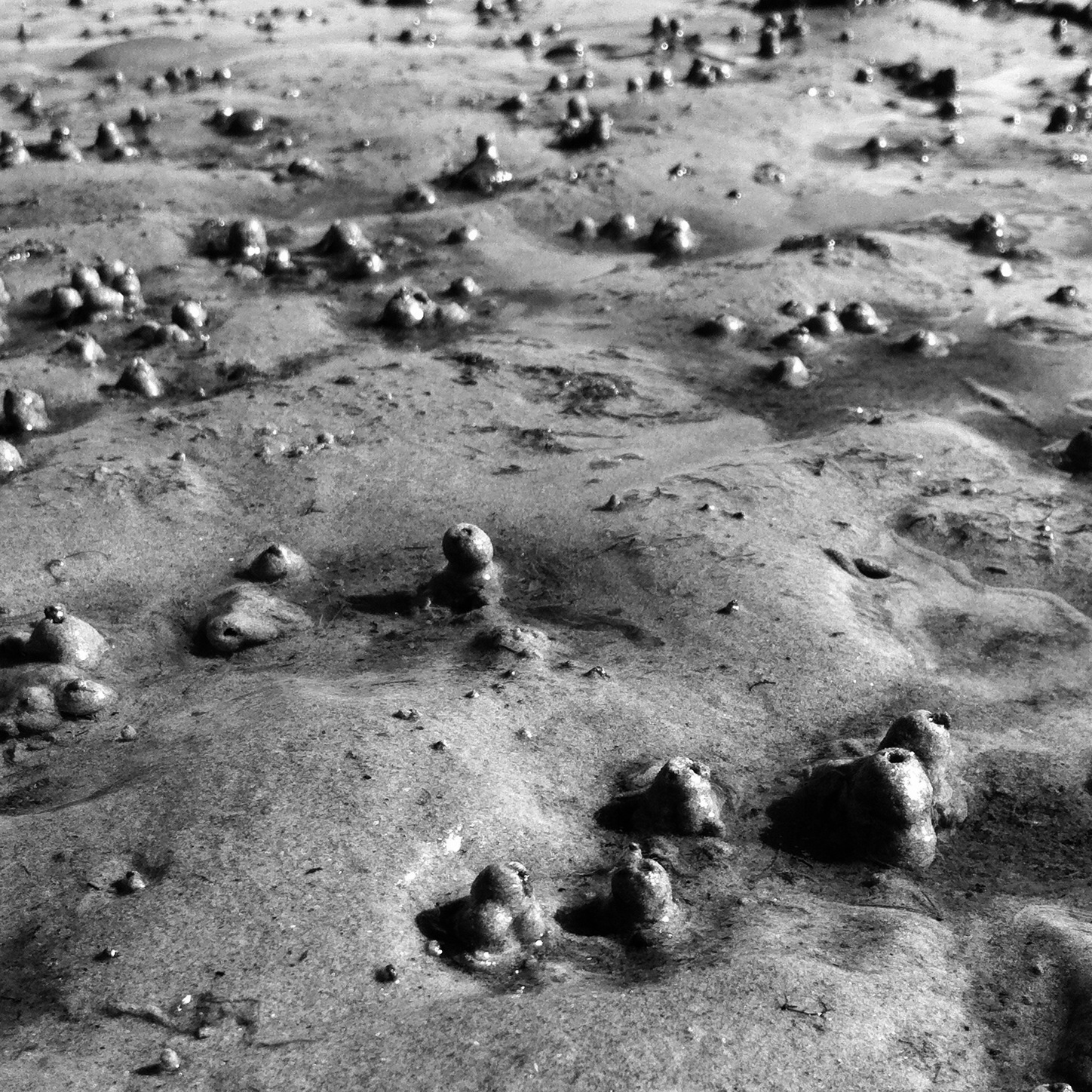
Meanwhile, down at the muddy lip where the low-tide ripples lapped the shore, otherworldly tubeworm "condos" stood proudly:
In the end, this was a very "unsorted" day. Masses of cobbles and pebbles came up high. Masses of sand, mud, and wrack slumped down. The ocean rearranged its coastal furniture quite a bit. So what would that mean for the collection?

26 pcs of rope, about 60 ft total
57 pcs of nonrope debris
87 finds:
  • Bldg material/furniture: 0
  • Foam/styrofoam: 0
  • Fishing rope/net: 26
  • Fishing misc.: 34 (20 vinyl trap scraps, bait bag, 8 trap parts, trap tag, 4 claw bands)
  • Food-related plastics: 8 (bottle - old & scoured, bottlecap, 5 cup scraps, straw - old & brittle)
  • Food-related glass/metal: 6 (2 can scraps, 4 sea glass)
  • Nonfood/unknown plastics: 9 (bag scrap, 3 cable ties, bucket rim, flower tag, circular base, rubberband, air filter scrap)
  • Scrap plastics: 4 (3 > 1" , 1 < 1" )
  • Paper/wood: 0
  • Non-plastic misc./unique: 0
In the end, not a huge haul. With much of the lighter sand and wrack pulled back downshore, probably the light & bouncy plastics went back to the sea. What was left behind was mostly larger and bulkier than usual. Sizable chunks of rusty trap, bigger scraps of broken plastics, heavy seaglass -- even the vinyl trap scraps tended to be larger than usual.

More sobering, look closer.
Om, nom, nom
The synthetic (read: plastic) fiber swatch on the left has been chewed and bored by various denizens of the deep. The hard piece of styrene on the right has been poked by many teeth/beaks, and ripped & torn by others.

Plastic seas feeding plasticized fish. This isn't science fiction. It's not some dystopian future. It's now. In the beautiful state of Maine.

Running YTD counts:
  • Total pcs of litter -- 9623
  • Pcs fishing rope -- 1977
  • Vinyl lobster-trap scraps -- 4442

Friday, October 19, 2012

Curtis Cove Report - Oct 6, 2012

Saturday, October 6. 10:15AM. A bright morning inland, misty with a seabreeze at low-tide. Temps in the low 60s. A little overnight drizzle--most obvious at the high-tide line.
Clues in the sand
There was good sorting of wrack & debris. And enough energy in a couple tides to push up and over the foreshore "barrier" onto the high ground beyond. Overall? Just a beautiful day to be at a breezy, deserted beach. A day of snail shell graveyards...
Also well-sorted into this one "nest" 
Beautiful balls of quartz...
Once a mountain-root, now beach rubble
Violet rivulets running through wrack-stained sand...
Unfiltered, it really looked like this!
And one of the few pieces of local litter I've found here in the past 10 months...
Hope they enjoyed the view
Amid the wrack there was definitely an uptick in what washed in. I found...
29 pcs of rope, about 26 ft total
103 pcs of nonrope debris
132 finds:
  • Bldg material/furniture: 0
  • Foam/styrofoam: 1
  • Fishing rope/net: 29
  • Fishing misc.: 69 (52 lobster trap vinyl scraps, 9 trap parts, 2 bait bags, 5 claw bands, fishing line)
  • Food-related plastics: 8 (bottlecap o-ring, 5 cup scraps, food wrapper, straw)
  • Food-related glass/metal: 3 (fresh aluminum can, old can top, sea glass)
  • Nonfood/unknown plastics: 12 (3 balloon string, latex balloon neck, cigarette, bandaid, bag scrap, 2 cords, silicone strip, flower tag, umbrella base)
  • Scrap plastics: 10 (4 > 1" , 6 < 1" )
  • Paper/wood: 0
  • Non-plastic misc./unique: 0
The numbers were definitely up. And it was all the usual. Including the fact that about 3/4 of it was lobster-fishing debris. No surprise. In the Gulf of Maine as many as one million lost, derelict traps are rotting on the seabed right now. Our legacy to our grandkids.

The mists actually picked up throughout my collection. A lot of moisture pulled in from the sea was gathering into clouds inland, and the drive home was a gray and ominous one. Neat to have been there to see it happen.

Running YTD counts:
  • Total pcs of litter -- 9536
  • Pcs fishing rope -- 1951
  • Vinyl lobster-trap scraps -- 4422

Tuesday, August 21, 2012

Curtis Cove Report - Aug 15, 2012

Wednesday, August 15, 2:30PM. A couple hours before low-tide. Upper 70s, seabreeze, bright sun. Bright green algae on the lower foreshore. A tumbled line of pebbles and seaweed mixed together halfway up toward the berm lip. The last remnants of June's wrack high and dry on the backshore.
Sand, cobbles, rip-rap, and wrack
A weak week, energy wise. So what would it bring? Well, this 30-gallon garbage bag for once. Having seeing too many mobster movies, I was a little hesitant to peek in.
Thankfully free from anything... untoward
It just held sand. As did this Luvs bundle of joy:
Also thankfully free of anything untoward!
This week the new wrack & pebble line held the most debris. Last week, 10, 20, 30 feet down the slope were other smaller wrack lines, each with lots of vinyl scraps. Probably remainders from the receding tide, dragging back as much as it could before giving up for the afternoon. This week it was all heavily compressed into one tiny zone of pebble & algae "carpeting" choc-a-bloc with plastic bits.

The haul:
9 pcs of rope, about 9 ft total
486 pcs of non-rope debris
495 finds:
  • Bldg material: furniture: 0
  • Foam/styrofoam: 0
  • Fishing rope/net: 9
  • Fishing trap gear: 334 (10 trap parts, 10 bumpers, bait tin, bait bag cord, entry net, 311 vinyl scraps)
  • Fishing misc.: 42 (40 claw bands, Perfect Fit glove, buoy)
  • Food-related plastics: 25 (3 bottle caps/o-rings, 18 cup scraps, 2 bread tags, food wrapper, straw)
  • Food-related glass/metal: 6 (2 can scraps, 3 sea glass, bottlecap)
  • Nonfood/unknown plastics: 28 (large trash bag, 3 bag scraps, cigarette packaging, 3 cigarettes, diaper, 3 bandaids, 4 cable ties, 2 plant tags, contact solution label, name tag, o-ring, attaching plate, 2 black tape, 4 vinyl upholstery)
  • Scrap plastics: 48 (18 >1", 30 <1 li="li">
  • Paper/wood: 0
  • Non-plastic misc./unique: 3 (2 bits of cord, fabric scrap)
All in all, what's become a fairly typical summer signature here at the Cove. Finding 300+ bits of lobster trap vinyl is hardly a shock anymore. Which is itself a little shocking.

Most everything else was also dense, sinkable, small material. Including many scraps that spoke to a long, tortured existence at sea.
Scrap of hi-tech super-insulated glove
Seat cushion? What's its story?
With one nice head-scratcher. NICK 975, who are you, what was this, and do you want it back?
"NICK 975" - Not a lobster tag, so...?
So as the summer wears on and the energy wanes, rope becomes rare and little vinyl bits proliferate. This makes sense. A beach is largely just a physical expression of the nature of the energy that hits it. Whether it's made of cobbles, sand, mud... Whether it runs for 20 miles or occupies a small niche at the bottom of a cliff -- the energy of wave crashing against land molds it. Makes it what it is.

A beach changes over millennia, and it also adjusts to the annual rhythm of storm and calm. It's a privilege to explore the same coast week after week, and learn the rhythms of energy that make Curtis Cove truly unique.

Running YTD counts:
  • Total pcs of litter -- 8164
  • Pcs fishing rope -- 1776
  • Vinyl lobster-trap scraps -- 3835

Sunday, July 29, 2012

Curtis Cove Report - Jul 27, 2012

Friday July 27, 1PM. Curtis Cove. And the beach roses are in bloom.
Temps were in the 70s, with heavy clouds & heavier air. The skies threatened a couple times, but at best pelted the ground with a few small drizzles.
Lunar landscape
I've always wanted to see how long it really takes debris to return to the sand here. It had only been 4 days since my July 23 collection. What would the beach hold? Well.... a lot of this:
A wrack line of seaweed and plastic
Depressing -- and eye-opening. After an hour or so on the beach, here's what I pulled up from my 150-foot zone.
38 pcs of rope, about 35 ft total
573 pcs of non-rope debris
611 finds:
  • Bldg material/furniture: 3 (2 vinyl floormat scraps, vinyl upholstery scrap)
  • Foam/Styrofoam: 0
  • Fishing rope/net: 38 (all rope)
  • Fishing trap gear: 396 (383 vinyl trap scraps, 11 bumpers, 2 bait bags)
  • Fishing misc.: 45 (1 fishing line, 44 claw bands)
  • Food-related plastics: 32 (26 #6 cup scraps, 3 bottle-cap o-rings, 2 candy wrappers, 1 bread tie)
  • Food-related glass/metal: 2 (can scraps)
  • Nonfood/unknown plastics: 15 (1 bandaid, 1 comb fragment, 1 toy sticker, 7 cable ties, 1 windshield washer bottlecap, 1 medicine blister pack, 1 'impatiens' plant ID tag, 1 rubber cord, 1 "DENT PIK")
  • Scrap plastics: 71 (20 >1", 51 scraps <1")
  • Paper/wood: 0
  • Non-plastic misc./unique: 9 (1 glove, 8 fabric pieces)
611, in just 4 days. Crazy! And of course tilted extremely heavily toward lobstering debris, including another insane haul of vinyl trap flecks. But the waves also brought many things that had no business being in the sea. Including:
A faded sticker from a toy
Windshield washer fluid bottle cap
'Impatiens' tag from planter/garden
Battered comb -- where's the rest?
"DENT PIK"?  Not even in Google!
Vinyl flooring scrap
Vinyl upholstery scrap
And of course poignant reminders of why plastics don't belong in the ocean in any amount:
Sealife-nibbled/poked cup scrap
Of all the finds on Friday, exactly one -- a candy wrapper -- was a local drop. Everything else came from the ocean. It was there because everything we use -- and lose -- is now plastic.

Running YTD counts:
  • Total pcs of litter -- 6396
  • Pcs fishing rope -- 1650
  • Vinyl lobster-trap scraps -- 2779

Sunday, April 1, 2012

Collection Report March 19, 2012

Monday March 19, 11:00AM. An hour or so after high-tide. After a ridiculously warm weekend, signs of a heavily used beach.
Augh.

Yet in spite of the disaster at the can, the beach itself weathered the onslaught well.
Another ridiculously weak tide:
Barely made it up the slope
And another dead, glassy sea:
Smooth enough to skate on
But a few items still managed to beach:
Vent released from derelict lobster trap
This vent is made of polyethylene or polypropylene -- light plastic that floats easily on the sea. The little fresh wrack that I found also was mostly floatable, with air bladders to stay on top of the ocean. Light plastic & light wrack -- both rare at Bay View this winter, but here this week. Is it because the air warmed so much that the difference between it and the chilled seawater is firing up internal waves? Sending energy through the ocean even when it's not visible on the surface? I wish I understood the mechanics better. At any rate, something's changed this week.

On to the count. Zone N:
50 finds:
  • Building materials: 14 (8 asphalt chunks, 4 brick, 2 roof tiles)
  • Foam/Styrofoam: 3
  • Fishing misc.: 6 (rope, trap tag, 3 vinyl trap scraps, claw band)
  • Food-related plastics: 4 (3 wrappers, old knife)
  • Food-related metal/glass: 2 (2 can scraps)
  • Nonfood/unknown plastics: 10 (balloon, golfball, packaging, makeshift funnel, wallet insert, 3 scraps >1", 2 scraps <1")
  • Cigarette filters/plastics: 6 (4 filters, 2 packaging)
  • Paper/wood: 4 (3 scraps, 1 packaging)
  • Misc./unique: 1 (grotty fabric/clothing)
Given the 70-degree weekend, the "local" plastic finds are really low. Even the knife was a wash-in.
Biofouling
Not sure how long that knife kicked around the sea. But most likely since at least the last good beach day of 2011. Plastic silverware is #6 plastic -- polystyrene that sinks gently in seawater. So the energy coming in to Bayview was both surface & seafloor energy this week.

Now down to Zone S, where a few other interesting things washed in:
49 finds:
  • Building materials: 7 (6 asphalt chunks, 1 roof shingle)
  • Foam/Styrofoam: 2
  • Fishing misc.: 21 (2 rope, trap vent, 15 vinyl trap scraps, trap tag, shotgun shell, very old claw band)
  • Food-related plastics: 0
  • Food-related metal/glass: 6 (3 can scraps, 1 sea glass, 2 foil wrappers)
  • Nonfood/unknown plastics: 7 (baggie, packaging, large tire scrap, 2 rubberbands, tubing, 1 scrap >1")
  • Cigarette filters/plastics: 5
  • Paper/wood: 0
  • Misc./unique: 1 (leather offcut)
The trap vent floated in on top, as did the trap tag. The large chunk of rubber tire may also be fishing-related, perhaps as part of a bumper on the side of a boat.

And there was a whole batch of vinyl scraps from lobster traps along the wrackline. Vinyl is quite dense and sinks to the bottom of the ocean, so rolled & bounced its way up to shore. And this stuff is insidious.
As these scraps break down smaller & smaller, they bounce in front of animals with smaller & smaller brains, and are no doubt eaten by them. Vinyl is toxic to make, toxic to burn, and no doubt toxic inside a gut. At the untouristed cove I also study about 5 miles away, this is what greets me in the tide pools at low tide:
One of these things is not like the others...
Each lobster trap can shed 1,000 of these bits as it rusts away. With at least half a million derelict lobster traps likely on the seafloor, the number of vinyl scraps we, our kids, and our great-grandkids will have to deal with is staggering.

The beach is different every week I visit it. Yet one thing's is constant. In nearly two years of beachcombing the same exact shoreline, the number of times that I've come away with zero pieces of manmade litter: Zero.