Showing posts with label cigarette butts. Show all posts

Friday, March 9, 2012

The Long Road

My friend Danielle of It Starts With Me and her family have picked up over 40,000 cigarette butts from Wrightsville Beach, NC. And counting.

This, by any measure in a sane world, would be insane. Knowing this, Danielle and the Cape Fear branch of Surfrider helped organize a town meeting last night to push for a ban on smoking at the beach.
Surfrider's campaign posters
are top-notch
Despite a packed house filled with a sea of supporters in blue shirts reading "Breathe Easy / Keep it Clean" (some 90% of the room supported the ban), the council voted 3-2 against.

In Portland, Maine it took until February 2012 for the city even to acknowledge that a plastic cigarette butt, loaded with a cocktail of toxic chemicals, was litter!
Monument Square, Portland, ME
(image from the Portland Press Herald online)
Let that sink in for a moment. The first rumblings of the ill-effects of cigarettes came in the 1940s. By 1970, cigarette advertising was banned from TV. The Tobacco Wars of the early 1990s ended with the universal understanding that cigarettes are dangerous, and deadly. Yet it took 20 more years for Maine's largest city to identify a cigarette butt as litter.

Last week I visited the Maine Fishermen's Forum up in Rockland at the beautiful Samoset Resort, overlooking rocky cliffs and a foggy sea. The fishing industry in the Gulf of Maine has reeled from one crisis to another for decades. Pollution, overfishing, acidification, sea-temperature rise -- these are putting tremendous pressure on fish stocks. So much of this comes back to simple mistreatment of the fishery & the environment. Yet judging by the view I saw out on the covered walkway...
100 more all around the can and snowy sidewalk
...care for the environment isn't high on the radar.

Since I started the Flotsam Diaries, I've pulled about 1/2 mile of fishing rope from local beaches.
200 more feet pulled up at Curtis Cove, Biddeford
on March 7, 2012
It's all plastic -- nylon or polypropylene. It will last forever, in some form. What I've retrieved represents the tiniest percent of what's certainly out there. I've also recorded several dozen derelict lobster traps washed up. Here's 30 or so from Goose Rocks Beach, Kennebunk, last year:
Each trap is vinyl-coated, and each slowly releases 1000 chunks of toxic polymers as the steel rusts. Conservatively there are half a million derelict lobster traps on the seafloor in the Gulf of Maine. The number is probably far higher.

Yet Maine has no regulations for monitoring lost rope. If a lobsterman loses a trap, they fill out a form. But that paper form goes into a stack, with nobody really examining where it was lost. Even if the location was known, there are ZERO funds in the state to recover any of the gear.

So the problems grow. And heads remain firmly buried in the sand.

Still, it's not all doom and gloom. More and more cities are taking cigarette litter seriously. Even Portland, finally. More and more are taking grocery-bag and other plastic litter seriously. And the state of Washington has just passed ground-breaking regulation to monitor and help clean up fishing debris. There are fingerposts and guides the world over showing the good that can happen when you admit a problem exists & then fight it like you mean it.

Change can be a long road. I know all too well that it can feel sometimes like a hopeless road. But at least it's a road. Can you imagine life if there were no roads to take you somewhere beyond where you are?

Saturday, January 21, 2012

Collection Report Jan 9, 2012

Monday, January 9, 2:30PM. Bright sun. Mild offshore breeze, chill in the air. 3 hrs after high-tide.
If you can call it a high-tide. This was the weakest tide I've ever seen at Bay View in 1 1/2 years of wandering it. Unsurprisingly, with no energy, no tides, and offshore winds, little washed up again. Actually, less than little.

Zone N:
12 finds:
  • Building materials: 5 (4 brick, 1 asphalt)
  • Foam/Styrofoam: 0
  • Fishing misc.: 1
  • Food-related plastics: 0
  • Food-related metal/glass: 1 (sea glass)
  • Nonfood/unknown plastics: 4 (baggie - not shown, black tape, 2 scraps >1")
  • Cigarette filters/plastics: 1
  • Paper/wood: 0
  • Misc./unique: 0
Zone S:
6 finds:
  • Building materials: 5 (2 asphalt, 3 brick)
  • Foam/Styrofoam: 0
  • Fishing misc.: 0
  • Food-related plastics: 0
  • Food-related metal/glass: 1 (glass bottle scrap)
  • Nonfood/unknown plastics: 0
  • Cigarette filters/plastics: 0
  • Paper/wood: 0
  • Misc./unique: 0
Take away the asphalt & brick, and there's nothing. On a hunch, I took a walk about 1/5 mile farther south than the southern edge of Zone S. This is an area that I've never collected, but have always anecdotally noted junk lying amid its wrack. This day? Nothing. Not one speck of seaweed or manmade debris. Not even a cigarette butt. Current conditions have pushed & blown everything that was on the sand back into the blue and kept more from washing up.

The perfect culmination of six weeks of truly "bizarre weather," as a NOAA oceanographer I'm in touch with has called it. By the end of the first week in January 2012, over 1000 all-time January heat records had broken. The jet stream, which usually dips deeply into the US from Canada, spent week after week riding high up in Canada. Could I be seeing a small part of the bigger story here on my little stretch of beach?

Anyway. Weirdness. But fun to be seeing it & adding it to the record.

Wednesday, November 2, 2011

Collection Report Oct 24, 2011

Monday, October 24. Bay View beach, Saco, Maine. 1:25PM, a couple hours before low tide. The latest high-tide had been fairly weak, and there was little new wrack/seaweed. An overcast day, 60 degrees and deliciously fall-like.

The cooler days & quieter beach gave me a little time to reflect. On ephemeral rivulets:
A seagull's walk, interrupted
And the wealth of color & texture strewn about:
It's funny what you see, when you just stop & look at a handful of sand and pebbles. (After all, in Maine, that sand may have 600 million years of history behind it.) Even with a weak tide, this was a great day for wash-ins -- slipper shells, blue mussels, tons of crab, a few fish bones. A real treat. Of course, nowadays the modern world always intrudes, though often in colorful ways:
1/1000th of one of the ~1 million lobster
traps on the floor of the Gulf of Maine
Which, I guess, brings me back to the point of a collection report. So, on to it. First, Zone N:
82 finds:
  • Building materials: 7 (5 asphalt, brick, wood block)
  • Foam/Styrofoam: 14
  • Fishing misc.: 7 (3 rope, rope twine, shell wadding, claw band, trap vinyl coating)
  • Food-related plastics: 1 (plasticized cupcake base?)
  • Food-related metal/glass: 3 (foil wrappers)
  • Nonfood/unknown plastics: 11 (5 bags/scraps, tube, 2 scraps >1", 3 scraps <1")
  • Cigarette filters/plastics: 36
  • Paper/wood: 1 (paper scrap)
  • Misc./unique: 2 (fabric scrap, odd piece of paper with thin wires embedded)
A wide range, but mostly the usual suspects. (Why any of this should be "usual" is another question.) Sad to see so many cigarette butts, but hardly surprised. 5.5 trillion are used in the world each year. If even 90% of those were disposed of properly, that's still about 17,500 tossed on the ground every second. Every second. It's not sustainable, and change is in the air. Where that will leave smokers in the end is, largely, up to smokers to decide.

Over to Zone S:
31 finds:
  • Building materials: 2 (asphalt)
  • Foam/Styrofoam: 6
  • Fishing misc.: 11 (4 rope, Plante bumper, 3 trap scraps, twine, 2 claw bands)
  • Food-related plastics: 1 (Gatorade label scrap)
  • Food-related metal/glass: 2 (sea glass)
  • Nonfood/unknown plastics: 2 (scraps >1", scraps <1")
  • Cigarette filters/plastics: 5 (4 cigs, 1 filter)
  • Paper/wood: 2 (firecracker sticks)
  • Misc./unique: 0
Nothing to see here. Except maybe the big black trap corner bumper, nicely stamped with the maker, "PLANTE" on the side. Also, curiously, there are two other words embossed: "CANADA" and "U.S." The "CANADA" had been X'ed out, making this seemingly meant for U.S. traps. Wonder what law/regulation is behind that. Such a regulated industry, yet still leaving such a legacy of debris.

As I was leaving, I noticed this scrawled on a drift-log up in Zone N.
I study the accidental ways we leave pieces of ourselves behind. Here's an intentional one. A hope for a little permanence in an ephemeral world. A reminder that Joyce was here. But a reminder to whom, again? Maybe it doesn't matter. She left, but for a while at least her presence is still at Bay View.

Sunday, October 16, 2011

Collection Report Oct 2, 2011

Early October, and the rain and drear lay thick for several days. During a very lucky ~45-minute break on October 2, I managed to hit the beach long enough to make a fair collection.
The wrack line was back. And with it, the usual suspects. And at least one unusual suspect:
Fading light on 10/1 when my daughter & I discovered
The evening before, my daughter and I wandered the beach as dusk gathered, and found this odd gift from the sea down at the southern end of my "zones." Fortunately it was still there the next morning. A better picture on Oct 2:
Logtek, Inc. is a fishing supply company from Tusket, Nova Scotia, Canada. As the Gulf of Maine Lobster Foundation explained to me, that doesn't necessarily mean that this floated in from 200 miles away. These crates are in general circulation among fishermen up and down the Gulf, and this one may have fallen off a more nearby dock. Still, it had clearly been bobbing in the sea for a long time.
How many more?
Another good mystery, probably never to be solved. (Though the bin did seem to have remnants of a serial #. Might just be a way to learn more about it sometime.)

The crate may have become flotsam from an unavoidable mishap. But the nine (!) balloons that I found were completely preventable litter. A few were latex (which supposedly disintegrates over time). But many were mylar -- a plastic that persists on & on. My daughter and I went to Saco's harvest festival yesterday. As we watched balloon after balloon escape up into the atmosphere, I wondered how many people actually realize that what goes up eventually comes down.

Anyway, back to 10/2, it's now obvious that scouring of Bay View by Irene is over. Easterly winds have started to bring the ocean's payload back to shore. Crates, balloons, and this double-headed lobster buoy among it:
On to the collection. Zone N:
68 finds:
  • Building materials: 0
  • Foam/Styrofoam: 10
  • Fishing misc.: 11 (2 buoys, buoy scrap, buoy rod, 3 claw bands, 2 rope, rope twine, shotgun shell wadding)
  • Food-related plastics: 12 (2 bottle caps, 2 cups, 2 tops, 6 wrappers)
  • Food-related metal/glass: 0
  • Nonfood/unknown plastics: 22 (4 balloons, 4 latex gloves, pacifier, cord, Hooksett disc, 6 non-food packaging, 2 scraps >1", 3 scraps <1")
  • Cigarette filters/plastics: 12
  • Paper/wood: 1
  • Misc./unique: 0
My big question: How is this good advertising?

Number-wise, a small haul. But a dreary week, soaking-wet beach, and a rain-curtailed collection played a part in that. The buoys, balloons, and disc from the NH sewage treatment plant disaster in March prove that the post-Irene lull is over. On to Zone S:
60 finds:
  • Building materials: 0
  • Foam/Styrofoam: 21
  • Fishing misc.: 5 (crate from Nova Scotia, 2 buoy scraps, rope twine, claw band)
  • Food-related plastics: 7 (2 bottles, bottlecap, 2 cups, food wrapper, straw)
  • Food-related metal/glass: 0
  • Nonfood/unknown plastics: 18 (3 bags/scraps, 4 balloons & 1 balloon end, bottlecap, flosser, Hooksett disc, 2 scraps >1", 5 scraps <1")
  • Cigarette filters/plastics: 9 (8 filters, 1 packaging)
  • Paper/wood: 0
  • Misc./unique: 0
An unheard-of thing. Almost the same amount of garbage in Zone S as Zone N. And almost the same kinds of stuff. Which strongly suggests that the week of October 2 was ruled by wave & wind, not the tromping of local feet.

A final thought.
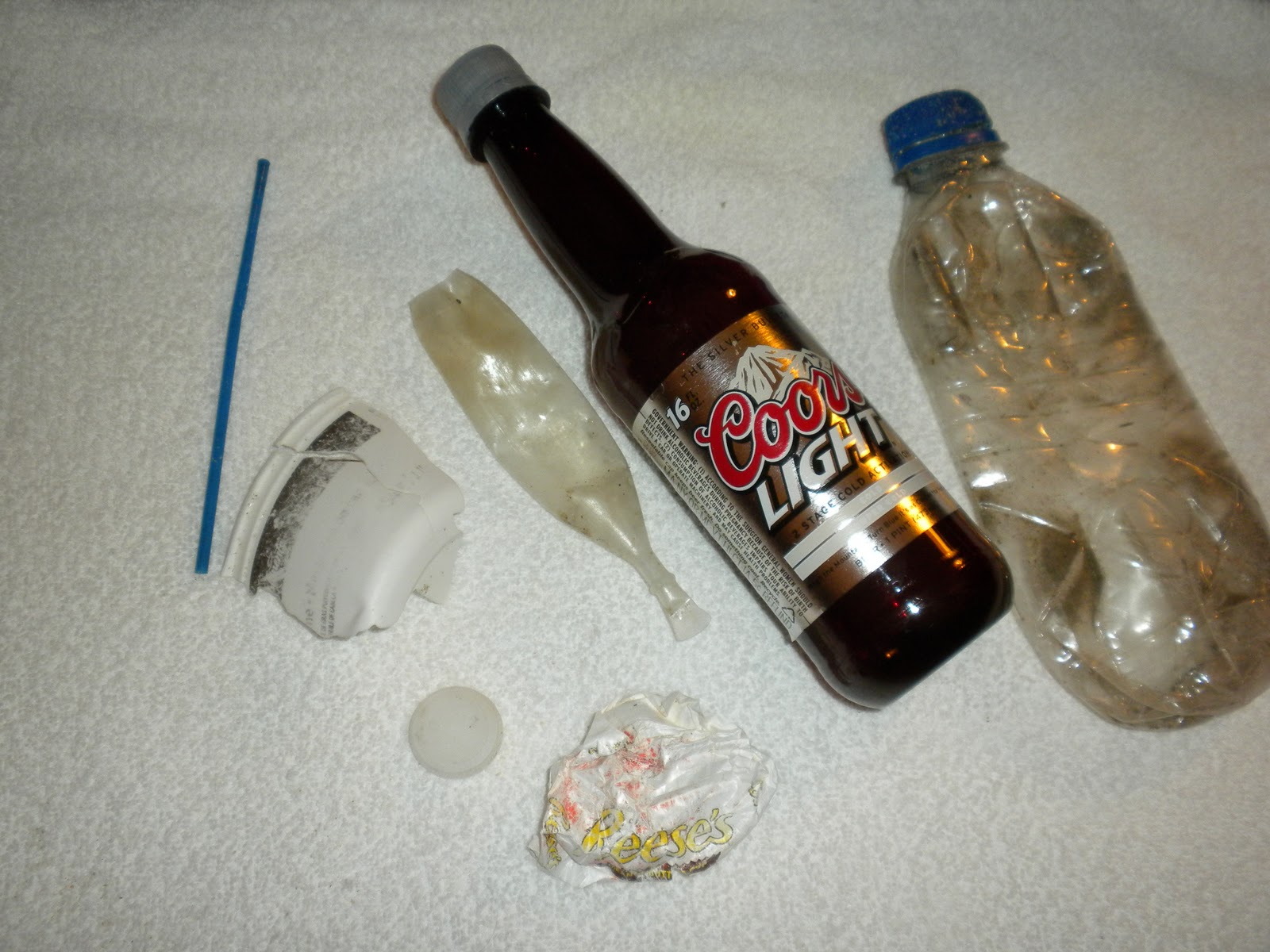
Beer bottlers have succeeded in convincing Eastern Europe to accept plastic beer bottles. It's cheaper for them to produce, and shifts the environmental burden to the unwary consumer. Western Europe and America have resisted. But as this plastic Coors bottle shows, the bottlers aren't going to stop. And are making inroads. The next time you visit a grocery store or drug store, look around at the packaging. Whatever you see that's not yet made of plastic, will be. Marine Debris Conferences aside, plastic pollution is just getting warmed up.

Monday, October 3, 2011

Collection Report Sep 18, 2011

A quick return to Bay View. 10AM. 60 degrees. A partly cloudy, moody, beautiful morning.
The kind of day where leaden skies offset glimmering sand, and you just can't quite tell what the air is doing.
It had only been five days since I'd been here. A couple of those had been cool and drizzly. With gentle tides that left the softest, finest powder behind. Sand dollars peeked out along the low-tide terrace, and there were few people to be seen.

All of which should point to a quiet, clean beach. Which wasn't at all the case. Though at least the litter tried to make itself interesting this week:
How to tell if your beach is in Maine
So, on to it. Zone N
151 finds:
  • Building materials: 4 (2 brick bits, asphalt bit, fence slat)
  • Foam/Styrofoam: 20
  • Fishing misc.: 11 (buoy scrap, 3 rope bits, 6 rope twine, shotgun shell wadding)
  • Food-related plastics: 6 (cup, bread tag, lid, 3 tear-off tops)
  • Food-related metal/glass: 7 (can, can scrap, 2 bottlecaps, 3 foil wrappers)
  • Nonfood/unknown plastics: 23 (bag, balloon, 2 condom wrapper scraps, bandaid, 2 firecrackers, rubberband, 2 plugs/grommets, pail handle, 3 scraps >1", 9 scraps <1")
  • Cigarette filters/plastics: 69 (67 filters, cigar cap, filter tip)
  • Paper/wood: 10 (7 paper scraps, popsicle stick, 2 firecracker sticks)
  • Misc./unique: 1 (headband)
A lot! Why? Some was probably lightly buried when I visited on the 13th, and later rains uncovered it. At any rate, the burned bits, styrofoam, and condom wrapper speak more to the 13th than they do to the 18th. Aside from some fishing scraps, the two most likely wash-ins were the faded sand-bucket handle and the balloon.
Those gray plastic fireworks are also strange. Nothing of the sort washed in during 2010. Yet most weeks since late spring 2011 I've seen them. Are they fishing-related somehow? Are they construction -- like blasting caps? Dunno. Would love your thoughts.

At any rate, another week filled mostly with debris of beach people doing beach things. On to Zone S:
22 finds:
  • Building materials: 1 (tile)
  • Foam/Styrofoam: 10
  • Fishing misc.: 3 (buoy scrap, rope scrap, shotgun shell wadding)
  • Food-related plastics: 0
  • Food-related metal/glass: 0
  • Nonfood/unknown plastics: 3 (bag scrap, pen cap, scrap <1")
  • Cigarette filters/plastics: 5 (all filters)
  • Paper/wood: 0
  • Misc./unique: 0
Zone S continues being comparatively dull & delightful.

Still, the week's big takeaway: A beach that looks clean, probably isn't that clean; a beach that's been picked clean, also probably isn't that clean. All it takes is a late summer shower to remind you. What lies beneath?

Friday, August 19, 2011

Collection Report Aug 4, 2011

Thursday, August 4, 7:22 AM. Seagulls crying in the distance. Flipflops left by the lifeguard tower, a ratty beach chair folded up & stowed away. (Forgotten?) Fog slowly burning off. Welcome to Bay View, Saco, Maine:
Still love seeing a beach like this
The week brought a little more energy to Bay View. Recent tides had crept higher up the shore, a few bits tumbled in from the deep ocean. But in general, the word of this day was still "dull." In fact, the above is the only picture I took while out and about. This had basically been another busy beach week, with busy-beach trash. Here's Zone N:
229 finds:
  • Building materials: 4 (asphalt chunks)
  • Foam/Styrofoam: 15
  • Fishing misc.: 17 (4 rope, 8 pieces of rope twine unfurled from impromptu "art" on shore, 4 claw bands, 1 trap tag)
  • Food-related plastics: 32 (15 food wrappers, 3 fresh fruit stickers, 7 straw wrappers, 4 bottle caps, straw, chewing gum, spoon scrap)
  • Food-related metal/glass: 10 (burned tin can, 4 bottle caps, 2 foil wrappers, 2 sea glass, pull tab)
  • Nonfood/unknown plastics: 32 (9 bags/scraps, balloon, 2 bandaids, flosser, watergun stopper, sunglasses, rubberband, tie strap, pen cap, twist-tie, 5 ribbon bits, dessicant, 7 scraps <1")
  • Cigarette filters/plastics: 93 (89 cigarettes, 4 plastics)
  • Paper/wood: 21 (13 paper scraps, 7 firecracker sticks, popsicle stick)
  • Misc./unique: 5 fabric scraps
Going on the record here, I hate these things:
Fresh fruit, now with more plastic!
I know, of all the things to hate. But it's so unnecessary. Even a person trying to be healthy, eating an unpackaged piece of fresh fruit -- instead of corn syrup, salt, and modified food starch -- ends up with plastic at the end of their snack. Why, and how, did we do this in just a couple generations?

The other thing I hate:
I have 2100 more at home
The cigarette numbers have been lower on the beach than last year. I hate that I'm kind of happy to "only" find 89 of these in a week. And the parking lot that I scoured in June is utterly trashed with them again. (But I have exciting news on that front, which I'll only tease with here. Maybe somebody will take the Bait?)

Anyway, food packs, cigarettes, And a quick view of Zone S:
31 finds:
  • Building materials: 1 (fence slat)
  • Foam/Styrofoam: 4
  • Fishing misc.: 5 (fishing rope twine, from another decayed bit of art)
  • Food-related plastics: 3 (food wrapper scrap, straw wrapper, gum)
  • Food-related metal/glass: 2 (can scrap, sea glass)
  • Nonfood/unknown plastics: 7 (firecracker, tape, 1 scrap >1", 4 scraps <1")
  • Cigarette filters/plastics: 6
  • Paper/wood: 2 (popsicle stick, firework stick)
  • Misc./unique: 1 (tiny scrap of fabric)
Wow. There is just nothing to say about this. Wouldn't it be nice to think that a long stretch of Saco Bay really stayed this relatively clean week after week?

Sunday, June 26, 2011

A Comprehensive Breakdown of Bay View's Debris, Year 1

My last collection report from Year 1, the June 7 report, is pending. But the numbers are tabulated and I wanted to get this published.

I can't quite believe that it's been a full year already at Bay View. I'm stunned both by what I've learned and how much there still is to learn. But I'm also very encouraged by the numbers that have been coming back. Some assumptions have been validated, others have been definitively blown apart. Most important, there are clear trends & compelling leads to follow, now that Year 2 has begun. And real points of discussion to bring to the wider flotsam-fighting world. I'm pretty chuffed.

So, details: From June 15, 2010 through June 7, 2011, I managed to collect at the beach 43 out of 52 weeks. (4 off-weeks were due to persistent foul weather, 2 due to being out of town, 3 due to overcommitments during the week.) All told, I picked up 8,456 individual pieces of manmade litter. It was quite a year.

Now, without further ado, the charts.
78-80% of the grand total consisted of some form of plastic
The number one culprit in terms of quantity over the full year was cigarette butts. The toxins in and persistence of these packets of plastic fiber are a subject of many Flotsam Diaries posts, as well as a three-part experiment. They will surely be the subject of future posts too.

After cigarette butts, the next largest litter source is nonfood/un-ID'd plastics. This is a catch-all category, as it includes things like beach umbrella bases, as well as tiny fragments & bag scraps that could have come from anything. Surprisingly, fishing gear beat out food-related plastics for third place. It's clear that the Gulf of Maine's fishing industry significantly contributes to the plastic pollution of the ocean & its coasts. What's less clear is what, if anything, can or should be done to mitigate. The industry is already one of the most regulated in the state & nation. A discussion for a later date.

Next in the list is food plastic & foam/styrofoam -- things most likely identifiable as local drops by beachgoers or, less often, from local garbage bins. Non-plastic items are a clear minority. Which only makes sense. Paper melts back to nothing; wood rots back to nothing; glass and steel settle to the seafloor and either erode or rust back to nothing. But plastic lives on and on.

Overall, these trends are fairly consistent with data found at such places as the Ocean Conservancy. But rather than one annual clean-up, The Flotsam Diaries is all about weekly cleanups. So I can take my data a step further, breaking down by season. And doing so shows some startling, and eye-opening, trends.
Summer's trend is cigarette-heavy
Over the summer, cigarette butts accounted for a full 2/5 of all the litter generated at Bay View! Saco has a no-smoking policy in its public parks, and the lifeguard station announced the beach as a "Tobacco-Free Area." But clearly the patrons weren't obeying.

Tied for distant second are food plastics and nonfood/unidentifiable plastics. The numbers of both are formidable each week at Bay View, but don't vie with cigarette waste. Fishing debris, near the bottom at 3%, may be misleading. Colorful pieces of rope, lobster trap tags, and buoy pieces can make unique souvenirs; much of that debris may have ended up going home with beachgoers.
Cooler weather brings a drop in cigarettes & food plastics
Good or fair weather remains for many weeks after Labor Day, and local beach debris still accumulates in the autumn. But cigarette & food plastic percentages show a significant drop. A late hurricane and later autumn storms cast a good deal of unidentifiable plastic upon the beach, as well as scattering asphalt chunks and wooden fence slats among the sands. (It remains to be seen if I'll keep including asphalt chunks in weekly totals. The material is so old & inert, it's become basically part of the rocky substrate to the beach. It's not clear if it aids or skews the record of what should be considered manmade debris.)
Winter turns debris counts on their heads
The winter record is what really surprised me. First, I had originally assumed that many of the cigarette butts were washing in. However, the winter signature shows that when beachgoers disappear at Bay View, cigarettes disappear. There is almost no recognizable cigarette waste washing into Zone N & Zone S at Bay View. It's local drops. The same is true of sytrofoam. Whatever happens to foam when it gets out on the ocean, it doesn't wash up in recognizable form at Bay View. What's there is local.

On the other hand, the % of fishing gear skyrocketed. Degraded rope, claw bands and trap tags, shredded bits of vinyl trap coating -- all washed up by the hundreds over the winter months. Do winter storms bring it in? Or does a lack of visitors mean that the colorful bits stay on the beach longer?

Also, un-ID'd/nonfood plastics washed up in amazing amounts. Many had been pulverized by wave action; many had marine organisms like bryozoans growing on them. Some may originally have been food-related, say tableware, but not identifiable anymore.

At any rate, the winter record shows the extent of plastics that now float in the Gulf of Maine. Some seemed to have been in the water for a very long time. Also, winter seems to be the time when the sea disgorges much of its battered debris back onto Bay View.
Spring brings its own mysteries
Springtime brought the least debris. Even after heavy storms & high winds, little washed in. This was true even of organics. Where there's seaweed, there's plastic; yet the big storms of early spring brought in little of either. Is there something about the coastal currents of early spring as fresh meltwater rushes out of rivers & mixes with the ocean? Worth a look.

Late in spring, the organics, with their plastic cargo, started returning. Also, foam & styrofoam started arriving in big #s. Probably the result of being blown out of local garbage bins, or careless early beachgoers; none of the foam showed signs of long-distance sea travel. A big % of the whole spring haul came from the last couple of weeks, the post-Memorial Day binge of beachgoing, with its attendant debris.

Overall, the ebb & flow of litter over the course of the year was quite remarkable. The amount of long-floating debris washed up from winter storms was shocking. The relative cleanliness of the beach/ocean for a few months afterward was also a surprise. And it provides an opportunity. A program of winter cleanups, when weather permits, may help do two major things: (1) Educate the public on the problem, as they will see that seaside pollution isn't all just local beachgoers & recent drops; (2) Possibly make a significant difference in the overall cleanliness of our coast & coastal waters, at least in the short term. Obviously the only true, sustainable answer is to stop polluting the ocean in the first place. But the more that organizations can bring the problem to light, the more willpower there should be to do something at the source.

This has been a remarkable year. I'm excited to have made these discoveries, and had a chance to bring them to the public. On June 20 I started my second year collecting & reporting on the litter that arrives at this small, quiet local beach. I'm already excited for June 2012, when I can compare Year 1 to Year 2.

Thanks to all for the support, advice, and ideas. It's been a lot of fun making new friends, learning new things, and trying to make a difference. Looking forward to keeping it up!

For those interested, below is the data, week-by-week, of what I collected from June 15, 2010 - June 7, 2011. Would love any & all thoughts.
Part 1 of 3
Part 2 of 3
Part 3 of 3

Friday, June 24, 2011

Collection Report June 2, 2011

After far too long, the last couple collection reports of my first full year at Bay View beach, Saco, Maine are on their way.

June 2, 10:30AM. Moody skies on this first collection post-Memorial Day. Even if I didn't know the date, two big clues that unofficial summer had started:
The trash bins are crowning
and:
The half-burned bonfires are back
This was an odd day. A mix of local debris, such as a little nest of cigarette butts all clustered together, buried in the sand by a lingering chainsmoker; and washed-in debris, such as the plethora of fresh & far-traveled lobster claw bands that I mentioned in this post.
Fancy meeting you here
And then there's this:
Surely a good story here
So, on to the details of what was a busy day. Zone N:
174 finds:
  • Building materials: 2 (asphalt chunk, slat)
  • Foam/Styrofoam: 65 (27 from one cooler, 11 colored bits, 2 big clamshells, 25 plate/clamshell pieces)
  • Fishing misc.: 18 (8 claw bands, 5 rope, 3 twine from rope, monofilament in seaweed, shell wadding)
  • Food-related plastics: 4 (bottle cap, straw wrapper, Hershey's wrapper, sour candy wrapper)
  • Food-related metal/glass: 12 (3 cans, 2 burned cans, scrap, 2 bottle caps, gum wrapper, 3 sea glass)
  • Nonfood/unknown plastics: 21 (6 bag/film, prescription bottle, 2 rubber bands, "hoodie" tag, water gun cap, another cap (?), 4 scraps >1", 5 scraps <1")
  • Cigarette filters/plastics: 40 (38 filters, plastic filter, cigar pack)
  • Paper/wood: 9 (wooden duck (?), 6 food labels, weight warning, cardboard disk)
  • Misc./unique: 3 (nonfishing woven rope, 2 metal necklaces)
65 pieces of styrofoam and a wooden duck cutout. You can't make this stuff up.

On to Zone S:
81 finds:
  • Building materials: 3 (2 asphalt scraps, plywood scrap)
  • Foam/Styrofoam: 40 (10 cooler bits (?), 11 colored bits, 19 misc)
  • Fishing misc.: 6 (Canada band, rope, 4 twines from rope)
  • Food-related plastics: 5 (Heinz label, 2 mini straws, 2 milk cap seals)
  • Food-related metal/glass: 0
  • Nonfood/unknown plastics: 20 (5 odd shredded tubes, golf ball, pen, 2 strappings, twine, 3 bag/film, 7 scraps <1")
  • Cigarette filters/plastics: 4
  • Paper/wood: 3 (2 firework sticks, paper wipe)
  • Misc./unique: 0
40 more pieces of styrofoam, most probably from the same cooler, etc. that started crumbling apart up in Zone N. Wonder how much plastic pollution one styrofoam cooler can create? This much.

I also started finding something that stumped me. (Which is getting harder to do.) Check it out:
What the heck?
Each looks about the size & weight of the cap to a ball-point pen. But they're not. 2" long, hollow, gray, hard plastic. Fairly intact on one end, but each one is exploded on the other end. Rusty inside, as though a piece of thick steel wire/cable was inside; unless it's powder residue? Any thoughts?

Anyway, this one week I collected 255 new pieces of trash. From a lazy, fairly quiet beach in southern Maine. On a day when winds prevailed from the west, and probably had already blown quite a bit back out into the bay.

Summer, she is back.