Showing posts with label Great North Pacific Gyre. Show all posts

Friday, March 25, 2011

What's In a Name?

(Condensed version of this post available here as a FaceBook note.)

This week's 5th International Marine Debris Conference got me thinking.

I used to tell friends that I was concerned about "marine debris." Their eyes would glaze over. They were lost, before the conversation even started. You see, the term doesn't sound like the problem. "Marine debris" sounds like driftwood, kelp. A river choked by fallen trees from a landslide. The term fails at its #1 job: naming. We put names on things to make them real, to make them understandable. To make them fixable. How do you fix "marine debris"?

Another term exists: "plastic pollution." 70-90% of the manmade waste that washes up on beaches is some kind of plastic (see p. 26 of the report). Daily life revolves around plastic; thus, most of what ends up in the ocean is plastic.

More critically, the material that will persist in the ocean is plastic. Cotton, wool, paper, and wood rot. Aluminum & steel oxidize, returning to the building blocks of bedrock. Glass, too, breaks down. Its surface hydrates. The molecules that bond the silica together are replaced by hydrogen, and eventually it breaks back down to silica -- sand.

Plastics don't break down. They break up, into ever smaller shards. Nothing in nature is known to break down plastic. Alkalis don't. Acids don't. Microbes don't. Sunlight doesn't. Oxygen doesn't. Quite simply, plastic persists. For centuries, millennia -- nobody knows. Worse, much plastic is buoyant -- especially #2, #4, #5, and styrofoam (which is simply puffed-out #6 plastic). It looks like food to marine life, and is ingested as food by marine life. Such as the turtle that ingested this:
All of this was found in -one- dead turtle
http://www.seaturtle.org/imagelib/?photo=5456
The "great garbage patches" in the world aren't a swirl of tin cans. Or library books. Or car engines. They're a swirl of plastic. Plastic that kills animals by the hundreds of thousands. Plastic that collects hydrophobic (water-hating) toxins such as persistent organic pollutants in the ocean, concentrating them at up to one million times the concentration of the surrounding seawater.

So, why wasn't this conference called the International Plastic Pollution Conference? For some insight, look at the list of sponsors:
In the highest bracket of sponsorship is none other than the American Chemistry Council -- the plastics industry. The plastics industry has links with websites like Save the Plastic Bag, which misrepresent facts to downplay the environmental impact of single-use plastics. The industry spends millions of dollars fighting laws that would even slightly tax & oversee use of plastic bags. The industry came up with the use of the "chasing arrows" symbol to make plastic recycling look like a closed loop, when it's nothing of the sort. The industry is now suing a maker of sustainable, organic shopping bags (Andy Keller, see "other bag news" section) for daring to lay out the facts.

The ACC does not gain by the term "plastic pollution" becoming forefront in people's minds. It doesn't gain by having to support any of the burden for the safe & responsible end of its products' lives. It doesn't gain when consumers use less single-use plastic. The ACC does gain by shaping the discussion in its favor.*

NOAA and UNEP seem to agree. Thus, the 5th International Marine Debris Conference. A place where, in the words of Plastic Pollution Coalition co-founder Daniella Russo, "there is the one who Must Not Be Named... Plastic Pollution."^

A second top-tier sponsor of the conference was Coca-Cola. In 2010, Coca-Cola Amatil, which runs operations in much of the South Pacific, celebrated a large rise in plastic-bottle sales to Indonesia (see p. 11 of report). They also touted a 30% increased capacity to supply Indonesia with more of the plastic bottles. Indonesia has no waste management infrastructure capable of dealing with the increase. It can't handle what it already has. The picture below is the Citarum River in Indonesia, from late 2008.
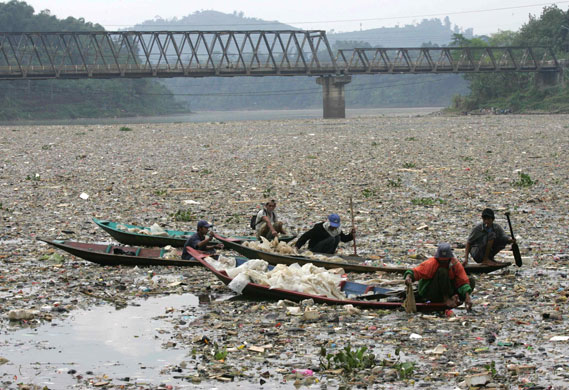
From the Guardian newspaper photo essay found at:
http://www.guardian.co.uk/environment/gallery/2008/
dec/05/water-pollution-citarum-river
What is that? Marine debris, or plastic pollution? Who is shaping the very words that we use to understand & describe what is happening to our world?

* For an impressive, and well-researched article on the reach of the plastics industry, it would be hard to beat "Is the Plastic Industry the New Tobacco Industry," by Amy Westervelt, published March 23, 2011.

^ This quote was reported by the Plastic Pollution Coalition's Facebook page on March 24, 2011.

Saturday, March 12, 2011

Scale

This week I visited Bay View beach at high-tide. The surf crashed loud & angrily against the shore's steep winter slope. Waves converged, criss-crossed, creating a foamy froth on the ocean's crests. It all felt so powerful.

And then I woke up yesterday morning, turned on the TV, and witnessed images of true power.
Original picture found at http://www.reuters.com/news/pictures/
slideshow?articleId=USRTR2JQY6#a=10
Lives lost, possessions lost, foundations of entire communities, lost. Pulverized, and then swept out by a pitiless sea.

For much of the day, I reflected on my time at the ocean this past year. I felt small. I, and my trash bag, and my camera, and my little section of shore. Not threatened by any Ring of Fire -- or any other monumental force likely to utterly reshape my coastline.

I reflected on the scale of what I had witnessed. "My" flotsam comes from single events. Human-scale events. A beachgoer loses a plastic sauce-packet in the sand; it's dragged out to sea, colonized by marine life, and eventually tossed back up. A diner at a pier-side restaurant loses her grip on a menu, dropping it into the bay; it travels 100 miles and finally washes in on my shore.

What just happened to Japan isn't a human-scale event. The ocean has just claimed the better part of several towns and cities, first blasting them to bits, and then sucking much of the mass back out into the wild Pacific. People, memories, priceless cultural artefacts, plastic forks -- it doesn't care. It can't care.

Much of what washed away will melt, and rot, and end. Much will sink to the seafloor, slowly to be covered by sediment, maybe to create curious fossils in some future landscape. But much will persist, and float, and enter a wider world.
Pic from http://www.mindfully.org/Plastic/Ocean
Moore-Trashed-PacificNov03.htm
Bobbing on the waves off Japan's east coast, much of this wreckage will travel a few miles southward or eastward, joining the Kuroshio Current. There it will cross the vast expanse of the Pacific. In about a year and a half, pieces of it will start appearing along the coast of Washington and Oregon.* Bits will break off to the north, following the Alaska Current up toward the Arctic. Most will curve southward, following the California Current, depositing bits and pieces along the coast of California and Baja California. From there it will follow the North Equatorial Current past the southern tip of Hawaii, leaving more of its mass there. Eventually, much of the wreckage will rediscover the Kuroshio Current. In about 6.5 years, Japanese fishermen may find pieces of 2011's destruction caught among their lines and nets.^

And on and on, until every last scrap of this tragedy ends up beached, buried, or utterly disintegrated back into its building blocks... however many centuries (millennia?) that will take.

We hear talk that recycling will end the pollution of the sea. But beyond the industry's questionable arguments, a larger fact looms. We are at the mercy of a merciless planet. As long as we fill our daily lives with material that can't return to the dust it came from, we will keep filling our oceans with its toxic legacy.

My heart and thoughts go out to everybody affected by the tsunami of 2011.

* Ebbesmeyer, C. and Scigliano, E. Flotsametrics and the Floating World. HarperCollins (New York, 2009): p. 143.
^ Ibid. p. 235.

Monday, January 10, 2011

Collection Report Dec 29, 2010

Here at last, long-delayed. December 29, two days after the fabled "Christmas storm." Though the mid-Atlantic was hit hard, Maine saw an average -- even light -- nor'easter. I arrived at Bay View beach late morning, low tide, to this:
A long morning - kelp beds carry far more than kelp
This report will have limited commentary. The pictures are enough. Keep in mind, this is from tide line, a few hundred feet of beach in southern Maine, in 28 degrees F. The same stretch of beach I've cleaned fastidiously nearly every week since June.

First, "Zone N" - the northerly of the two sections I clean, closest to the public access, and more populated during the summer months.
341 finds:
  • Building materials: 3
  • Foam/Styrofoam: 3
  • Fishing misc.: 75 (36 lobster claw bands, 14 bits of vinyl trap coating, lure, "Lunker Fishing" packet scrap, 1 webbed basket, sinker bead, 2 monofilaments, 19 bits of rope)
  • Food-related plastics: 55 (11 scraps of #6 drinking cup, 17 bits of cutlery, 13 bottlecap seals, 1 "medium-well" steak tag, 2 bread tags, 11 misc.)
  • Food-related metal/glass: 9 (7 can scraps, 2 bottle caps)
  • Non-food/unknown plastics: 180 (you name it, it's there)
  • Cigarette filters/plastics: 1
  • Paper/wood: 1 (golf tee)
  • Misc./unique: 14 (13 fabric scraps, 1 piece of cord)
Summer's fare, lurking offshore til the storm
Misc. confetti of modern life
Closeup of some misc. plastic
Shovels, pail bits, umbrella bases, etc.
Broken ruler helps size other flotsam
Whither the missing comb teeth?
Aluminum cans degrading
The cost of a robust fishing economy
Many bands had apparent bite marks
On to "Zone S" -- the southern zone, separated from Zone N by a private patio built out slightly onto the beach, and thus much quieter & less-traveled in summertime:
137 finds:
  • Building materials: 1
  • Foam/Styrofoam: 0
  • Fishing misc.: 21 (12 claw bands, 3 vinyl trap coating bits, 1 shotgun shell, 5 bits of rope)
  • Food-related plastics: 15 (7 bottlecap seals, 3 bread wrapper tags, bottle cap, spoon, fork tine, 2 scraps of drinking cup)
  • Food-related metal/glass: 9 (can scraps)
  • Non-food/unknown plastics: 89 (a little of everything)
  • Cigarette filters/plastics: 2 (1 cigarette and one plastic cigar end)
  • Paper/wood: 0
  • Misc./unique: 0
More confetti
More fishing debris
July 19, what year?
Recycling doesn't close the loop;
it restarts it
My highest weekly total ever. 478 pieces of trash washed up from one storm. And it's simply not possible that I got it all - the kelp was too thick and sandy to turn over every last bit of it, try as I might.


An aside:

Last week there was a dustup when a researcher in Oregon suggested that the extent of plastic pollution was exaggerated. Here's how you can really find the truth. Look down at your feet. That's all you have to do.

Maine is nowhere near a great ocean gyre. Its currents are fed from the north by waters that flow along the least populated parts of the Atlantic Ocean. And yet here is the waste of modern life washing around me. Nearly 500 pieces of plastic along 500 feet of beach, when Maine's tidal shoreline is 3,500 miles.

So fine; it's true that the plastic doesn't swirl in a vortex twice the size of Texas.

It swirls everywhere.