Showing posts with label fishing debris. Show all posts

Monday, January 28, 2013

Curtis Cove Report - Jan 11, 2013

Friday January 11, 12:55 PM, ~2 hrs before low tide. Gray and windy. Two weeks since last visit; lots of the same plus a little change. The wrack from Dec. 24 was still there, now smeared up and down the backshore. No new goop in the mix. It seems the past two weeks had been relatively low energy, just a reshuffling of the deck.
With the old seaweed spread about, more of its plastic load lay now on the surface. And it was fearsome. There are at least 9 pieces of plastics in this square foot:
And of course, the ubiquitous balloons.
Launched from miles -- or hundreds of miles -- away, to end up here.

It was a depressing week for plastic garbage. But I did see something kind of fun:
This is a slipper shell (a kind of snall) upside-down attached to a small stone. A seagull was lifting and dropping this stone over & over, trying to shatter the shell against the cobbles of the low foreshore. Except, this week there were no cobbles on the foreshore! December's storm reshaped the beach, burying the low ground under soft, fine sand. The gull, clearly used to a rocky shoreface, was doing what he always did in order to break open a shell. And he was clearly confused why it wasn't working!

Ecology in action.

I'll be interested to see how long it is before the sand washes back away and the shore is "healed" to its more usual form. In the meantime, this was a busy week of collection, especially for rope.
232 pcs of rope, about 550 ft total
203 pcs of nonrope debris
435 finds:
  • Bldg material/furniture: 0
  • Foam/styrofoam: 0
  • Fishing rope/net: 232 (~550 ft)
  • Fishing misc.: 90 (49 vinyls, 6 bumpers, 4 trap tags, 14 bait bags, 4 trap mesh, 2 parts, 2 vents, 7 clawbands, shotgun shell, buoy handle)
  • Food-related plastics: 32 (3 bottles, 3 bottlecap rings, 9 cup scraps, 10 tops/scraps, salad dressing packet, 6 straws)
  • Food-related glass/metal: 4 (4 can scraps)
  • Nonfood/unknown plastics: 42 (13 bags/scraps, 2 mylar balloons, latex balloon, balloon string, golfball, 10 cords/cable ties, big wingnut, 5 upholstery scraps, 4 pcs tape, crate seal, pen cap, Victorinox knife handle, tubing)
  • Scrap plastics: 27 ( 10 > 1" , 17 < 1" )
  • Paper/wood: 0
  • Non-plastic misc./unique: 8 (5 fabric pieces, 3 gloves)
Just a mess. No other word for it. So much that could be discussed, but I'll point out just one bit. All of this food-related debris originated somewhere else:
Whether a fishing boat, pleasure boat, beach up the road, seaside in Nova Scotia, or city drain in Portland. All from somewhere else, and most of its spent a long time in the ocean. Note the marine-life bite/poke marks on things like this remnant of red Solo cup:
Or this blue cheese salad dressing packet:
When your life is packaged in plastic, it never really goes away.

Running YTD counts:
  • Total pcs of litter -- 12271
  • Pcs fishing rope -- 3313
  • Vinyl lobster-trap scraps -- 4742

Wednesday, January 2, 2013

Curtis Cove Report - Dec 15, 2012

Digging out from the Christmas deluge -- figuratively & literally -- to wish you all a Happy New Year! And to publish my last beach reports for 2012.

Saturday, December 15. 1:45PM, bright sun, mild offshore breeze, ~37 degrees. Shortly after high-tide, so I followed the waters down & down as I went back & forth.
Becalmed
The high-tide waters were incredibly calm. They lapped placidly with barely a ripple against the soaked sands. Small wonder why such fine muds and silts drop out of this water -- as well as so many tiny bits of plastic when the conditions were right. Curtis Cove is an amazing place.

Today was a day of velvet sand:
Tumbled & rounded beach stones on the high foreshore:
A totem from a vanished visitor:
And the coolest find, sand volcanoes:
A sandy beach isn't solid, of course. There's actually a lot of space between the sand grains. Water trickles through, organisms make homes, and air percolates -- lots of air. On this morning, the thinnest veil of ice had formed on the sand's surface. By noon, the rising tide with its ~two million gallons of water was squeezing the air trapped within the sand, trying to force it out. Usually this results in thousands of tiny little dots in the sand, "nail holes," where the air rushes out. But this day, the icy sheen resisted the onslaught. Finally the air pressure built up so much that it bulged the sand up in hundreds of pockmarks before finally exploding through and out the top.

Nature is amazing.

Though I spent an hour+ watching the tide slowly recede, I couldn't get down to the lower foreshore where so much plastic gets left behind on calm pleasant days like this. So my haul was light:
81 pcs of rope, about 90 ft total
28 pcs of nonrope debris
109 finds:
  • Bldg material/furniture: 0
  • Foam/styrofoam: 0
  • Fishing rope/net: 81 (most found amid the high wrack)
  • Fishing misc.: 12 (4 bait bags, 3 trap bumpers, 3 trap vinyl coating scraps, 1 trap part, 1 trap tag)
  • Food-related plastics: 3 (bottlecap, skewer, cup scrap)
  • Food-related glass/metal: 2 (aluminum can bottoms-modern)
  • Nonfood/unknown plastics: 7 (3 packaging scraps, endpiece/coverplate, strap, plug/cap, brittle tube)
  • Scrap plastics: 3 ( 2 > 1" , 1 < 1" )
  • Paper/wood: 0
  • Non-plastic misc./unique: 1 (small fabric scrap)
I'm not sure how much more I would have found at the low foreshore. With low-tides running before dawn and after dark this week there wasn't much hope finding out.

Still, this turned out to be very much the calm before the storm. Wait til you see the photos from December 24.

Running YTD counts:
  • Total pcs of litter -- 11469
  • Pcs fishing rope -- 2891
  • Vinyl lobster-trap scraps -- 4691

Saturday, December 22, 2012

Curtis Cove Report - Dec 11, 2012

Tuesday, December 11. 1:35PM, half-hour before low-tide. Bright sun, mid-40s.
Actually a beautiful December day with a mild land breeze, and excellent lines of wrack banding. I also had some company this day - a lot of company:
Intersection
With berries & worms in short supply, the birds were now flocking to the relative warmth of the coast. They rooted through the rotting wrack, feasting on the bugs among it. (And whatever else was in with it.)

Down lower on the foreshore, the fine, saturated sand was eroding in incredible works of art:
Ephemeral beauty, gone in hours
And by the water's edge, a Curtis Cove first:
First mostly dead, then fully dead
When I tapped at this red sculpin (sea raven), presuming it dead, it wriggled! It had been speared or clawed in the side and was in a bad way. I moved it back into the water in case it still had any fight in it. But it finished its life just a couple minutes later. When I left I saw the seagulls diving on it. Reminded me of words I'd learned some time back: "The sea isn't cruel, it just doesn't tolerate any mistakes."

Also down at the water's edge was another amazing sight:
High Occupancy Zone
Thousands of tubeworm "condos" poked up out of the sand. These sand tubes are cemented together by the burrowing worms that thrive in gentle muddy coves like Curtis Cove. All the fresh and decaying seaweed mixing with the tide waters is a smorgasborg.

You can look at a beach, see nothing moving, and think there's no life there. But you'd be wrong.

Surprisingly, in the end I found very little of this:
This knife at first looked like a new, local drop. But a closer look showed chipped teeth on the serrated edge and a frosted/etched look to the plastic. It's another wash-in from afar.

Given all the beautiful banding of gently-laid wrack I was sure this would be a heavy-plastic day. But in my zone, it wasn't. (The banding was its strongest just south of my zone, so maybe plastics etc. were pushed that way this week?)
62 pcs of rope, about 70 ft total
61 pcs of nonrope debris
123 finds:
  • Bldg material/furniture: 0
  • Foam/styrofoam: 0
  • Fishing rope/net: 62 
  • Fishing misc.: 17 (10 vinyl trap coating scraps, 2 trap parts, trap tag, metal ring part, bumper, 2 claw bands)
  • Food-related plastics: 12 (bottle - old w/ top cut off, 5 cup scraps, CapriSun, OLD ketchup pack, 2 wrapper scraps, frosted/old knife, straw)
  • Food-related glass/metal: 3 (fresh beer can, 2 old can bottoms)
  • Nonfood/unknown plastics: 12 (10 bag scraps, 2 mylar balloons - one very old)
  • Scrap plastics: 14 ( 9 > 1" , 5 < 1" )
  • Paper/wood: 0
  • Non-plastic misc./unique: 3 (2 fabric scraps, 1 worn/eaten fabric glove)
A curious day. The conditions seemed ripe for heavy debris. And much of what washed in was the old, degraded, broken bits of modern society that are all too common now in the Gulf of Maine. Yet by Curtis Cove standards there wasn't that much to find. At least on the surface. As so often, it's not always about what you see. It's about what lies beneath.
Not collected - how many more are there?
Running YTD counts:
  • Total pcs of litter -- 11360
  • Pcs fishing rope -- 2810
  • Vinyl lobster-trap scraps -- 4688

Monday, September 10, 2012

Curtis Cove Report - Aug 31, 2012

Friday, August 31. 7AM. Already a bright, bright day. Crisp cool air, but the promise of a hot afternoon, following a delicious week in the low 70s with no humidity.
New tracks in the fine sand high on the backshore brought a reminder of the changing season, the fast aging summer.
Sandpiper highway
Places like Curtis Cove are vital to thousands -- millions -- of annual migrators. As these sandpipers picked through their own finds on the beach, I wondered how well they could tell food from flotsam.
One of these is a slipper shell, the other a coffeecup lid
And I wondered how many birds, fish, and sea mammals would think this bright green confetti -- dragged and smeared down along the low foreshore -- a feast:
Found the lobster-trap vinyl scrap motherlode
And I wondered, how many places left in the world can truly be called protected?

On to the week's finds:
42 pcs of rope, about 35 ft total
402 pcs of non-rope debris
444 finds:
  • Bldg material/furniture: 0
  • Foam/styrofoam: 0
  • Fishing rope/net: 42
  • Fishing trap gear: 216 (204 vinyl trap coatings, 7 bumpers, name tag, vent, 2 trap parts, buoy rod)
  • Fishing misc.: 43 (39 clawbands, 4 fishing line)
  • Food-related plastics: 25 (20 cup scraps, 2 food wrappers, cutlery handle, old straw scrap, cooking-temp stick)
  • Food-related glass/metal: 7 (6 aluminum can bottoms, sea glass)
  • Nonfood/unknown plastics: 33 (baseball cap visor insert, long stapled strap, shoulder strap, 2 cable ties, vinyl carrying bag neck, 3 anchors, 3 plant pot tag bits, 2 o-rings, 2 tubes, sticker, screw-top neck, carabiner, large garbage bag, 5 bag scraps, cigarette, gauze patch, rubberband, comb, shovel handle loop, teacup handle, 2 nonfood packaging scraps)
  • Scrap plastics: 70 ( 26 > 1", 44 < 1" )
  • Paper/wood: 0
  • Non-plastic misc./unique: 8 (2 fabric scraps, 6 cords)
A few strange things this week. First, lots of fishing rope after a lull. And after a similar drought, 6 aluminum can bottoms scoured up from the deep! I wonder what has changed in the currents or the sea floor to let them finally land again. Each week brings new questions.

The only other real oddities were this:
Baseball cap brim insert
and this:
Intact -- though gnarled -- comb
Somehow all of the fabric of that baseball cap got left behind, leaving only the plastic brim insert to beach at the cove. And it's rare to find a comb still intact -- even if this one shows some signs of banging around on rocks & debris.

Another week of beautiful sights, and way too much garbage.

Friday, March 9, 2012

The Long Road

My friend Danielle of It Starts With Me and her family have picked up over 40,000 cigarette butts from Wrightsville Beach, NC. And counting.

This, by any measure in a sane world, would be insane. Knowing this, Danielle and the Cape Fear branch of Surfrider helped organize a town meeting last night to push for a ban on smoking at the beach.
Surfrider's campaign posters
are top-notch
Despite a packed house filled with a sea of supporters in blue shirts reading "Breathe Easy / Keep it Clean" (some 90% of the room supported the ban), the council voted 3-2 against.

In Portland, Maine it took until February 2012 for the city even to acknowledge that a plastic cigarette butt, loaded with a cocktail of toxic chemicals, was litter!
Monument Square, Portland, ME
(image from the Portland Press Herald online)
Let that sink in for a moment. The first rumblings of the ill-effects of cigarettes came in the 1940s. By 1970, cigarette advertising was banned from TV. The Tobacco Wars of the early 1990s ended with the universal understanding that cigarettes are dangerous, and deadly. Yet it took 20 more years for Maine's largest city to identify a cigarette butt as litter.

Last week I visited the Maine Fishermen's Forum up in Rockland at the beautiful Samoset Resort, overlooking rocky cliffs and a foggy sea. The fishing industry in the Gulf of Maine has reeled from one crisis to another for decades. Pollution, overfishing, acidification, sea-temperature rise -- these are putting tremendous pressure on fish stocks. So much of this comes back to simple mistreatment of the fishery & the environment. Yet judging by the view I saw out on the covered walkway...
100 more all around the can and snowy sidewalk
...care for the environment isn't high on the radar.

Since I started the Flotsam Diaries, I've pulled about 1/2 mile of fishing rope from local beaches.
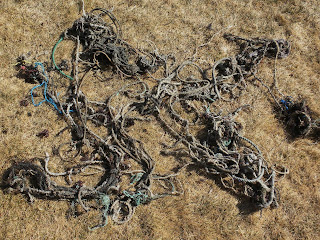
200 more feet pulled up at Curtis Cove, Biddeford
on March 7, 2012
It's all plastic -- nylon or polypropylene. It will last forever, in some form. What I've retrieved represents the tiniest percent of what's certainly out there. I've also recorded several dozen derelict lobster traps washed up. Here's 30 or so from Goose Rocks Beach, Kennebunk, last year:
Each trap is vinyl-coated, and each slowly releases 1000 chunks of toxic polymers as the steel rusts. Conservatively there are half a million derelict lobster traps on the seafloor in the Gulf of Maine. The number is probably far higher.

Yet Maine has no regulations for monitoring lost rope. If a lobsterman loses a trap, they fill out a form. But that paper form goes into a stack, with nobody really examining where it was lost. Even if the location was known, there are ZERO funds in the state to recover any of the gear.

So the problems grow. And heads remain firmly buried in the sand.

Still, it's not all doom and gloom. More and more cities are taking cigarette litter seriously. Even Portland, finally. More and more are taking grocery-bag and other plastic litter seriously. And the state of Washington has just passed ground-breaking regulation to monitor and help clean up fishing debris. There are fingerposts and guides the world over showing the good that can happen when you admit a problem exists & then fight it like you mean it.

Change can be a long road. I know all too well that it can feel sometimes like a hopeless road. But at least it's a road. Can you imagine life if there were no roads to take you somewhere beyond where you are?

Wednesday, July 20, 2011

Collection Report July 1, 2011, Part I

Looking through my pictures for my July 1 cleanup, this one lends itself to more of a photoblog. So, without more ado, let's give it a whirl.

If this morning looks about perfect, it was:
The calm before the swarm
And just in time for the 4th of July weekend, an upgrade out in the parking lot:
Semi-private bliss
Yet even with two huge no-smoking signs, some people simply will not get it:
Oh, maybe it was just a suggestion?
But looking beyond the manmade marring, something interesting is happening in Bay View beach.
Reclamation
Sea levels creep slowly up. Development & erosion take their toll. Yet Bay View's dunes are bucking the trend. They're actually moving back onto the sand! In busier Zone N, it's just occasional tufts. But in Zone S, the new dune layout has been formalized with a fresh fence, 12-15 feet closer to the ocean than last year! So Zone S's usable beachfront is compressed. In fact, high tides now mostly eliminate the beach there. It'll be interesting to see if Zone S trash plummets.

Neat ecology aside, this was a day filled with other surprises. Not least being this:
You're a long way from home
This plastic disc is one of 4.3 million released into the Merrimack River on March 11 from the Hooksett, New Hampshire wastewater treatment plant in a big screw-up. Since then, they've been found from Maine to Rhode Island. This one is the first found as far north as Saco. It probably found a mini-gyre off Cape Cod, spun counter-clockwise, & got shot out toward Saco Bay. Many others have likely picked up the Gulf Stream southeast of Cape Cod, and will start washing up on European shores by late summer.

Note: This disk was in the ocean for nearly four months and is pristine. Another piece of plastic washed up nearby, not nearly as pristine.
Rotten to the core
This squirt bottle nozzle is crusted, faded, brittle, cloudy, and ancient. However long ago it was lost, it wasn't a few weeks, or even four months. When plastics get in the ocean, they will survive a long, -long- time.

Moving along, I (1) added yet another perfect beach toy to Ruby's growing collection:
Will probably open a re-sale shop this fall
(2) wondered if the rest of this is now in an endangered marine mammal's gut:
What goes up, comes down
(3) pondered just how many tons of this material have been lost to the Gulf of Maine:
Fishing rope is polypropylene, and persists for centuries
and (4) reflected on today's big battles between powerful industry lobbyists and grass-roots common sense:
Hard as it is to believe, I'm still betting
on common sense in the end
Photoblog: off. Amazing what we can find & learn strolling the beach, when we really start to look.

Speaking of which, I'll follow this up shortly with the actual numbers for the week. They're pretty astounding. And not in a good way.

Tuesday, March 1, 2011

Collection Report Feb 12, 2011

Bay View, Feb. 12. Even after a mini-thaw, this was a beach still held by winter's clutches.
1:15PM, 33 degrees, ~1 1/2 hrs past low tide
Surprisingly, this winter, for all its snowstorms, has brought little energy to the beach so far. We've had some extremely windy weather & even thundersnow. But ever since the Christmas storm, winds seem to have blown hard offshore as the tides approach. Waves have been low (the tide lines are several feet -- even yards -- below the level of last year's spring tides), and very little is either being tossed in or scoured back out.
December's flotsam: freed now, but undisturbed
No fresh lines of kelp, no other heavy detritus. Just old, dried, withered remnants of December -- and before. So, in a time of low ocean energy, what would a trip to the beach bring? First, Zone N:
64 finds:
  • Building materials: 6 (4 chunks of asphalt, brick, part of asphalt roof shingle)
  • Foam/Styrofoam: 0
  • Fishing misc.: 36 (5 claw bands/scraps, 2 rope scraps, 29 trap coating scraps)
  • Food-related plastics: 1 (gum)
  • Food-related metal/glass: 0
  • Non-food/unknown plastics: 16 (inc. tire-tread scrap, 2 bottle caps, umbrella base, caulk, hairband, tieback, 2 o-rings, bandaid)
  • Cigarette filters/plastics: 3
  • Paper/wood: 2 (wooden handle, fence slat)
  • Misc./unique: 0
Pretty much the normal spread. Dominated as usual by fishing debris, mostly scraps of the vinyl coating of lobster traps, ripped apart as the metal underneath rusts. (See "Ex Uno, Plures.") The piece of tread seemed odd. My hunch is that it's from an old waste tire used as a boat bumper, but that's just a guess.

Oh, and why list chewing gum as a food plastic? Because that's what chewing gum is. It's plastic: polyvinyl acetate and/or polyethylene, to name just a couple potential ingredients. All part of our plastic world.

On to Zone S:
47 finds:
  • Building materials: 10 (asphalt chunks)
  • Foam/Styrofoam: 0
  • Fishing misc.: 22 (3 rope scraps, 2 claw bands, 17 trap coatings)
  • Food-related plastics: 1 (fork tine)
  • Food-related metal/glass: 0
  • Non-food/unknown plastics: 13 (inc. bottle cap, duct tape, silly band, tiedown, o-ring)
  • Cigarette filters/plastics: 0
  • Paper/wood: 1 (fence slat)
  • Misc./unique: 0
More of the usual. Except for a bunch of small asphalt chunks this time. Maybe freeze/thaw shattered one big one? Don't know. As with Zone N, nothing really worthy of a close-up.

So that's about it for this week. This report sheds little light by itself. But it builds on what's come before. And it's a reminder that even a sleeping shoreline is still invaded every week by things that don't belong.
The ocean doesn't forget