Showing posts with label ACC. Show all posts

Wednesday, June 6, 2012

Plastic Bag Recycling Hype

Hilex Poly makes plastic bags. They make a very large amount of money from making these "free" bags that you find at supermarkets, Big Box stores, and your local take-out shop. They wish to keep making this money.

They know people are sick of seeing littered plastic bags in parking lots, gulleys, roadsides, parks, playgrounds, and wrapped around (or inside) dead creatures.
A dead, starved pelican, beak wrapped tightly in plastic bag
Plastic bag caught around endangered loggerhead turtle
So Hilex Poly has decided that by promoting "recycling," they will win the day over bag bans.

Hence their latest volley in the spin wars: "Hilex Poly Co. leading by example in battle against plastic bag bans."

In it, their PR firm says, with straight face, that "Legislation doesn’t address the plastic waste problem." They describe a system that uses ~32% recycled content (meaning 68% is brand-new virgin plastic) as "closed loop." Among much else.

I've asked them questions, repeatedly. Oddly, they haven't responded. So I'm asking them here:

  • As you well know, industrial film has a very different use history from a consumer shopping bag, in terms of potential contaminants encountered. You say your recycled bags are made of both industrial film & end-user bags. What is the ratio? How much of the recycled resin in your bags is from post-end-user consumers (i.e. actual supermarket bags) and how much from industrial, pre-end-user sources?
  • What is your yield loss due to "kick-out"? What percentage of the post-end-user consumer bags returned from supermarkets ends up unusable for recycling into supermarket bags?
  • Do you recycle bags that already use recycled resin a second time into new food-grade supermarket bags? Or has the resin broken down too far after 1 recycling to use as food-grade again?
  • What percent of your used bags are unrecyclable thanks to post-supermarket user activity (use as trash-basket lining, school lunches, dog-poop containers)?
  • A related question: How clean and untouched by any contaminant must an end-user plastic bag be in order to be recycled as food-grade material?
  • What is the cost of creating a recycled bag compared to creating a virgin-plastic bag? What does a consumer pay in terms of inflated grocery prices to pay for "free" bags? Is that price increased when recycled bags are used?
  • If your average bag has ~1/3 recycled material, then 2/3 of each bag is made with virgin material. If consumers recycled 1 million bags, to use them all in new bags you'd have to make 3 million bags. If those 3 million bags were recycled, to use them all you'd have to make 9 million bags. If 100 billion bags were recycled, to use them all you'd have to make 300 billion bags. Where is the saturation point? At what point do you start getting back too many bags to use in new bags?

I'd like answers. As a consumer, as someone who values the cleanliness & health of the planet, we all deserve the truth. Not spin.

If you would like answers also, please share this blog post with your friends, or on FaceBook, Twitter -- however else you like getting questions answered. I'd be honored for the help.

Monday, November 14, 2011

Captain Charles Moore's New Book, "Plastic Ocean"

I first learned of Captain Charles Moore in a Discovery Channel documentary in 2009. He was strolling the plastic sand at Hawaii's infamous Kamilo Beach, exposing the realities of a plastic society. Since then, he and the pioneering work of his non-profit, Algalita Marine Research Foundation, have loomed large in the back of my mind & in my efforts. It looms still larger, now that I've just finished his brand-new "Plastic Ocean" (with collaborator Cassandra Phillips).


"Plastic Ocean" is something of an enigma -- as I imagine Capt. Moore to be. It's part personal narrative, part adventure tale, part history/science lecture, part manifesto. It follows no real chronology. But it thinks big. In it, Moore cuts a broad (and occasionally deep) swath through the invention of plastics, methods of plastic production, international treaties on plastic dumping, scientific literature listing the ills of plastic, collaborations with scientists & artists, joint ventures, a walk-through of how a scientific paper gets into peer-reviewed journals. And he sums it up with a clarion call for a complete rethinking of what it means for a society to be prosperous and successful.

No small work, this.

Its 337 pages take the reader through turbulent swells, doldrums blazing with hot sun and heavy air, refreshing dips in clear lagoons. An occasional statement threatens to capsize the whole thing. (He cites the "100,000 animals killed each year" figure, which has been floating around as an untested number since 1984. He also raises the spectre of plastic pellets being used to fatten cattle, although various searches reveal only a grainy newspaper article from 1971 about this being tried.) Yet somehow it all works, and the pages keep turning.

In the end, this is a love story. A vision & memory of wide seas, roaring surf, sparkling beaches. Simpler times and tastes, before the throwaway world, when people made crafts -- and crafted things were built to last. Every good love story has its crisis. And of course the crisis here is plastic waste, and its attendant soup of toxic chemicals that foul seas, beaches, & marine life. But plastic itself is not the villain. Cheap, disposable plastics and the companies who shamelessly make, promote, and defend them in spite of mounting evidence of their harm -- these cast the shadow across this text. Moore has no love for the American Chemistry Council or bottling giant Coca-Cola. He has little patience for organizations who receive large checks from them and still profess to be seriously working on the problem of plastic pollution.

Moore also devotes many pages to exposing the still-growing destruction caused by fishing debris -- decimated coral reefs, dead & injured sea creatures, hazards to shipping & sailing. (The latter of which he experienced first-hand and recounts vividly.) He shows convincingly that international treaties such as MARPOL Annex V (1988) are toothless tigers, flouted by many rogue fishing fleets still today.

"Plastic Ocean" is literally chock-a-bloc with facts and figures. Sadly, with no footnotes it's hard for a reader to take further steps to delve into these figures themselves. (It does contain a well-stocked general bibliography at the back.) Moore notes this as a conscious choice, but his logic isn't exactly satisfying. Still, this book is a powerful wake-up call to a modern dystopia of our own making. It's a great introduction for people who are just learning of the problem. And even seasoned plastic-pollution fighters will find details & angles that they hadn't considered before.

As the pages turn, and solution after solution is vetted -- and shot down -- the scale of the problem and the need to change the game at the source becomes ever more clear. We cannot quickly clean up the mess we've made. There's no way to do it. We just have to stop adding to it.

Capt. Moore writes, "The seductive idea that the more we consume, the better off we'll be has timed out, and the Plastic Ocean is one of many witnesses to this fact... The ocean planet will thank you if you help end its plastic plague." I can't tell whether he looks to the future with optimism or pessimism. Either way, his words ring true.

Thursday, August 4, 2011

Bagging the Rhetoric

On July 31, Lisa Kaas Boyle, co-founder of the Plastic Pollution Coalition, wrote a fact-based article for The Huffington Post on the myths of plastic recycling. Today, Mark Daniels, VP of Marketing and Environmental Affairs for Hilex Poly (a major plastic bag maker/recycler), retorted with a less-fact-based article. His industry spin compelled me to reply, both in the article, and here.

1. "We believe in educating the public about... potential dangers of reusable bags."
Suggesting that most reusable bags contain lead & other heavy metals, or contain bacteria that are a dire danger is a cheap scare tactic. If you have independent, peer-reviewed data supporting this, show it. Otherwise, it's hot air.

2. "At the crux of this plastic bag debate is the principle of consumer freedom."
If so, then surely the industry would support a small fee on plastic bags to cover the cost of cleanup for the inevitable pollution. Such a fee would help maintain clean communities and retain consumer choice. But the industry aggressively fights even a 5-cent tax whose proceeds were targeted for river cleanup.

3. "Recycling plastic reduces the use of virgin plastic."
No. You can't economically make a recycled bag from already-reheated & reformed material, it's too weak and degraded. So even if your bags were made of 100% recycled plastic, the only way to get that plastic is to pump in a steady supply of virgin film, which has to get recycled before it can be turned into a recycled bag. It's a never-ending spiral of virgin plastic.

4. "More than 800 million lbs of plastic bags and film are recycled every year."
The U.S. produces 36.6 billion lbs of #2 & #4 resin a year. 800 million lbs is 2.2% of that. Moreover, 57% of that 800 million lbs of recycled film is just exported to developing nations like China (p. 3 of the report). This percentage is climbing every year.

This deserves re-emphasis: Already, more than half of the film that we recycle has no market in the U.S. It gets dumped extremely cheaply on countries without any safety infrastructure in place. How can the argument be "recycle more" when we can't deal with what we already recycle?

5. "Sales of other, heavier gauge plastic bags soared by 400 percent in Ireland after they implemented a ban on plastic bags."
It was a tax, not a ban. And what was the original number of heavy bags used; what's the new number? Ireland cut grocery bag use by ~1 billion a year. Are you suggesting that the Irish now use 1 billion heavy-gauge bags in their place? Overall, how many tons of #2 and #4 resin are staying out of the environment because of the tax? How many individual bags? Please tell us the numbers. Saying "400% increase" by itself is useless. Apples to oranges.

6. "Plastic pollution can be cleaned out of the environment."
Egregiously false. Plastic cannot be effectively and efficiently cleaned out of the environment. The microplastics swirling in the ocean cannot be removed without removing plankton too -- the very base of the entire food web. As for what's killing marine life, was this turtle a one-off? Or these bags, pulled from a dead whale?

7. "The easier it is for consumers to recycle plastic bags, the less likely it is for them to be disposed of improperly."
Plastic can just as easily blow out of a recycling bin as a trash bin. Or a recycling truck as easily as a trash truck. Or a recycling center as easily as a landfill. Or a person's hand in a gust of wind no matter what their best-laid plans were. And even if a bag successfully runs the long gauntlet and is made into another bag, it then has to run the gauntlet all over again. The concept that a plastic bag only enters the environment if the original owner didn't mean to recycle it is ludicrous.

8. "Time for common sense legislation."
Absolutely agreed. Common sense says that small fees on a bag do wonders for the environment. It also says that if you put a tiny fee on a bag and people immediately stop using the bag, they never really loved the bag. They just used it because it was there. You talk about choice? The tiniest of taxes in Washington, DC suddenly make people realize they have a choice.

With the experience, talent, and firepower behind you, you at Hilex Poly and the American Chemistry Council could be truly part of the solution. Instead, you grasp onto an old, failed system while the world moves beyond it. The biggest of missed opportunities.

Friday, March 25, 2011

What's In a Name?

(Condensed version of this post available here as a FaceBook note.)

This week's 5th International Marine Debris Conference got me thinking.

I used to tell friends that I was concerned about "marine debris." Their eyes would glaze over. They were lost, before the conversation even started. You see, the term doesn't sound like the problem. "Marine debris" sounds like driftwood, kelp. A river choked by fallen trees from a landslide. The term fails at its #1 job: naming. We put names on things to make them real, to make them understandable. To make them fixable. How do you fix "marine debris"?

Another term exists: "plastic pollution." 70-90% of the manmade waste that washes up on beaches is some kind of plastic (see p. 26 of the report). Daily life revolves around plastic; thus, most of what ends up in the ocean is plastic.

More critically, the material that will persist in the ocean is plastic. Cotton, wool, paper, and wood rot. Aluminum & steel oxidize, returning to the building blocks of bedrock. Glass, too, breaks down. Its surface hydrates. The molecules that bond the silica together are replaced by hydrogen, and eventually it breaks back down to silica -- sand.

Plastics don't break down. They break up, into ever smaller shards. Nothing in nature is known to break down plastic. Alkalis don't. Acids don't. Microbes don't. Sunlight doesn't. Oxygen doesn't. Quite simply, plastic persists. For centuries, millennia -- nobody knows. Worse, much plastic is buoyant -- especially #2, #4, #5, and styrofoam (which is simply puffed-out #6 plastic). It looks like food to marine life, and is ingested as food by marine life. Such as the turtle that ingested this:
All of this was found in -one- dead turtle
http://www.seaturtle.org/imagelib/?photo=5456
The "great garbage patches" in the world aren't a swirl of tin cans. Or library books. Or car engines. They're a swirl of plastic. Plastic that kills animals by the hundreds of thousands. Plastic that collects hydrophobic (water-hating) toxins such as persistent organic pollutants in the ocean, concentrating them at up to one million times the concentration of the surrounding seawater.

So, why wasn't this conference called the International Plastic Pollution Conference? For some insight, look at the list of sponsors:
In the highest bracket of sponsorship is none other than the American Chemistry Council -- the plastics industry. The plastics industry has links with websites like Save the Plastic Bag, which misrepresent facts to downplay the environmental impact of single-use plastics. The industry spends millions of dollars fighting laws that would even slightly tax & oversee use of plastic bags. The industry came up with the use of the "chasing arrows" symbol to make plastic recycling look like a closed loop, when it's nothing of the sort. The industry is now suing a maker of sustainable, organic shopping bags (Andy Keller, see "other bag news" section) for daring to lay out the facts.

The ACC does not gain by the term "plastic pollution" becoming forefront in people's minds. It doesn't gain by having to support any of the burden for the safe & responsible end of its products' lives. It doesn't gain when consumers use less single-use plastic. The ACC does gain by shaping the discussion in its favor.*

NOAA and UNEP seem to agree. Thus, the 5th International Marine Debris Conference. A place where, in the words of Plastic Pollution Coalition co-founder Daniella Russo, "there is the one who Must Not Be Named... Plastic Pollution."^

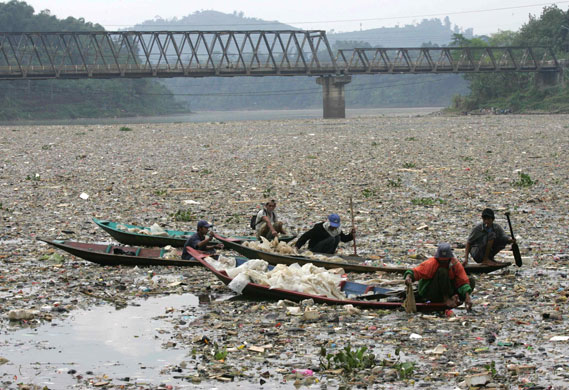
A second top-tier sponsor of the conference was Coca-Cola. In 2010, Coca-Cola Amatil, which runs operations in much of the South Pacific, celebrated a large rise in plastic-bottle sales to Indonesia (see p. 11 of report). They also touted a 30% increased capacity to supply Indonesia with more of the plastic bottles. Indonesia has no waste management infrastructure capable of dealing with the increase. It can't handle what it already has. The picture below is the Citarum River in Indonesia, from late 2008.
From the Guardian newspaper photo essay found at:
http://www.guardian.co.uk/environment/gallery/2008/
dec/05/water-pollution-citarum-river
What is that? Marine debris, or plastic pollution? Who is shaping the very words that we use to understand & describe what is happening to our world?

* For an impressive, and well-researched article on the reach of the plastics industry, it would be hard to beat "Is the Plastic Industry the New Tobacco Industry," by Amy Westervelt, published March 23, 2011.

^ This quote was reported by the Plastic Pollution Coalition's Facebook page on March 24, 2011.

Wednesday, January 5, 2011

The Recycling Myth

Today was going to be my collection report for December 29. Then something happened. Last night, I discovered this in the bag of junk I collected from Zone S:
(Added 1/6/11: The stamp on top reads "Made of 100%
recycled PETE")
And suddenly, everything I've been learning all these months came into focus. The #1 plastic (PET, or polyethylene terephthalate) I held in my hand managed to go successfully:

  • from synthesis
  • to plasticizing
  • to pelletizing
  • to shipping
  • to factory
  • to product
  • to more shipping
  • to retail warehouse
  • to more shipping
  • to retail shelf
  • to 1st consumer.

Then a fairly rare thing happened. This lucky bit of plastic was among the 28% of #1 plastic that was recycled last year. (The number comes from the Natl Assoc for PET Container Resources 2009 report found here.) Remember, the plastic industry has pushed recycling as a panacea for 20 years. And even now only 28% is recycled.

From the hand of the conscientious consumer that recycled it, it successfully went:

  • to recycling bin
  • to recycling truck
  • to recycling center
  • to sorting/cleaning process
  • to bundling/sale process

This now luckier bit of plastic was then among the 44% actually sold to U.S. reclaimers. Most "recycled" #1 plastic is dumped on developing nations, who use their own laws & methods of oversight. (From the same report, p. 3.) That makes 12% overall of #1 plastic that was both recycled and remained in the U.S.

Passing this next big hurdle, my bit of plastic went successfully from purchase:

  • to shipping
  • to factory

At the factory, only 76% of recycled #1 could be used, the rest was waste. Now we're down to 9% overall of #1 plastic recycyled, remaining in the U.S., and returned to usable flakes. These quite lucky usable flakes then went:

  • to product

What product? Fibers, sheet, strapping, resins, etc. Oh yeah, and a little bit -- 29% -- went to making new #1 containers. (Same report, p. 8.) Now we're down to 2.6% of all #1 containers sold in the U.S. actually being made into new #1 containers. Now, my extremely lucky plastic traveled successfully:

  • to more shipping
  • to retail warehouse
  • to more shipping
  • to retail itself
  • to second consumer.

At some point after this second consumer bought it, it escaped. It was lost at the beach, or blew out of a garbage can, or was tossed out a window, or got scavenged by an animal, or blew out of the recycling truck, or got swept out at the recycling center, or flew off the trash truck on the way to the incinerator. And it ended up in the ocean.

Even if this consumer had successfully recycled it, it would still have had to negotiate the path all the way back to product. What are the chances that a #1 plastic will get recycled twice into more #1 plastic? 2.6% of 2.6% = .068%.


Only 7 out of 10,000 #1 containers will get recycled -- really recycled -- more than once.

#1 plastic is held up by the plastics industry as a model. Its numbers are often cited to show the success rates of recycling.
Here is the truth: It's a downward spiral. There is no end to it, other than in the fires of an incinerator. We pat our backs when we take that old Coke bottle and put it in the recycling bin. But its fate is solely to move on, and down, until it winds up in the ocean, lays dormant for millennia under a capped landfill, or dies in a raging fire.

As it spirals downward, much of it will end up fouling the rivers, lakes, streams, ponds, shores, and oceans we hold dear. No matter our best intentions.

Just like the recycled piece I picked up on December 29. Do you think the person who recycled it the first time envisioned where it would end up?
The triangle is a lie.