Showing posts with label #1 plastic. Show all posts

Monday, August 1, 2011

Following the Plastic Triangle

I want to start this post with a graphic I've used before. But it deserves to be seen again.
From the National Assn. for PET Container Resources
http://www.napcor.com
We keep hearing, from both the cynical and the well-meaning, that the answer to plastic pollution is to recycle more.

We are recycling more. And more. And more.

In the U.S., from 1999 to 2009 we nearly doubled the tonnage of #1 PET plastic we recycled. Almost none of that extra wonderful, "easy-to-recycle" PET stayed in the U.S. 91% of that extra plastic we dutifully recycled was dumped on developing nations, mostly China. The reason is simple. Recycling plastic into safe, strong, useful materials -- while protecting the health of workers & local communities -- is extremely hard, expensive, and rare.
  1. Plastic needs to be sorted extremely finely. One stray #3 plastic bottle can contaminate a batch of 10,000 #1 bottles if melted with them, leaving a product filled with yellowed or black streaks.
  2. Plastic can't be superheated to kill toxins. Instead, recyclers use acids, caustic soda, and chemical slurries to burn off contaminants. The waste is toxic, persistent, and expensive to mitigate.
  3. Bottlers change designs too quickly for recycling technology to keep up. Coke learned this with the epic flame-out of its $50 million bottle-to-bottle recycling facility in South Carolina. That facility couldn't cope with one design change -- a thinner bottle -- and imploded.
So here we are in the U.S. (and Canada), with warehouses bulging and overflowing with recycled plastic that nobody wants. What's a recycler to do?

Sell it to China.

Why would China buy 553,000 metric tons a month of Western plastic waste that nobody wants? Simple. In the U.S. we have a regulatory system that functions. Not perfectly, but it functions. In China, for all intents and purposes, they don't. Even in areas where regulation exists, the cost of fines is less than the cost of compliance. The result is a no-brainer. Recycling plastic in the U.S. is expensive. In China, it's cheap.

11 provinces in China are recognized as major plastic recycling centers: Hebei, Shanghai, Guangdong, Zhejiang, Beijing, Jiangsu, Shandong, Fujian, Henan, Liaoning, and Anhui. The heart of recycling in these provinces are self-described "recycling villages." Places where plastics aren't just a job, they're a way of life.

Here's a little trip through a few Chinese recycling villages. Getting photographs & stories like this isn't easy, and is getting harder as the world takes a closer look. City managers and mayors work to keep Western cameras out of their villages, sometimes threatening -- and using -- violence.

Zhaoqing, Guangdong Province (the nearest province to Hong Kong, and thus one of the largest and busiest recycling centers):
Original photo by D J Clark, found at:
http://www.flickr.com/photos/99425225@N00/1558890678
Fuyang, Anhui Province. A worker stands in toxic rainwater, pulling batteries from plastic trash, separating out the plastic and batteries for recycling.
Original photo by pots455, found at:
http://www.flickr.com/photos/pots/456442389
Ma'anshan, Anhui Province. Untreated wastewater from plastic processing plants dumps straight into the Yangtze River.
This and other photos at: http://www.chinahush.com/
2009/10/21/amazing-pictures-pollution-in-china/
Wenan County, Hebei Province. A huge importer of Western plastic. This picture is one of countless open-air recycling centers in the county.
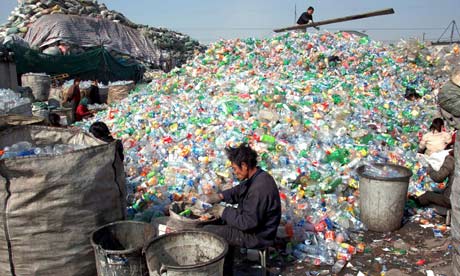
Photo and story can be found at:
http://www.ecns.cn/in-depth/2011/07-05/444.shtml
In Wenan, groundwater down to 100 meters is now polluted and undrinkable. Young people no longer pass the army's physical, as they have enlarged livers. The county's sewage treatment plant doesn't operate. That's right: The one sewage treatment plant for 10,000 plastic recycling workshops is only turned on when government officials come by.

The plastic that can't find any reuse often gets a simpler end: an open pit bonfire, spewing black toxic clouds into the air. Such as here, at Guiyu, Guangdong Province, center for plastic and especially e-waste recycling:
This and other brilliant photos at:
http://www.alexhoffordphotography.com/node/2206
Here's a river in Guiyu, Guangdong Province:
Story & photo by Greenpeace: http://www.greenpeace.org/
international/en/multimedia/photos/polluted-water/
And it's not just China. Here's a snapshot of another place that collects & processes Western plastics, Khoai, Vietnam:
story & photo at http://vninfogate.com/gate/?module=
newsdetail&newscode=7685
As of now, more than 50% of the plastic we in the U.S. recycle goes to these nations. Where so much of the sorting, remelting, and processing happens under these conditions. This is what plastic recycling really is. This is why plastic recycling is cheap, why we can buy so much cheap plastic garbage in the $1 aisle of big-box stores.

It's sobering to think that one out of every two soda / juice / water bottles each of us puts in our neat, tidy bin is directly responsible for the scenes above. Plastic recycling, 2011 style: Not green. The farthest thing from green.
The Triangle Is a Lie


Thursday, May 5, 2011

Swimming Upstream

I hear talk that the tide is turning in the fight against plastic pollution. That laws are being passed, people are waking up, corporations are coming up with solutions. A sense of hope that scenes like this:
Ocean Park, Maine
or this:
Albatross belly, Midway Atoll, North Pacific
(site: soaronhirschi.blogspot.com/2010/11/
question-for-noaa-and-alldid-these-flip.html)
will soon be a thing of the past.

Reality check. Corporations are not poised to shun plastic. Quite the opposite. In our household, no product we've been using has turned away from plastic. In fact, we've noticed:

* Snapple, formerly bottled in glass, is now bottled in #1 PET.
* Honest Tea, formerly bottled in glass, is now bottled in #1 PET.
* Noxzema, formerly bottled in glass, is now bottled in #5 PP.
* Nivea aftershave, formerly glass, now unidentified plastic.
* Tom's of Maine toothpaste, once aluminum, now unid'ed plastic.

Among others.

The trend is global. In Europe, the plastic industry is nearing a tipping point: public acceptance of #1 plastic for beer/wine. Long a stronghold of glass, beer has begun to come in plastic in Eastern Europe. It's poised to enter the massive Western market. Elsewhere, Coke in Indonesia is ramping up its single-use #1 PET bottles in a nation that already can't handle the waste produced today.

More insidious is the trend to bioplastics. Turning food or compost into persistent, undecomposable polymers is folly. Yet self-described "green" blogs have fawned over the announcements, with only a few voices doing honest journalism and asking questions.

Couple this with high-profile failures in the Bottle-2-Bottle recycling world. In March, Coke quietly pulled the plug on its vaunted plant in Spartanburg, SC. This happened at precisely the same time that a rep from Coke was addressing the Marine Debris Conference, touting its commitment to recycling. Turns out that, surprising nobody, turning old plastic into new, food-quality plastic is extremely hard. Even "easy to recycle" #1 PET.

More and more of what we use is made of plastic. Whether that plastic is from oil, gas, compost, or sugarcane, it's still persistent, hard to refashion cleanly & cheaply, and deadly once in the environment. Millions of tons of new, virgin plastic are created each year. The old "recycled" stuff mostly becomes cheap feedstock for the stuff you see & buy at big box retailers.

Look at everything in your house that isn't yet made of plastic. Somewhere, there's an engineer in a company trying to change that. And some of every new thing made from plastic that was formerly made from paper, glass, wood, aluminum, steel, or anything else will end up in our persistently polluted oceans.

There are real successes in curbing the spread of this waste. Plastic bag bans and taxes are slowly making headway, despite the efforts of the American Chemistry Council with its dishonest "Bag the Ban" Web site and the equally misleading "Save the Plastic Bag" operation. A 9-year-old boy in Vermont is opening many eyes to the silliness of throwing away 500 million plastic straws a day. And speaking of tipping points, I'm an optimist that there will be a global tipping point against this rampant, unchecked pollution.

But for now, those of us who see the damage that our plastic world is causing have to be honest: The reach of plastics is growing, not shrinking. If we recognize and admit that, there's a better chance we can do something about it.

Thursday, March 17, 2011

Deconstructing a Greenwash

Amid the tragedy unfolding in Japan this week, a press release from PepsiCo caused some buzz.
Full text at: http://www.pepsico.com/PressRelease/PepsiCo-
Develops-Worlds-First-100-Percent-Plant-Based-
Renewably-Sourced-PET-Bott03152011.html
Sounds wonderful. Plant-based packaging! Great, right? That's about as "green" as it gets?

No. Not even close. Let's deconstruct this.

Claim #1: This "enable[s] the company to manufacture a beverage container with a significantly reduced carbon footprint."

Reality: According to the plastics lobby itself, the natural gases used to make plastic are a byproduct of petroleum drilling/refining. By not capturing these gases as plastic, instead they'll either be flared off or burned as another fossil fuel. Sourcing plastic from plant matter does not appear to lower the amount of fossil fuels currently being drawn from the earth or reduce the carbon footprint of production.

Claim #2: "PepsiCo's 'green' bottle is 100 percent recyclable and far surpasses existing industry technologies."

Reality: The plastic made by this new process is #1 polyethylene terephthalate, the same exact #1 plastic that currently goes into these bottles. As explained in the "Triangle Is a Lie" trilogy, #1 plastic recycling is a downward spiral. Walk down your neighborhood grocery aisle. Look at all the #1 bottles of soda/water/juice. Find -one- that says "Made Using Recycled PET." Recycling a plastic bottle back into a food-worthy mirror of itself is extremely hard, because of contamination and the breakdown that happens to PET when it is crushed, remelted, and remolded. Recycling a "plant-based" PET bottle doesn't change this. For every single bottle of PET bought, 100% new virgin PET usually has to be created to replace it on the shelf. Plastic recycling is not a closed loop. It was never meant to be. It only offers a very cheap feedstock for recyclers (mostly in developing nations) who want to create lower-quality products from the free labor of citizens who recycle.

Claim #3: "By... using its own agricultural scraps as feedstock for new bottles, this advancement should deliver a... win for the environment."

Reality: PepsiCo wishes to take organic plant material and turn it into plastic. Switchgrass, pine bark, corn husks -- and eventually orange peels, potato peels, and oat hulls. All of these are compostable materials -- materials that can break down back into the building blocks needed to renourish depleted soils. But instead of maintaining a healthy and natural soil cycle, Pepsi wants to strip much of these building blocks away from nature and turn them into nondegradable plastic, which will persist in the environment for centuries or millennia. If it's ecologically unfriendly to use fossil fuels as plastic, it is folly to use nature's own perfect fertilizers as plastic.

Pepsi is correct about one thing, however. This is a momentous achievement. Because it now means that, even if some future society has been able to wean itself completely from fossil fuels, companies will still be able to keep churning out all the plastic our oceans can handle.

Business as usual.

Wednesday, January 5, 2011

The Recycling Myth

Today was going to be my collection report for December 29. Then something happened. Last night, I discovered this in the bag of junk I collected from Zone S:
(Added 1/6/11: The stamp on top reads "Made of 100%
recycled PETE")
And suddenly, everything I've been learning all these months came into focus. The #1 plastic (PET, or polyethylene terephthalate) I held in my hand managed to go successfully:

  • from synthesis
  • to plasticizing
  • to pelletizing
  • to shipping
  • to factory
  • to product
  • to more shipping
  • to retail warehouse
  • to more shipping
  • to retail shelf
  • to 1st consumer.

Then a fairly rare thing happened. This lucky bit of plastic was among the 28% of #1 plastic that was recycled last year. (The number comes from the Natl Assoc for PET Container Resources 2009 report found here.) Remember, the plastic industry has pushed recycling as a panacea for 20 years. And even now only 28% is recycled.

From the hand of the conscientious consumer that recycled it, it successfully went:

  • to recycling bin
  • to recycling truck
  • to recycling center
  • to sorting/cleaning process
  • to bundling/sale process

This now luckier bit of plastic was then among the 44% actually sold to U.S. reclaimers. Most "recycled" #1 plastic is dumped on developing nations, who use their own laws & methods of oversight. (From the same report, p. 3.) That makes 12% overall of #1 plastic that was both recycled and remained in the U.S.

Passing this next big hurdle, my bit of plastic went successfully from purchase:

  • to shipping
  • to factory

At the factory, only 76% of recycled #1 could be used, the rest was waste. Now we're down to 9% overall of #1 plastic recycyled, remaining in the U.S., and returned to usable flakes. These quite lucky usable flakes then went:

  • to product

What product? Fibers, sheet, strapping, resins, etc. Oh yeah, and a little bit -- 29% -- went to making new #1 containers. (Same report, p. 8.) Now we're down to 2.6% of all #1 containers sold in the U.S. actually being made into new #1 containers. Now, my extremely lucky plastic traveled successfully:

  • to more shipping
  • to retail warehouse
  • to more shipping
  • to retail itself
  • to second consumer.

At some point after this second consumer bought it, it escaped. It was lost at the beach, or blew out of a garbage can, or was tossed out a window, or got scavenged by an animal, or blew out of the recycling truck, or got swept out at the recycling center, or flew off the trash truck on the way to the incinerator. And it ended up in the ocean.

Even if this consumer had successfully recycled it, it would still have had to negotiate the path all the way back to product. What are the chances that a #1 plastic will get recycled twice into more #1 plastic? 2.6% of 2.6% = .068%.


Only 7 out of 10,000 #1 containers will get recycled -- really recycled -- more than once.

#1 plastic is held up by the plastics industry as a model. Its numbers are often cited to show the success rates of recycling.
Here is the truth: It's a downward spiral. There is no end to it, other than in the fires of an incinerator. We pat our backs when we take that old Coke bottle and put it in the recycling bin. But its fate is solely to move on, and down, until it winds up in the ocean, lays dormant for millennia under a capped landfill, or dies in a raging fire.

As it spirals downward, much of it will end up fouling the rivers, lakes, streams, ponds, shores, and oceans we hold dear. No matter our best intentions.

Just like the recycled piece I picked up on December 29. Do you think the person who recycled it the first time envisioned where it would end up?
The triangle is a lie.