Showing posts with label recycling. Show all posts

Wednesday, June 6, 2012

Plastic Bag Recycling Hype

Hilex Poly makes plastic bags. They make a very large amount of money from making these "free" bags that you find at supermarkets, Big Box stores, and your local take-out shop. They wish to keep making this money.

They know people are sick of seeing littered plastic bags in parking lots, gulleys, roadsides, parks, playgrounds, and wrapped around (or inside) dead creatures.
A dead, starved pelican, beak wrapped tightly in plastic bag
Plastic bag caught around endangered loggerhead turtle
So Hilex Poly has decided that by promoting "recycling," they will win the day over bag bans.

Hence their latest volley in the spin wars: "Hilex Poly Co. leading by example in battle against plastic bag bans."

In it, their PR firm says, with straight face, that "Legislation doesn’t address the plastic waste problem." They describe a system that uses ~32% recycled content (meaning 68% is brand-new virgin plastic) as "closed loop." Among much else.

I've asked them questions, repeatedly. Oddly, they haven't responded. So I'm asking them here:

  • As you well know, industrial film has a very different use history from a consumer shopping bag, in terms of potential contaminants encountered. You say your recycled bags are made of both industrial film & end-user bags. What is the ratio? How much of the recycled resin in your bags is from post-end-user consumers (i.e. actual supermarket bags) and how much from industrial, pre-end-user sources?
  • What is your yield loss due to "kick-out"? What percentage of the post-end-user consumer bags returned from supermarkets ends up unusable for recycling into supermarket bags?
  • Do you recycle bags that already use recycled resin a second time into new food-grade supermarket bags? Or has the resin broken down too far after 1 recycling to use as food-grade again?
  • What percent of your used bags are unrecyclable thanks to post-supermarket user activity (use as trash-basket lining, school lunches, dog-poop containers)?
  • A related question: How clean and untouched by any contaminant must an end-user plastic bag be in order to be recycled as food-grade material?
  • What is the cost of creating a recycled bag compared to creating a virgin-plastic bag? What does a consumer pay in terms of inflated grocery prices to pay for "free" bags? Is that price increased when recycled bags are used?
  • If your average bag has ~1/3 recycled material, then 2/3 of each bag is made with virgin material. If consumers recycled 1 million bags, to use them all in new bags you'd have to make 3 million bags. If those 3 million bags were recycled, to use them all you'd have to make 9 million bags. If 100 billion bags were recycled, to use them all you'd have to make 300 billion bags. Where is the saturation point? At what point do you start getting back too many bags to use in new bags?

I'd like answers. As a consumer, as someone who values the cleanliness & health of the planet, we all deserve the truth. Not spin.

If you would like answers also, please share this blog post with your friends, or on FaceBook, Twitter -- however else you like getting questions answered. I'd be honored for the help.

Monday, April 23, 2012

Laughter and Tears

Our family just returned from a week at Disney World's Animal Kingdom Lodge. Our 5-year-old's first trip to Disney -- and for her a truly magical week. For me, sitting on the balcony with her watching the sun set over a savanna of fairly wild zebras, giraffes, antelopes, and colorful exotic birds -- well, that's magic too.
A good day
Of course, the real world is always around us, even in Disney's 40-square-mile "Girdle of Melian." And I learned long ago that the Flotsam Diaries isn't something I just turn off for a week. So what does Disney look like through the lens of a Flotsam Diarist?

In a word: Schizophrenic.

Walt Disney World heavily touts its green credentials. And given that it's set off 1/3 of its acreage as protected habitat, and was an early adopter of waste-to-energy and zero-emission vehicles, it's at least made an effort to earn them. In fact, Disney holds the State of Florida's "Green Lodging Certification" for all of its resorts.

But a grain of salt is needed. Walt Disney World made Central Florida's economy, and supports it still. Florida has no state income tax. Its coffers depend on tourism, largely Disney tourism. So if the latest buzzword is "green," it behooves the State to shower Disney with green accolades.

This isn't to say that Disney isn't actually trying. It's just that the signs I saw this past week never added up to a coherent story. Take the Mara cafe right at the Lodge. They offer reusable mugs to Lodge guests, and stock paper straws, not plastic.
Both an excellent start
But everything else in the whole cafe is wrapped in single-use plastic. This is what a meal there looks like:
Would you like polymers with that?
Plastic salad, plastic fruit cup, plastic cutlery, plastic coated paper plates, plastic candies. Even the apples were individually plastic-wrapped -- only the bananas & oranges were spared. We tried to cut back, but with limited success;* the healthiest foods were the most plasticized.

And look at that reusable mug. Way too big & bulky to lug through theme parks. In our week I never saw one of them used outside of the Lodge. Instead, vendors were hawking 20oz bottles of Dasani water at $2.75 each. That translates into $17.60/gallon, whereas well-monitored & regulated tap costs about $0.01/gallon! A company that really wants to promote & protect the environment would chill & filter water fountains and encourage re-use of visitors' bottles. But what for-profit entity would turn its back on such a cash cow?

Next, there was the hot & cold with recycling. Some parts of the parks offered obvious recycling bins next to the trash cans, some didn't. Some restaurants used care with their resources (the "Lunching Pad" in Tomorrowland offered cardboard trays and well-marked signs on where to recycle those trays); most didn't. It was literally the luck of the draw. In 2010 Disney claimed that it recycled a full 60% of all the 303,000 tons of waste produced on its properties. From what I saw, I don't know how they get to that number. Perhaps, like Europe, they consider burning trash for energy to be "recycling"?

I ran into still more schizophrenia at the shops. On the one hand, Disney has done something truly impressive -- and rare. Their shopping bags are made of 100% recycled plastic.
This is uneconomic with current technology; a real money loser. But it's good PR. On the other hand, about 0% of these bags will actually get recycled again into anything, so it's dubiously-green good PR. Worse, where were the reusable totes? I don't recall seeing reusable totes at any of the stores we visited; if they were there, they weren't being promoted.

Lastly, a poignant note of self-awareness in the Animal Kingdom Lodge literature. The Lodge is a special place. They've carved a functioning savanna out of the Central Florida jungle, populated it with untamed African animals of grace & beauty, and are very protective of them. As here:
Balloons -- of any kind -- are forbidden at the Lodge. Disney knows that balloons kill animals. They know that balloons escape, and it's usually impossible to track where they've gone until it's too late.

Yet just 3 miles away, vendors sells helium balloons to young, wide-eyed visitors by the hundreds (thousands?). The great folks at Balloons Blow have found Disney balloons on their beach 130 miles away. Who really thinks there are no Disney balloons lurking in the undergrowth on Animal Kingdom property? Disney knows they're there, they have to. But kids love balloons, balloons make money, so balloons are still sold in droves.

Disney's motto is "We Create Happiness." Today, happiness equals convenience. So for all the green talk, Disney caters to a modern throwaway culture, and doesn't do much to curb that culture. It makes nods, it makes efforts. But in the end, it doesn't make waves.

Which, in a way, makes it even worse. Disney property is kept fastidiously clean. But its budget & grounds crew would be the envy of any city treasury in the world. Disney has resources that few places can boast. If people get the belief that they can generate countless tons of waste and it all magically goes "away," what lesson is brought back home? How many visitors see this one sign tucked away in the Animal Kingdom Safari, and remember it two seconds later?
When the millions of tourists leave Disney's carefully crafted fairy tale and return to their lives, wouldn't it be nice if this idea was part of the top tier of good memories & inspiration going forward?

It is a small world, after all.


* The water bottle wasn't my choice. Florida's groundwater runs through soluble limestone -- tap tastes minerally, and can be unpleasant, albeit safe. I'm fine with the taste, my daughter called it "Daddy's gross water."

Thursday, May 5, 2011

Swimming Upstream

I hear talk that the tide is turning in the fight against plastic pollution. That laws are being passed, people are waking up, corporations are coming up with solutions. A sense of hope that scenes like this:
Ocean Park, Maine
or this:
Albatross belly, Midway Atoll, North Pacific
(site: soaronhirschi.blogspot.com/2010/11/
question-for-noaa-and-alldid-these-flip.html)
will soon be a thing of the past.

Reality check. Corporations are not poised to shun plastic. Quite the opposite. In our household, no product we've been using has turned away from plastic. In fact, we've noticed:

* Snapple, formerly bottled in glass, is now bottled in #1 PET.
* Honest Tea, formerly bottled in glass, is now bottled in #1 PET.
* Noxzema, formerly bottled in glass, is now bottled in #5 PP.
* Nivea aftershave, formerly glass, now unidentified plastic.
* Tom's of Maine toothpaste, once aluminum, now unid'ed plastic.

Among others.

The trend is global. In Europe, the plastic industry is nearing a tipping point: public acceptance of #1 plastic for beer/wine. Long a stronghold of glass, beer has begun to come in plastic in Eastern Europe. It's poised to enter the massive Western market. Elsewhere, Coke in Indonesia is ramping up its single-use #1 PET bottles in a nation that already can't handle the waste produced today.

More insidious is the trend to bioplastics. Turning food or compost into persistent, undecomposable polymers is folly. Yet self-described "green" blogs have fawned over the announcements, with only a few voices doing honest journalism and asking questions.

Couple this with high-profile failures in the Bottle-2-Bottle recycling world. In March, Coke quietly pulled the plug on its vaunted plant in Spartanburg, SC. This happened at precisely the same time that a rep from Coke was addressing the Marine Debris Conference, touting its commitment to recycling. Turns out that, surprising nobody, turning old plastic into new, food-quality plastic is extremely hard. Even "easy to recycle" #1 PET.

More and more of what we use is made of plastic. Whether that plastic is from oil, gas, compost, or sugarcane, it's still persistent, hard to refashion cleanly & cheaply, and deadly once in the environment. Millions of tons of new, virgin plastic are created each year. The old "recycled" stuff mostly becomes cheap feedstock for the stuff you see & buy at big box retailers.

Look at everything in your house that isn't yet made of plastic. Somewhere, there's an engineer in a company trying to change that. And some of every new thing made from plastic that was formerly made from paper, glass, wood, aluminum, steel, or anything else will end up in our persistently polluted oceans.

There are real successes in curbing the spread of this waste. Plastic bag bans and taxes are slowly making headway, despite the efforts of the American Chemistry Council with its dishonest "Bag the Ban" Web site and the equally misleading "Save the Plastic Bag" operation. A 9-year-old boy in Vermont is opening many eyes to the silliness of throwing away 500 million plastic straws a day. And speaking of tipping points, I'm an optimist that there will be a global tipping point against this rampant, unchecked pollution.

But for now, those of us who see the damage that our plastic world is causing have to be honest: The reach of plastics is growing, not shrinking. If we recognize and admit that, there's a better chance we can do something about it.

Wednesday, February 23, 2011

Acidification and Disintegration, Part I

Anyone who's strolled a beach has seen signs of nature's recycling all around them.
Kennebunk Beach, Maine
Sand & wave help wear shells down, sure. But the most important agent of recycling is carbonic acid. Surprisingly, all rain is mildly acidic. As raindrops pass through the air, they smack into CO2 molecules and create a very weak carbonic acid.

Seashells are made up of calcium carbonate, an alkali. When an acid and an alkali get together, they react. A rained-on seashell slowly disintegrates. In months or years, that shell will completely dissolve away, releasing the building blocks for new organisms. It's been the way of the world for at least 570 million years.

So what?

Simple. Most shelled creatures need an alkaline world, acid kills them. You've heard of the pH scale: 0 to 14, 0 is most acidic, 14 is most alkaline, 7 is neutral. Historically, the ocean's average pH was 8.179. Today, it's 8.069. Doesn't sound like a big change. But that's a 28.8% increase in the concentration of hydrogen ions (the things that make an acid acidic), in just 250 years. It's all because there's more CO2 in the air. Acidic rain, combined with mixing of air & surface ocean water, is driving down the pH of the oceans. Antarctic ice cores show that CO2 levels are higher now than they've been in at least 800,000 years.

Shelled sea organisms make their shells by creating calcium carbonate. Acids attack and destroy calcium carbonate. As the pH of the ocean sinks, shelled creatures will have a harder & harder time creating and keeping the shells they need to survive. It's happened before. It's happening now. Good luck finding a wild oyster in the waters off the NW U.S. They haven't bred for 6 years now, thanks to a local pH of about 7.7. That's right. An ancient animal -- and major food source -- can no longer survive in its ancestral waters.

This isn't some "Children of Men" dystopian future. This is now.

With all this in mind, a couple weeks ago I started a little experiment to show just what happens to a seashell in an acidic world. For fun, I decided also to show what happens to plastics in an acidic world.
2 surf clams, 1 blue mussel, 1 #4 plastic,
1 #5 plastic, 1 #6 plastic
It was eye opening.
Recycling


Wednesday, January 5, 2011

The Recycling Myth

Today was going to be my collection report for December 29. Then something happened. Last night, I discovered this in the bag of junk I collected from Zone S:
(Added 1/6/11: The stamp on top reads "Made of 100%
recycled PETE")
And suddenly, everything I've been learning all these months came into focus. The #1 plastic (PET, or polyethylene terephthalate) I held in my hand managed to go successfully:

  • from synthesis
  • to plasticizing
  • to pelletizing
  • to shipping
  • to factory
  • to product
  • to more shipping
  • to retail warehouse
  • to more shipping
  • to retail shelf
  • to 1st consumer.

Then a fairly rare thing happened. This lucky bit of plastic was among the 28% of #1 plastic that was recycled last year. (The number comes from the Natl Assoc for PET Container Resources 2009 report found here.) Remember, the plastic industry has pushed recycling as a panacea for 20 years. And even now only 28% is recycled.

From the hand of the conscientious consumer that recycled it, it successfully went:

  • to recycling bin
  • to recycling truck
  • to recycling center
  • to sorting/cleaning process
  • to bundling/sale process

This now luckier bit of plastic was then among the 44% actually sold to U.S. reclaimers. Most "recycled" #1 plastic is dumped on developing nations, who use their own laws & methods of oversight. (From the same report, p. 3.) That makes 12% overall of #1 plastic that was both recycled and remained in the U.S.

Passing this next big hurdle, my bit of plastic went successfully from purchase:

  • to shipping
  • to factory

At the factory, only 76% of recycled #1 could be used, the rest was waste. Now we're down to 9% overall of #1 plastic recycyled, remaining in the U.S., and returned to usable flakes. These quite lucky usable flakes then went:

  • to product

What product? Fibers, sheet, strapping, resins, etc. Oh yeah, and a little bit -- 29% -- went to making new #1 containers. (Same report, p. 8.) Now we're down to 2.6% of all #1 containers sold in the U.S. actually being made into new #1 containers. Now, my extremely lucky plastic traveled successfully:

  • to more shipping
  • to retail warehouse
  • to more shipping
  • to retail itself
  • to second consumer.

At some point after this second consumer bought it, it escaped. It was lost at the beach, or blew out of a garbage can, or was tossed out a window, or got scavenged by an animal, or blew out of the recycling truck, or got swept out at the recycling center, or flew off the trash truck on the way to the incinerator. And it ended up in the ocean.

Even if this consumer had successfully recycled it, it would still have had to negotiate the path all the way back to product. What are the chances that a #1 plastic will get recycled twice into more #1 plastic? 2.6% of 2.6% = .068%.


Only 7 out of 10,000 #1 containers will get recycled -- really recycled -- more than once.

#1 plastic is held up by the plastics industry as a model. Its numbers are often cited to show the success rates of recycling.
Here is the truth: It's a downward spiral. There is no end to it, other than in the fires of an incinerator. We pat our backs when we take that old Coke bottle and put it in the recycling bin. But its fate is solely to move on, and down, until it winds up in the ocean, lays dormant for millennia under a capped landfill, or dies in a raging fire.

As it spirals downward, much of it will end up fouling the rivers, lakes, streams, ponds, shores, and oceans we hold dear. No matter our best intentions.

Just like the recycled piece I picked up on December 29. Do you think the person who recycled it the first time envisioned where it would end up?
The triangle is a lie.

Sunday, December 5, 2010

The Downward Spiral, or "The Triangle is a Lie"

Becoming a Flotsam Diarist has meant opening my eyes. Even when what I see makes me want to close them again.

Most of the man-made debris that washes up at Bay View beach is plastic. The reason is simple.

Look at this.
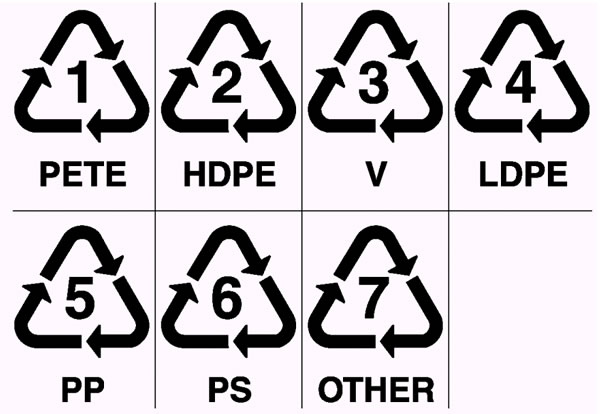
from http://crossplastics.com/domestic_recycling_symbols.shtml
Wonderful isn't it? Makes it look like plastic recycling is a closed loop. You pitch your jug or wrapper into the recycling bin, the truck hauls it off, and it's renewed.

Sadly, it's not true. Because of this.
From http://www.fda.gov/Food/FoodIngredientsPackaging/
FoodContactSubstancesFCS/UCM155197
This is a "Letter of No Objection" (LNO) from the U.S. Food & Drug Administration. Want to recycle plastic into food packaging? You need this letter. It's extremely valuable, and extremely rare.

Why? Contamination. Take your #1 plastic juice bottle. #1 plastic is the sturdiest and most easy/cheap to fully recycle.* Yet to recycle one into another food-grade #1 plastic bottle requires:
  • Separating out all other plastics before remelting. One stray #6 plastic out of 1,000 is enough to contaminate the lot.
  • Cleaning the plastic to remove all food/waste/oil/toxin residue.
  • Sorting all the strains of #1 plastic to avoid contamination.
  • Running the cleaned material through the FDA's gauntlet.
  • Finally, finding a distributor willing to buy the expensive product.
How much plastic actually meets strict recycling standards? Look for yourself. Walk down a grocery aisle. Look at all the plastic packaging. How much do you see that says "X% post-consumer recycled (PCR) material"?
Row upon row of plastic
I thought so.

2.54 million tons of virgin #1 plastic are made each year in the U.S. alone. In 2009, the world's largest #1 bottle-to-bottle recycler opened in Spartanburg, SC. One day it may turn 50,000 tons of #1 plastic back into food-grade recycled material. That's two percent. If we're lucky.

What happens to the rest? Downgraded, downcycled into junkier items, ultimately landfilled. And new, virgin #1 plastic must be created to keep up with the demand.

Take a different plastic, #4 film. The stuff in grocery bags. In 2008, the U.S. produced 7 billion lb. of #4 plastic. Even after 20 years of recycling initiatives, only 12% was recycled. Worse, only 4% of that 12% actually gets turned back into any kind of new film.
image copyright: American Chemistry Council
http://www.americanchemistry.com
The rest goes into deck materials, downgraded plastic uses, or is shipped overseas.** From there, into landfills - or the ocean.
Grocery bag on the beach
This means that, out of the 7 billion lbs of #4 made each year, one-half of one percent will become film again. The next year, 6.95 billion more lbs of virgin #4 plastic will be brought into the world to keep up with demand. And the next year. And the next year...

**************************************

The story is the same from #1 to #7. The vast majority of plastics can only be recycled once, maybe twice, before becoming worthless. What's stocking the aisles of your grocery store, big-box retailer, etc.? Almost all virgin plastic.*** Almost every bottle you recycle? Replaced by another virgin-plastic bottle, which is added to an already overloaded world.

There's hype about plastic recycling. And then there's the truth: Every year, the U.S. plastic industry adds 50 million tons of new plastic to the world. The only way that plastic will die is in the fires of an incinerator. The only way.

So when you dutifully place that milk bottle or HandiSnacks wrapper in the recycling bin, remember, it's almost certainly going on a one-way trip. It will, one way or another, either end up in a landfill, or your local stream, or the ocean, before it is done.
Just look down, you'll find it
Why is there so much plastic soup in the oceans? On the beach? In the gutters? In the ditches? In our bloodstream?

Because the triangle is a lie.


* Though generally considered safe, it's also traditionally been made with been found contaminated with BPA, a man-made chemical now found in the bloodstreams of 90% of humans. Its possible toxicity is gaining more & more attention. Which is another story, and another post.

** The American Chemistry Council loves to talk up the value of plastic recycling. Look for their symbol on many recycling Web sites. Also look for them as sponsors of recycling initiatives nationwide. But their own fact sheets dispell the myth. 50+% of recycled #4 plastic was sold to developing nations in 2008. Many have much lower standards for their plastics and permit very contaminated plastics to be melted together and used in food packaging. Each grocery bag you recycle may be poisoning a family somewhere on the other side of the world.

*** Don't believe the spin that this is from the waste by-products of oil refining. It's made from the same kinds of natural gas that are being harnessed and used as energy the world over. It could find a perfectly good non-plastic life.