Showing posts with label marine plastic pollution. Show all posts

Sunday, November 3, 2013

Collection Report - September 29, 2013

Sunday, September 29. 1:40PM, right at very weak low tide. 60 degrees. Bright, bright sun. Cool seabreeze coming in. Low energy week, unchanged largely since last week.
The foreshore still awash with jumbled and poorly sorted cobbles, pebbles, and wrack. On this early fall day the backshore still looked an awful lot like summer!
A truly beautiful day to have a beach all to myself.

Things I noticed this week: The slope down to the waterline felt longer, more gradual, more consistent & noticeable. There were fewer flat berms and falloffs. There was little sorting or piling of new cusps & mounds. And little new wrack come in. But at very back of last high-tide line (20-30 feet up from what had been the end of the live-algae zone), I found an area of smushed & sand-tossed loose wrack. Lots of vinyl & plastic churned up through this loose wrack.
It's rare at Curtis Cove to see that kind of mixing. Usually the vinyl sits on top, but this stuff got churned into the back of the foreshore, yet not dragged away. As though a couple last high waves made an energetic slush, that then quickly died back away.

So what did I find?
528 pcs of nonrope debris
528 finds:
  • Bldg material/furniture: 0
  • Foam/styrofoam: 0
  • Fishing rope/net: 0
  • Fishing misc.: 481 (456 vinyl lobster trap coating bits, 9 trap parts, 2 bumpers, big ball of fishing line, 13 claw bands)
  • Food-related plastics: 11 (bottom of drink bottle, 4 bottlecap o-rings, 5 cup scraps, container)
  • Food-related glass/metal: 1 (tiny aluminum can scrap)
  • Nonfood/unknown plastics: 9 ("silk" flower, 6 cable ties, o-ring, anchor)
  • Scrap plastics: 25 (4 > 1" , 21 < 1" )
  • Paper/wood: 0
  • Non-plastic misc./unique: 1 (sea glass)
Another zero-rope week! That's become a very good indicator of a very low-energy week at the cove. As is the return of large masses of lobster trap vinyl:
Beyond the vinyl, I did find one other interesting thing:
This bleached, faded, & abraded cup surely has a tale to tell. Who lost it? Where? When? Why? How? So many questions -- all of them essential if we're ever going to reclaim clean oceans & give our descendants reason not to despise us. Yet none of them answerable.

The tides go on.

Running YTD counts:
  • Total pcs of litter -- 9848
  • Pcs fishing rope -- 1862
  • Vinyl lobster-trap scraps -- 6123

Friday, October 26, 2012

Curtis Cove Report - Oct 19, 2012

This was originally going to be a report for Thursday, October 18. But my trip got cut short just as I was getting onto the beach. So I came back the next day. And what a difference a day can make!
Oct 18, 8:45AM - sand, cobbles, a little wrack
Oct 19, 8:45AM - mounds & bands of wrack!
There was no major weather system that moved through overnight Thursday. No massive winds. The tides were similar overnight as they had been Wednesday night. Yet this happened!

So, Friday, October 19th. 8:45AM. Thick clouds, large flocks of migratory birds going past. And a lot of seaweed. Sadly, where there's seaweed, there's plastic. Thursday's sunny skies, birdsong, and images of:
and:
became Friday's gloom:
The waves overnight Thursday night brought both a huge dump and big scour event. In addition to all the seaweed up high, much sand had been pulled back down low again. The 200-lb mass of knotted rope and trap bits that had been buried on the high foreshore all summer was peeking out again.
Kicking through the seaweed (and hundreds of sand fleas still clinging to their warmth) was depressing. You always hope that maybe things aren't really as bad in the oceans as you think. Then you realize that yes, yes they are. Here's what I found:
77 pcs of rope, about 75 ft total
248 pcs of nonrope debris
325 finds:
  • Bldg material/furniture: 5 (plywood scrap, carpet swatch, 3 feet/bases)
  • Foam/styrofoam: 1
  • Fishing rope/net: 77
  • Fishing misc.: 137 (12 claw bands, 112 vinyl trap scraps, trap tag, 2 bumpers, 3 trap parts, bait baggie, 4 bait bags, glove, fishing line)
  • Food-related plastics: 32 (2 bottlecaps, 3 o-rings, fresh McCafe cup and lid, 21 cup scraps, 4 cutlery scraps)
  • Food-related glass/metal: 6 (can scraps)
  • Nonfood/unknown plastics: 25 (6 bag scraps, 1 mylar balloon, 3 industrial bottlecaps, cigarette, diaper, sewage disk, duct tape, 2 cable ties, lg heavy float (?) fragment, shirt tag, stick-on hook, cover/cap, cord, 4 heavy clear plastic scraps)
  • Scrap plastics: 40 ( 19 > 1" , 21 < 1" )
  • Paper/wood: 0
  • Non-plastic misc./unique: 2 (fabric scraps)
A little comparison. More than a year and a half ago now, in March 2011, Hooksett, New Hampshire's sewage treatment facility had a major accident. They flushed into the river 4 million "sewage disks" -- little plastic mesh disks meant to be suspended in the tanks and give bacteria extra habitat for growing and breaking down sewage. About 400,000 remain unaccounted for. They'll be washing up for decades. This one came into Curtis Cove on the 19th:
After all that time in the harsh sea, it looks as good as new. Unstained, flexible, perfect. So how long do you think it's taken for this bottlecap/twist-cap to look like this?
Plastic is forever. And while it's all out there in the ocean being forever, it's also getting poked, chewed, and consumed.
All due respect to NOAA, the problem isn't "marine debris." It's plastic pollution. And it will only keep getting worse as long as we keep dancing around it.

Running YTD counts:
  • Total pcs of litter -- 9948
  • Pcs fishing rope -- 2054
  • Vinyl lobster-trap scraps -- 4554

Tuesday, October 23, 2012

Curtis Cove Report - Oct 11, 2012

Thursday October 11. 1:30PM. 55 degrees, bright skies, mild gusts. A real autumn feel.
This was another beautiful day. The Little River marsh behind the cove was awash in rust & ochre:
On the beach, the power of the ocean had pulled down a lot of older sand, revealing once-buried rope chunks. It also carved out nice cliffs amid the high sands and wrack:
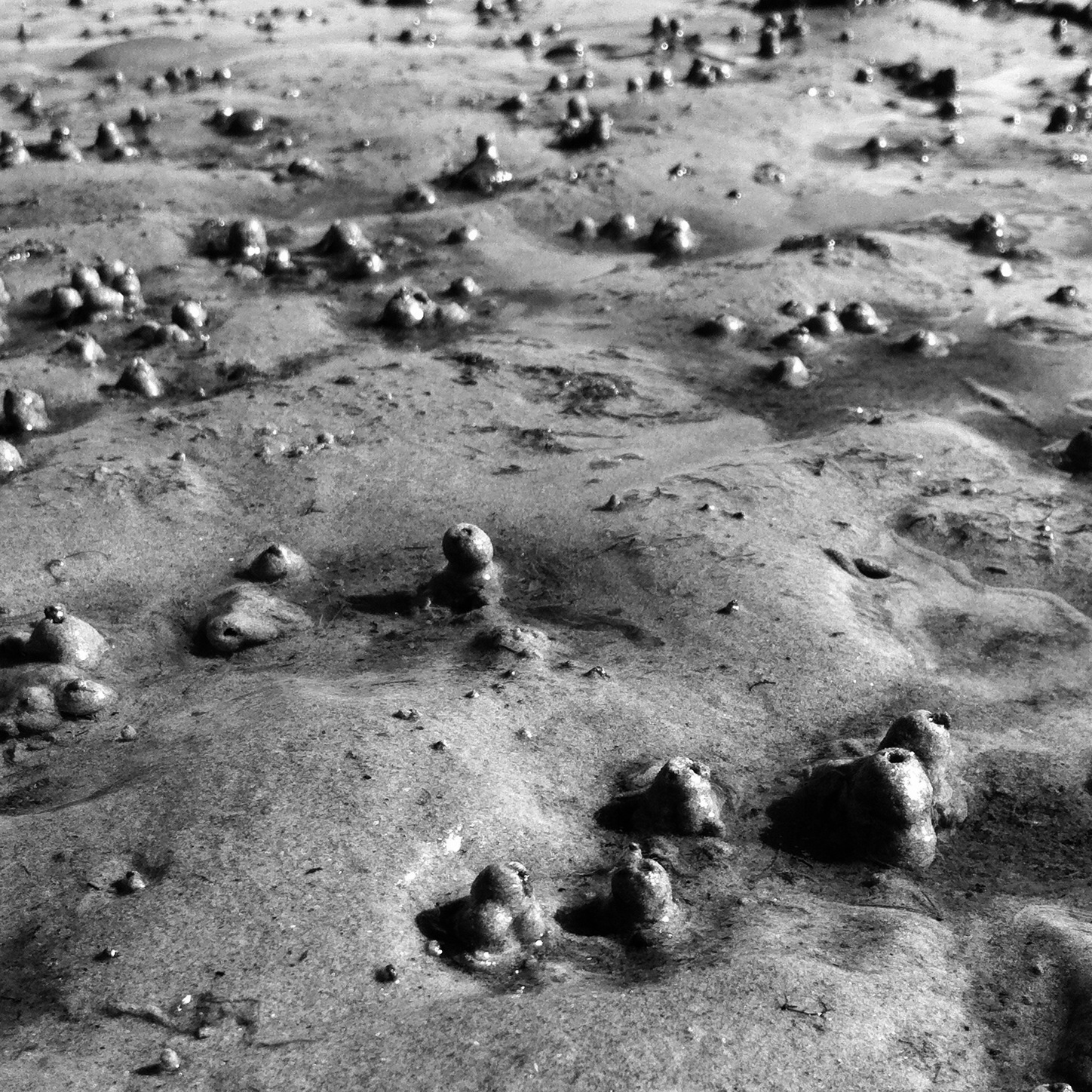
Meanwhile, down at the muddy lip where the low-tide ripples lapped the shore, otherworldly tubeworm "condos" stood proudly:
In the end, this was a very "unsorted" day. Masses of cobbles and pebbles came up high. Masses of sand, mud, and wrack slumped down. The ocean rearranged its coastal furniture quite a bit. So what would that mean for the collection?

26 pcs of rope, about 60 ft total
57 pcs of nonrope debris
87 finds:
  • Bldg material/furniture: 0
  • Foam/styrofoam: 0
  • Fishing rope/net: 26
  • Fishing misc.: 34 (20 vinyl trap scraps, bait bag, 8 trap parts, trap tag, 4 claw bands)
  • Food-related plastics: 8 (bottle - old & scoured, bottlecap, 5 cup scraps, straw - old & brittle)
  • Food-related glass/metal: 6 (2 can scraps, 4 sea glass)
  • Nonfood/unknown plastics: 9 (bag scrap, 3 cable ties, bucket rim, flower tag, circular base, rubberband, air filter scrap)
  • Scrap plastics: 4 (3 > 1" , 1 < 1" )
  • Paper/wood: 0
  • Non-plastic misc./unique: 0
In the end, not a huge haul. With much of the lighter sand and wrack pulled back downshore, probably the light & bouncy plastics went back to the sea. What was left behind was mostly larger and bulkier than usual. Sizable chunks of rusty trap, bigger scraps of broken plastics, heavy seaglass -- even the vinyl trap scraps tended to be larger than usual.

More sobering, look closer.
Om, nom, nom
The synthetic (read: plastic) fiber swatch on the left has been chewed and bored by various denizens of the deep. The hard piece of styrene on the right has been poked by many teeth/beaks, and ripped & torn by others.

Plastic seas feeding plasticized fish. This isn't science fiction. It's not some dystopian future. It's now. In the beautiful state of Maine.

Running YTD counts:
  • Total pcs of litter -- 9623
  • Pcs fishing rope -- 1977
  • Vinyl lobster-trap scraps -- 4442

Thursday, May 24, 2012

Introducing Curtis Cove

I've mentioned in passing that my work lately has expanded beyond one beach. Time to dish on what I've been up to these past several months.

Welcome to Curtis Cove, Biddeford, Maine:
I discovered this place in December 2010. It's at the end of a long, winding, wonderful seashore drive that wends past salt marshes and beautiful homes. The road grows more & more narrow and rustic -- and isolated. Then, rounding a sharp corner bordered by a rip-rap seawall and thick brambles, it ends abruptly at a private dirt access road (the arrow below).
When I got to the end, I hopped out for a look. The cove was private, so I didn't stay long. It should have been a little slice of heaven. An untouched secret shore with rocky headlands at its front, a salt marsh & tidal estuary at its rear. But what I saw shocked me. The entire beach was littered in garbage. Rope, old cups, a balloon, innumerable lobster trap parts, unidentifiable but long-suffering plastic scraps, a tire.

This private, untouristed, unknown cove was a dump -- a huge collection spot for ocean-borne garbage. I took some pictures, and left heavy-hearted.

Fast-forward to Fall 2011, when I came across amazing news. The family that owned the whole 97-acre peninsula was selling. To a group of conservation organizations. One of the last undeveloped coastal gems in southern Maine was going to be preserved forever! And I just might have a chance to get back onto Curtis Cove to have a real look.

In the end, the peninsula, "Timber Point," came into the hands of the Rachel Carson National Wildlife Refuge. I met with the refuge management, discussed my flotsam work with them, and suggested that Curtis Cove would be an ideal spot to see -- really see -- what's out there in the Gulf of Maine. And happily they agreed! Within weeks my permits had been signed & granted.
I was in!

On January 1, 2012, I visited Curtis Cove for the first time as a licensed Flotsam Diarist. I scouted the land and decided on a plan of attack for studying the beach. With the heavy influx of flotsam, I decided to focus on a 150-foot wedge of shoreline along the northern part of the cove. And I got to work. Thanks to a ridiculously mild winter, I was able to spend January and half of February cleaning off the age-old debris, finally getting to a clean "baseline" on February 22.

Since then, I've been returning weekly to scour the same 150-foot stretch of beach and see what's come in.

The results have been gobsmacking.
This is 1325 feet of fishing rope. More than 1/4 mile of rope, 757 individual pieces, washed in between February 29 and May 17. And it shows no signs of stopping, or slowing.

But far beyond just rope is the assortment of other debris, almost all plastic. A few examples. February 29:
Or March 7:
Or March 13:
Or the huge shocker, March 30:
On March 30 alone I collected 526 pieces of garbage -- 398 of them were little scraps of vinyl coating torn from derelict & rusting lobster traps. At least half a million derelict traps now rest on the floor of the Gulf of Maine. Each trap will release over a thousand of these vinyl scraps by the time it's done disintegrating. They don't go away.

Curtis Cove has always been a natural collection point of ocean debris. Seaweed still washes in two feet thick if the weather's right. As it decays (the nose won't miss this), it pours an amazing amount of nutrients back into the soil and the water. This rich environment supports wonderful tide pools, choc-a-bloc with life and diversity.
A nudibranch -- a shell-less snail
A gunnel, or "rock eel"
When the gulls bobbing on the incoming tide cry... or the geese soar by overhead straight as an arrow... or the surf roars as it breaks on the distant ledge at the head of the cove... or you discover a new creature you've never seen before... that's when you realize that this is a special place.

And when you see a gorgeous tide pool littered with modern junk:
...that's when you realize that the special places in the world are under assault. From our plastic lifestyle. And that this has to change. Curtis Cove is now a wildlife refuge. A place protected from the modern world. But there is no protection from what the modern world has dumped into the sea.

It's not really possible to overstate how badly the Gulf of Maine is being abused by persistent plastic garbage. But now that I have Curtis Cove to visit week after week, it is possible to shine a bright & searing light on it.

Sunday, March 18, 2012

Collection Report Feb 29, 2012

Wednesday, February 29, 2012. 10:15 AM. Happy Leap Day! A gray, brisk morning, low tide, temps about 30 degrees F.
Look, a wrack line! A pathetic one, but more pronounced than most this winter. The latest high-tide was extremely weak though, barely pushing swash 1/3 of the way up the beach.

Still, the waves & winds managed to form a new range of cusps -- high grounds of sand with low troughs in-between, spaced evenly up and down the shoreline. And they dumped enough sand to bury some (much?) of what they brought in:
Well hello, little... scrap of bag?
Um, no, entire bag!
Just north of my zones, a washed-in lobster trap held half a dozen broken beer bottles from a recent party. More troubling is what happens to a trap as it slowly rots on the seafloor.
Tortured
When the vinyl scrapes against the bottom enough to expose the steel, the steel rusts & bubbles out. Eventually it splits and bursts the vinyl coating into tiny scraps. Each rusting lobster trap can spew off 1,000 or more little pieces of vinyl that then bounce colorfully along the sea bottom and likely into the food web. There are likely half a million -- or more -- rotting lobster traps at the bottom of the Gulf of Maine.

At any rate, the week had some excitement, though not for volume of debris. Zone N:
19 finds:
  • Building materials: 1 (brick)
  • Foam/Styrofoam: 2
  • Fishing misc.: 2 (claw band, vinyl trap coating)
  • Food-related plastics: 0
  • Food-related glass/metal: 3 (1970s can scrap, 2 sea glass)
  • Nonfood/unknown plastics: 6 (bag, rubberband, plastic cord, 1 scrap >1", 2 scraps <1")
  • Cigarette filters/plastics: 3
  • Paper/wood: 1
  • Misc./unique: 1 (fabric scrap)
Number-wise, nothing worth noting. But this guy is worth noting:
This pull-tab era aluminum top to a steel can is 30+ years old. It's the second such ancient piece of aluminum to wash into Bay View within a few weeks. If an offshore sandbar is shifting, revealing ancient debris, maybe it's blocking the transport of new debris at the same time. The junk is still out there. Maybe this humble scrap is a big clue as to why it's currently bypassing Bay View.

Anyway, on to Zone S:
14 finds:
  • Building materials: 2 (brick)
  • Foam/Styrofoam: 1
  • Fishing misc.: 2 (claw band, monofilament line)
  • Food-related plastics: 2 (sauce pack lid, fork/spoon scrap)
  • Food-related glass/metal: 2 (bottlecap, sea glass)
  • Nonfood/unknown plastics: 4 (bag, old comb, 1 scrap >1", 1 scrap <1")
  • Cigarette filters/plastics: 1
  • Paper/wood: 0
  • Misc./unique: 0
This poor thing is probably glad finally to be at rest:
I wonder if it had been buried under a sandbar for 30 years too?

Another week down. The numbers are as unimpressive as they've been most of the winter. But sometimes it's not about how much you find; it's about how much you can find out.

Wednesday, March 14, 2012

Collection Report Feb 21, 2012

Monday, February 20th, 2PM. Hour before low-tide. Bright sun, 40 degrees. A rare brisk Winter '12 seabreeze.
February 20
But on the sands? Nothing. No wrack, rock, shell, paper, metal, or plastic. A void. So, a return Tuesday, February 21st. 1:15PM, a couple hours before high-tide. A repeat of the day before, weatherwise.
February 21, cusps, rocks, and...
And mostly a repeat of conditions on the ground. At least the regular, beautiful cusps are back. Behind, the sand slopes sharply up to the dunes; in front, the sand drops off sharply again to the low-tide terrace. But on either side? Still nothing. Zone N:
16 finds:
  • Building materials: 1 (asphalt)
  • Foam/Styrofoam: 0
  • Fishing misc.: 1
  • Food-related plastics: 1 (straw wrapper)
  • Food-related metal/glass: 3 (sea glass)
  • Nonfood/unknown plastics: 6 (survey flag/marker, tieback, 1 scrap >1", 3 scraps <1")
  • Cigarette filters/plastics: 4 (3 filters, 1 filter tip)
  • Paper/wood: 0
  • Misc./unique: 0

How dull? That dull. Oh, and Zone S? Zip. Not one bit of manmade debris washed in.

Thus ends one of the briefest collection reports I've ever done! I'd love for this to be great news... But at the beginning of the year, I got approval from National Fish & Wildlife Service to work on a second beach about 5 miles south, an untouristed little nook called Curtis Cove.
Yay, I'm official!
After removing, so far, 1000+ feet of fishing rope from the Cove -- plus hundreds of scraps of new washed-in plastic every week -- I know that the Gulf of Maine hasn't miraculously cleaned itself.*
One recent week's haul at Curtis Cove
The junk's just bypassing Bayview's shores. But in a way, this is exciting to me. The debris is out there, yet Bayview this year is monumentally different from last. The question is, why?

I'm working two hypotheses:

(1) A little-known phenomenon called "internal waves," which propagate through the water instead of on the surface. If those waves are missing or weak, seafloor debris may not get churned up enough to move onto land.

(2) Sandbars. If a series of sandbars has moved into the Bay just offshore, it might be blocking debris as well as dampening the energy of the incoming waves. The high-tide swash marks this winter have been pathetic compared to last year. Several yards further down the slope than last year's average. For whatever reason, the energy just isn't there at Bay View this year.


* I'm keeping track of my Curtis Cove finds too. Soon I'll devote a blog page describing what I'm doing there and will post its collection reports as well. Being a site that gets no tourists, practically everything I find has been washed in. And I'm learning that much of it has really fascinating stories to tell.

Thursday, March 1, 2012

Collection Report Feb 6-7, 2012

Monday, Feb. 6, 3:30PM. Low-tide. Brilliant late sun with its long shadows:
A whole lot of bright blue sky, and a whole lot of nothing else. The only thing to see was a dry "wrack" line of landborne reeds. The final gasp of the large sand-dump from two weeks before lay as a very faint sandbar just seaward from the foreshore. Otherwise, the beach was back to normal. No rocky strewn-field, no starfish, no tube-worm casings by the thousands. Just soft sand spread along from dune to terrace.

A lovely day for a walk, but dismal for collecting flotsam.

On a hunch, I stopped by again Tuesday. The difference a day makes. Noon, an hour past high-tide. Mostly cloudy, 40s again, slight onshore breeze, and another weak, low high-tide line. But... fresh seaborne wrack!
Overnight the Bay dumped a batch of fresh, seafloor "sea colander."
See? It sinks
All winter long there has been nothing floating into Bay View. Everything that gets kicked up is from different parts of the seafloor. In that regard, this week was the same as the past two months. But at least this week some combination of magic churned up the seabed and dragged in a few things of interest from the watery grave. First, Zone N:
78 finds:
  • Building materials: 9 (7 brick, 2 asphalt)
  • Foam/Styrofoam: 25
  • Fishing misc.: 9 (5 rope scraps, 2 clawbands, lure bag scrap, shotgun shell wadding)
  • Food-related plastics: 6 (2 bottlecap o-rings, 2 Solo cup scraps, food wrapper, fork)
  • Food-related metal/glass: 1 (can scrap)
  • Nonfood/unknown plastics: 17 (plastic glove, swiffer scrap, 2 toy scraps, battery/cartridge cover, silk flower, toggle weight ?, 5 scraps >1", 5 scraps <1")
  • Cigarette filters/plastics: 10 (9 cigarettes, 1 packaging)
  • Paper/wood: 0
  • Misc./unique: 1 (fabric swatch)
A lot of foam, but none of it showed signs of sea voyage. Probably bits and pieces blown in from up and down the shore, out of garbage cans or freed from dunes. The other, non-foam plastics showed signs of being ocean-borne. And like I said, they were all dense, sunken plastics tossed up from the seabottom.

Zone S:
30 finds:
  • Building materials: 9 (6 asphalt, wood offcut, tile, concrete)
  • Foam/Styrofoam: 6
  • Fishing misc.: 2 (rope scrap, bait bag)
  • Food-related plastics: 4 (bottlecap o-ring, 3 food wrapper scraps)
  • Food-related metal/glass: 1 (can)
  • Nonfood/unknown plastics: 5 (balloon w/ string, 2 large vinyl upholstery scraps, 2 scraps >1")
  • Cigarette filters/plastics: 0
  • Paper/wood: 1
  • Misc./unique: 2 (cloth strip, leather offcut)
Those upholstery scraps were some of the most brutalized, tortured pieces of vinyl I've ever seen. Whatever their story, I'm sure it's a doozy.

Still, flotsam-wise there really is no comparison between Winter '11 and Winter '12. The same can be said weather-wise. Are the two related? Does warmer air shut down the systems that normally drag thousands of bits of plastic into the bay? Does less snow/rain = less river runoff = changed circulation patterns? I don't know. But it's worth looking into.