Showing posts with label claw bands. Show all posts

Friday, September 6, 2013

Curtis Cove Report - June 27, 2013

Thursday June 27, 9AM. Low-tide 2 weeks since last visit. Stormy day the day or two before. Overcast & wet skies.
Green algae healthy on the low foreshore shows that the recent storms didn't have a lot of ripping/tugging energy. Life quickly growing back into the pulverized backshore:
A day of contrasts. The tide pools high up, away from the rotting wrack, were crystal clear, beautiful, and full of life:
The tide pools caught in the line of runoff were miasmas, dead.
There's such a thing as too much nutrients -- too much of a good thing! As well as, of course, way too much of a bad thing:
The smear of tiny plastics spread throughout the fine pulverized wrack on the foreshore told me this would be a busy day. All told, here's what I collected:
67 pcs of rope, about 80 ft total
252 pcs of nonrope debris
300 finds:
  • Bldg material/furniture: 0
  • Foam/styrofoam: 1
  • Fishing rope/net: 67 (80 ft)
  • Fishing misc.: 158 (127 vinyl lobster trap coating scraps, 15 trap parts, 2 bumpers/cleats, 13 clawbands, buoy-stick scrap)
  • Food-related plastics: 21 (19 cup scraps, 2 food wrappers)
  • Food-related glass/metal: 3 (can scraps)
  • Nonfood/unknown plastics: 11 (3 straps, vinyl stitching, old flanged tube, cable tie, 5 cords)
  • Scrap plastics: 36 ( 20 >1" , 16 < 1" )
  • Paper/wood: 0
  • Non-plastic misc./unique: 3 (fabric scrap, 2 sea glass)
All of the above that I found is new -- it's not the remnants of winter storms filtering back into the sea. This is just new stuff that the sea is continually dumping on the shores of Curtis Cove. A couple of the more curious items:
-Ancient- plastic chair/table foot
Badly fish-eaten lobster claw bands
We keep giving it to the ocean. The ocean keeps giving it to us.

Running YTD counts:
  • Total pcs of litter -- 4611
  • Pcs fishing rope -- 1722
  • Vinyl lobster-trap scraps -- 1880

Wednesday, July 3, 2013

Curtis Cove Report - June 13, 2013

Thursday, June 13. 9:30 AM. Mid-60s and on its way up. Light breeze, 1/2 hour before low tide, bright sun... Bring on summer!
And still all to myself
Long lines of clouds in the sky, reverberating energy up and down just like a plucked guitar string -- or a pebble thrown in the ocean.
"Gravity Waves"
It had been a mostly low-energy couple of weeks since my last visit, with a healed summer slope to the beach as a whole. The backshore, so ravaged in February, was back & in blossom.
The low foreshore, heavily saturated by a week of heavy & steady rains, swirled with standing pools and life.
Walking along the backshore, my feet sank into fresh sand that had been blown or washed on top of the last remnants of winter's wrack. Bits of rope stuck out of the mid-foreshore, signs that their overburden had been stripped off (and then tossed onto the backshore). What would that mean for any washed-in plastic? Well, you tell me.
184 pcs of rope, about 140 ft total
158 pcs of nonrope debris
342 finds:
  • Bldg material/furniture: 2 (fiberglass fragments)
  • Foam/styrofoam: 0
  • Fishing rope/net: 184
  • Fishing misc.: 81 (61 vinyl trap scraps, 8 bait bags/scraps, 2 bumpers, 2 trap parts, 3 balls of fishing line, 4 claw bands, trap tag)
  • Food-related plastics: 19 (bottlecap seal, bottle, 14 cup scraps, bread wrapper tag, tiny plate scrap, straw)
  • Food-related glass/metal: 3 (2 aluminum can scraps, seaglass)
  • Nonfood/unknown plastics: 29 (6 bag scraps, 3 mylar balloon scraps, Clorox bottlecap scrap, nonfood bottlecap, hair band, 2 very old/broken toy scraps, 7 cords, 2 rubber belts/straps, 2 woven straps, plant ID stake, 3 cable ties)
  • Scrap plastics: 18 ( 10 > 1" , 8 < 1" )
  • Paper/wood: 1 (paper backing/lining)
  • Non-plastic misc./unique: 5 (3 fabric scraps, 1"Lobster Cove" scrap, shoelace)
More of the usual. And maybe a little unusual:
The steel inside this large lobster trap scrap has all rusted away. All that's left is the permanent, nondegradable vinyl coating. How long would it take to do that, do you think?

And of course, more subtle evidence of commercial fishing's effects on the Gulf of Maine:
Bleach bottles and bleach bottlecaps are common finds. After sanitizing decks & work surfaces on a rocking boat, bleach bottles are often accidentally (or not accidentally) dumped overboard. They don't go away.

Neither do the plastic remnants of early mornings out to sea.
I have found dozens -- or hundreds -- of scraps of coffeecups and cup lids washed up on my one shore. (Many or most with sea-creature bite & poke marks on them.) More than could be accounted for by seaside strollers. Coffee is an excellent 5AM wake-up for a long day at sea. But pitching a coffee cup overboard when the coffee's gone is bad form.

Running YTD counts:
  • Total pcs of litter -- 4159
  • Pcs fishing rope -- 1627
  • Vinyl lobster-trap scraps -- 1701

Monday, May 6, 2013

Curtis Cove Report - Apr 8, 2013

Wow. Way too far behind now. Time to make a few brief posts to catch back up if I can! Monday, April 8. 1:15PM. Three hrs past high-tide. Strong seabreeze, low 50s. Bright sun, a beautiful day to be here.
The beach was still healing itself nicely after winter's violence, getting its old shape back. On this day I found great natural sorting -- a tight layer of wrack & pushed-up plastics at the back of the foreshore; beautiful rippling and sand on the low foreshore.
All the wrack was very old & pulverized. Not a lot of new energy this week. Though at least one wave brought something interesting:
Took a wrong turn at Albuquerque
Normally, this would be the kind of day with very limited finds. But, this is Curtis Cove. And the beach's healing process included releasing more of the pent-up plastic from winter's storms. As the seaweed rots & disintegrates, ever more plastic gets left high and dry.
211 pcs of rope, about 250 ft
289 pcs of nonrope debris
500 finds:
  • Bldg material/furniture: 0
  • Foam/styrofoam: 0
  • Fishing rope/net: 211
  • Fishing misc.: 230 (188 vinyl scraps, 4 bait bags, 3 vents, 2 trap tags, 2 bumpers, 5 various trap parts, 1 glove, 25 claw bands)
  • Food-related plastics: 16 (2 bottles, 1 bottle half, scrap bottlecap, 1 whole cup, 11 cup scraps)
  • Food-related glass/metal: 5 (4 aluminum can scraps, bottle cap)
  • Nonfood/unknown plastics: 18 (4 upholstery pcs, duct tape, 2 washers/spacers, bead, warning tag, caulk strip, 2 plant tags, cigarette lighter, bag scrap, mylar balloon scrap, latex balloon, bandaid scrap, toy taxi)
  • Scrap plastics: 14 ( 8 > 1" , 6 < 1" )
  • Paper/wood: 0
  • Non-plastic misc./unique: 6 (3 fabric scraps (1 large), 3 gloves)
Wow, 500 on the dot! I promise I didn't plan that.

A varied week. "Only" 188 vinyl lobster trap scraps, a step in the right direction. But a really eclectic week. Of course lobster fishing heavily dominated. But a big slice of modern life was represented. A couple stand-outs:
Warning tags aren't paper anymore; they're plastic fiber. Surprise, surprise.

And of course I found still more of these plant ID stakes:
As I'm now clearing out our condo's community garden, it's easy to see why so many of these stakes get into the ocean. I'm finding many years' worth in the overgrowth. A good rainstorm can easily tumble them into the drainage gulley, and from there, straight out to the Deep Blue. :/

Running Year 2 YTD counts:
  • Total pcs of litter -- 2758
  • Pcs fishing rope -- 723
  • Vinyl lobster-trap scraps -- 1551

Wednesday, April 24, 2013

Curtis Cove Report - Mar 31, 2013

Sunday, March 31. 9:35AM. An hour after low tide. Bright, sunny, upper 30s on a day quickly headed toward the 50s. The air was rich with the cries of gulls, jays, ducks, geese. Scuds & snails & tubeworms were back in the tidepools. Spring was on its way, if not yet here!
The sand this day was striking. The rivulets draining back down the beach left dark stains in their tiny valleys.
Other larger outwash streams wound their usual beautiful plaits & threads behind as well.
Of course, the ugly was on display too. And the poignant.
"Pitch In" indeed
But the story of the day was, again, the lobster trap vinyl:
At least half a dozen pieces just in this tiny section
Another week of fine, pulverized wrack at the back of the foreshore meant one thing. A big day. But "big" doesn't begin to describe it.
122 pcs of rope, about 125 ft total
1113 pcs of nonrope debris
1287 finds:
  • Bldg material/furniture: 2 (painted moldings)
  • Foam/styrofoam: 0
  • Fishing rope/net: 122
  • Fishing misc.: 1051 (958 lobster trap vinyl scraps (!!), 16 trap bumpers, 7 bait bags, 4 vents, opening ring, 63 claw bands, 2 bait tins)
  • Food-related plastics: 17 (bottle, 14 cup scraps, bread tag, fork/spoon handle)
  • Food-related glass/metal: 7 (3 aluminum can tops, can scrap, 2 sea glass, bottle cap)
  • Nonfood/unknown plastics: 24 (latex balloon, balloon string, cigarette, glove, shovel handle, large strapping, 9 cable ties, plunger stake (?), 3 upholstery scraps, plant ID stake, goggle strap, 2 crate seals, rope-and-eyelet)
  • Scrap plastics: 52 ( 18 > 1" , 34 < 1" )
  • Paper/wood: 0
  • Non-plastic misc./unique: 12 (2 socks, 2 fabric pieces, 6 gloves, pottery shard, leather strap)
No words. Not like words would matter. Here's a picture of what 958 little flecks of lobster trap look like.
All of these trap vinyl bits put back together wouldn't even create one lobster trap. At least 38,000 are lost by Maine lobstermen alone, each year. Another side-effect of the lobster industry are the huge numbers of claw bands that go overboard:
Many have bite marks on them. They don't go away, not for years & years at least. And of course there's the larger lobstering debris -- the trap vent doors that release if the trap is lost. Storms bring them into Curtis Cove regularly:
Wouldn't want to hit one of those with a propeller.

What is the biggest source of persistent plastic debris that I find on the beach at Curtis Cove? No points for answering.

Running YTD counts:
  • Total pcs of litter -- 2258
  • Pcs fishing rope -- 512
  • Vinyl lobster-trap scraps -- 1363

Monday, December 3, 2012

Fishing Industry Debris Clogs Gulf of Maine

A warm "thank-you" to the Portland Press Herald / Maine Sunday Telegram for running the op-ed I wrote about the debris I'm finding at Curtis Cove yesterday in the Sunday newspaper. This cove, a "protected" wildlife habitat, is an incredible open-air laboratory of so much of what's currently going wrong in the Gulf of Maine. And in a sense, the wider world.
76.1% of the plastic I pull from the beach there is directly related to lobstering. There have to be other ways to do this work. If there aren't, we'll just continue to finish off the complex web of life in the sea that sustains us.
Below is the original text of the op-ed that I wrote. 99% of it made it into the Press Herald, but I wanted it documented as originally written. As hopefully a pathway into a conversation that we in the state need to have, and that will in the end hopefully benefit all.

Curtis Cove, a deep, horseshoe-shaped nook, lies at the southern tip of Biddeford’s coastline. There, gentle waters lap against pebbles and fine gray sand. Rocky tide pools teem with life. Beach roses bloom among the rip-rap. It’s protected space, set aside as vital habitat for great annual seabird migrations.

Unmolested, untouristed. Supposedly free from the modern world.

Yet the modern world swirls in on every tide.

Along the wrack line, the eye catches them. Little flecks of unnatural green, bright yellow. See one, and you can’t help but see more. A few blue, a white fleck, a red one.

They’re the colors of lobster traps, like those seen stacked in front yards and docks and postcards. Except these aren’t lobster traps anymore. They’re part of what happens when a lobster trap dies.

The Great Pacific Garbage Patch is old news. The Gulf of Maine is its own plastic garbage patch. Much of our marine litter rolls and bounces along the sea floor, washing up at places like Curtis Cove. That litter includes countless scraps of nondegradable vinyl coating, burst from countless derelict lobster traps rotting on the Gulf of Maine seabed.

I visit the cove weekly, collecting and cataloging what washes in. Along just 150 feet of it I have collected 10,617 pieces of man-made garbage since late winter.

Of course it isn’t all lobster-trap bits. I have found plant pots, fiberglass siding, a car arm rest, carpet scraps, a saw handle, a crate lid, half of a coathook, part of an outdoor thermometer, even an antique clay pipe.

But sadly, most of what washes up here is directly related to lobstering. 8,076 pieces, 76.1% of everything I’ve found. 477 lobster claw bands; 144 trap bumpers; 119 bait bags; 2487 fishing rope scraps -- some 4/5 mile total length. Various other scraps of traps, buoys, etc.

And 4563 flecks of lobster trap vinyl coating.

All from 150 feet of protected cove, in a state with over 3,000 miles of coastline.

It’s ugly, of course. It’s litter. It shouldn’t be there. But beyond that, plastics in the ocean adsorb terrible toxins. They kill sealife and shore dwellers. Many of the claw bands (lost overboard as lobsters are being banded) have fish bite marks all over them -- possibly from young cunner. The harder vinyl trap coatings could be swallowed whole, tear an animal up, and survive intact to kill again.

Maine’s Department of Marine Resources licenses 3 million lobster traps each year. How many have been lost? Nobody knows. From the time that the first trap was put into Maine waters all the way up to 2009, DMR kept no record.

Now they require lobstermen to submit a request in order to get replacement tags. From 2009-2011, they received about 38,000 requests per year -- which of course doesn’t account for undeclared losses.

Fishing with rope & traps means losing gear. That’s reality. When it was biodegradable, it mattered less. But around 1980 vinyl-coated steel traps and plastic bait bags/rope became the gear of choice. Because it seemed cheaper, both in cost and effort.

30+ years at 38,000+ lost traps a year means, conservatively, one million derelict plastic-coated lobster traps on the seafloor by now.

Of course a few wash up. Every beach and island has its wrecked traps. Others are grappled and removed by nonprofits, fishermen, & volunteers. But most sit hidden in the deep, rot, and shed their plastic bits over decades.

Fact: One of the state’s largest industries uses a business model that plans for losing hundreds of tons of nondegradable plastic into the Gulf annually -- and offers no mitigation! Industry’s debris, our great-grandchildren’s problem.

It’s well past time to drop the myth of “cheap” plastic. Plastic gear’s costs are very insidious and very real. Besides, the frenzied rush of “more, cheaper, more” has proven to benefit very few. And it leaves a growing legacy of dangerous, persistent pollution that washes up all around us.

It’s time to stop, look at the sand at our feet, and really see what’s there. We must treat our resources with respect. Return to degradable gear, demand a fair price for fishing responsibly, and promote the industry internationally as a model of a conscientious and sustainable fishery.

Whatever we do today, our descendants will still find scraps of yesterday’s “cheap” fishing gear on their shores and inside their sealife for decades. But if we change the game now, maybe at least they’ll look back on us and not shake their heads.

Sunday, June 19, 2011

The Persistence of Discovery


Yesterday our family discovered a real gem practically in our backyard. Wood Island, an uninhabited 32-acre nature preserve, sits at the southern entrance to Saco Bay, Maine. It's only 1/3 mile off the finger of mainland known as Biddeford Pool, but really does feel like a different world. It houses a boat ramp...
Approaching the sheltered western end of the island
...a boardwalk that runs across the island from west to east...
It runs through seagull nesting grounds;
angry seagull dads aren't to be trifled with
...and a lighthouse dating from 1838. Attached is the old lighthouse-keeper's home, which was inhabited until the light was fully automated in 1978 1986, and is now a free* museum.
About as "Maine" as you can get
Spectacular Maine beauty lay in all directions. Knobbly islands, rocky cliffs, crying gulls, pounding surf. Lobster buoys are thick in the water (some are visible in the next picture, my other pictures of thicker clusters didn't come out well). Watching the lobster boats setting & hauling is good fun on a beautiful day.
In some places you could hop from buoy to buoy
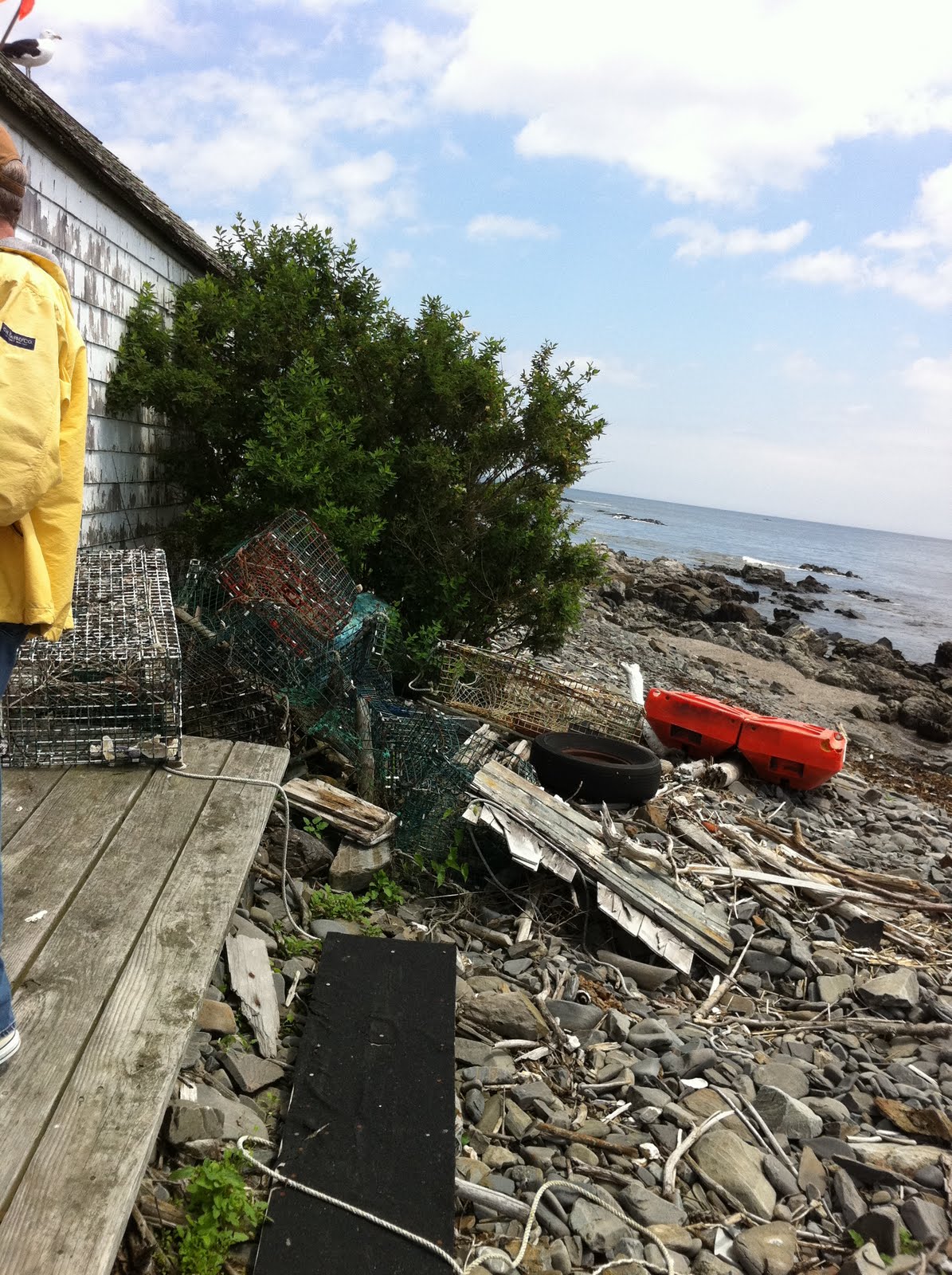
This is a place where the timelessness of Maine persists. Its architecture, landscape, traditions. There are even deer on the island, whose forefathers swam over at some point in the forgotten past. But Wood Island is also a repository for what happens when other things persist. For example, how many mangled lobster traps do you see in this picture? (Mouse-over to see what's really there.)
Do you really want to know?
All of that, in 40 or so feet of shore. Not to mention the rope, claw bands, and plenty of non-fishing garbage among the branches & rocks. Other side of the ramp, more of the same.
Wreckage everywhere
I'll swear to seeing 100 traps. It was probably 200. Plus, of course, water bottles, styrofoam, flipflops, tires, a wrecked sailboat (!), and other plastic debris of the modern world. All on one island out of many; in one small bay out of many; in a coastline that stretches for 200+ miles; which is itself only one out of countless such coastlines in the world.

The Wood Island "Friends" mow the lawns, maintain the buildings, offer tours, keep the museum. They're a dedicated group who have spent years stabilizing & restoring the buildings, and making the island available to anybody who would like to visit. But they're not equipped to deal with the influx of manmade trash the sea keeps feeding this refuge's shores. Really, until we stop dumping so much persistent waste into the ocean, nobody would be equipped to deal with that.

And it's a shame. Because this is a really special spot & a great place. And it should stay that way!
My daughter leading her friend through the wilds
To learn more of the island's history and the efforts of the Friends, please check out http://www.woodislandlighthouse.org/.

* There's a suggested donation of $10 for visiting the island & museum; more than fair given the beauty of the place & the amount of upkeep needed to maintain it.

Wednesday, December 1, 2010

The Storm after the Calm

Ever sit down to write about a recent event, and realize you just don't have the photo you need? November 24 at Bay View beach, Saco, Maine, was 41° F. A stiff northerly wind gusted over 30 mph. Many times I had to turn my face to duck a sandblast. And my trash bag kept trying to pull free from my hand, hoping to scatter my finds back to the shore. But do you see any of that in this picture?
Looks like a lovely beach day, no?
Still, there is proof. Angry wind & wave had carried in a piece of flotsam most unlooked-for. Remember the chunk of fiberglass from last week? It was just the leading edge of a much bigger, and heavier, surprise.
Is there still more lurking?
This battered 6 ft x 5 ft fiberglass hull fragment is now the second partial boat that I've found washed up. It had no markings on what was left of it, no personal effects. Most likely, it simply ripped away from a mooring and broke up a long time ago, with no loss of any crew. Still, I'll be just as happy not to find a third.

Mother Nature is kicking into gear. The shoreline is fast changing. Summer's sands are being blown & washed back down into the waves, steepening the slope dramatically. There are now two tide lines, with a berm grown in-between.
Two kelp rows (center and far right)
Still, for all the bluster, last week was the lightest haul I'd ever had. Could I hope for a repeat performance?

No. Beyond pieces of seacraft, this day quickly dispelled any cautious optimism I may have had. The tide line teemed with trash. Battered, abused, abraded trash. Every few steps, another piece popped out.
A scene of lobster claw bands...
...and frayed fishing rope...
...and shredded plastic cups
An hour and a half later, I'd only managed to scour the berm, not the whole beach. (Granted, I'd lost time dragging the boat carcass to the trash bin in the parking lot.) I decided to return the next day (Thanksgiving) to hit the rest.

Thanksgiving morning was only 33°, but it was bright and calm. I started with a stroll back to the tide line, just to see if I'd missed anything the day before. And within seconds I was off to the races again. Dozens upon dozens more bits and bobs were sitting pretty.
Driftwood threading the needle
Cheerrful plastic gem button
Which pebble doesn't belong?
An hour later, I'd still only managed to hit the tide lines again. In two days, I never got time to walk carefully up and down from wave to dune. (Though a cursory walk suggested the wind had left little to be found.)

In much the same way, there are too many interesting finds from this week to fit in this post. As a teaser for the forthcoming collection report, here's what I hauled in.
Zone N
Zone S
And as with the shotgun shell from last week, there is no doubt that much of this had ridden the waves for months (or years) before arriving back on my shore.
Sauce packs and egg sacs
Keep in mind, all of this comes from two small sections of beach. Two small sections that I have visited -- and scoured --almost every week since June. My part of southern Maine sits far away from any of the great gyres of the world. Yet the refuse of our artificial life just keeps coming in. Look down at your feet. What do you see?