Showing posts with label wave energy. Show all posts

Wednesday, March 14, 2012

Collection Report Feb 21, 2012

Monday, February 20th, 2PM. Hour before low-tide. Bright sun, 40 degrees. A rare brisk Winter '12 seabreeze.
February 20
But on the sands? Nothing. No wrack, rock, shell, paper, metal, or plastic. A void. So, a return Tuesday, February 21st. 1:15PM, a couple hours before high-tide. A repeat of the day before, weatherwise.
February 21, cusps, rocks, and...
And mostly a repeat of conditions on the ground. At least the regular, beautiful cusps are back. Behind, the sand slopes sharply up to the dunes; in front, the sand drops off sharply again to the low-tide terrace. But on either side? Still nothing. Zone N:
16 finds:
  • Building materials: 1 (asphalt)
  • Foam/Styrofoam: 0
  • Fishing misc.: 1
  • Food-related plastics: 1 (straw wrapper)
  • Food-related metal/glass: 3 (sea glass)
  • Nonfood/unknown plastics: 6 (survey flag/marker, tieback, 1 scrap >1", 3 scraps <1")
  • Cigarette filters/plastics: 4 (3 filters, 1 filter tip)
  • Paper/wood: 0
  • Misc./unique: 0

How dull? That dull. Oh, and Zone S? Zip. Not one bit of manmade debris washed in.

Thus ends one of the briefest collection reports I've ever done! I'd love for this to be great news... But at the beginning of the year, I got approval from National Fish & Wildlife Service to work on a second beach about 5 miles south, an untouristed little nook called Curtis Cove.
Yay, I'm official!
After removing, so far, 1000+ feet of fishing rope from the Cove -- plus hundreds of scraps of new washed-in plastic every week -- I know that the Gulf of Maine hasn't miraculously cleaned itself.*
One recent week's haul at Curtis Cove
The junk's just bypassing Bayview's shores. But in a way, this is exciting to me. The debris is out there, yet Bayview this year is monumentally different from last. The question is, why?

I'm working two hypotheses:

(1) A little-known phenomenon called "internal waves," which propagate through the water instead of on the surface. If those waves are missing or weak, seafloor debris may not get churned up enough to move onto land.

(2) Sandbars. If a series of sandbars has moved into the Bay just offshore, it might be blocking debris as well as dampening the energy of the incoming waves. The high-tide swash marks this winter have been pathetic compared to last year. Several yards further down the slope than last year's average. For whatever reason, the energy just isn't there at Bay View this year.


* I'm keeping track of my Curtis Cove finds too. Soon I'll devote a blog page describing what I'm doing there and will post its collection reports as well. Being a site that gets no tourists, practically everything I find has been washed in. And I'm learning that much of it has really fascinating stories to tell.

Monday, March 12, 2012

Collection Report Feb 13-15, 2012

February 13, 2012. 2PM, an hour or so before high-tide. Yet another bright, sunny day. A very cold morning, so I left my collection bags at home, figuring everything would be iced hard to the ground. I figured wrong.
No ice here!
Oh well. I stuck around to survey the landscape. There had definitely been energy here, at least judging by the pebbles sculpted & blasted up onto the beach face. But...
Lake Placid?
...Where on earth was that energy? All the way out to the horizon, the sea surface on this day was as glazed and dead as it's been all winter.

The answer is fairly simple. The energy's been where it's been all winter, when it's been around at all. On the seafloor. The swash zone (where the high tide waves break and splash up the slope) was littered with shell, pebbles, gravel -- all heavy, dense seafloor debris.

What isn't typical about this week is one way that energy manifested itself on the 13th:
The artist at work
The ocean has cast up pebble mounds before. But always in even rows, spaced consistently down the beach. Never one massive headland of cobbles and pebbles sitting all on its own! Yet again, nature amazes.

At any rate, given the lack of bags on my person on the 13th, I came back on the 15th. About 9:45AM, an hour after low-tide. In one sense the view was the same:
This actually is a different pic from the first,
look at the tide!
In another sense it was quite different:
That's where the rock pile was two days before;
by the 15th, blown utterly out of existence
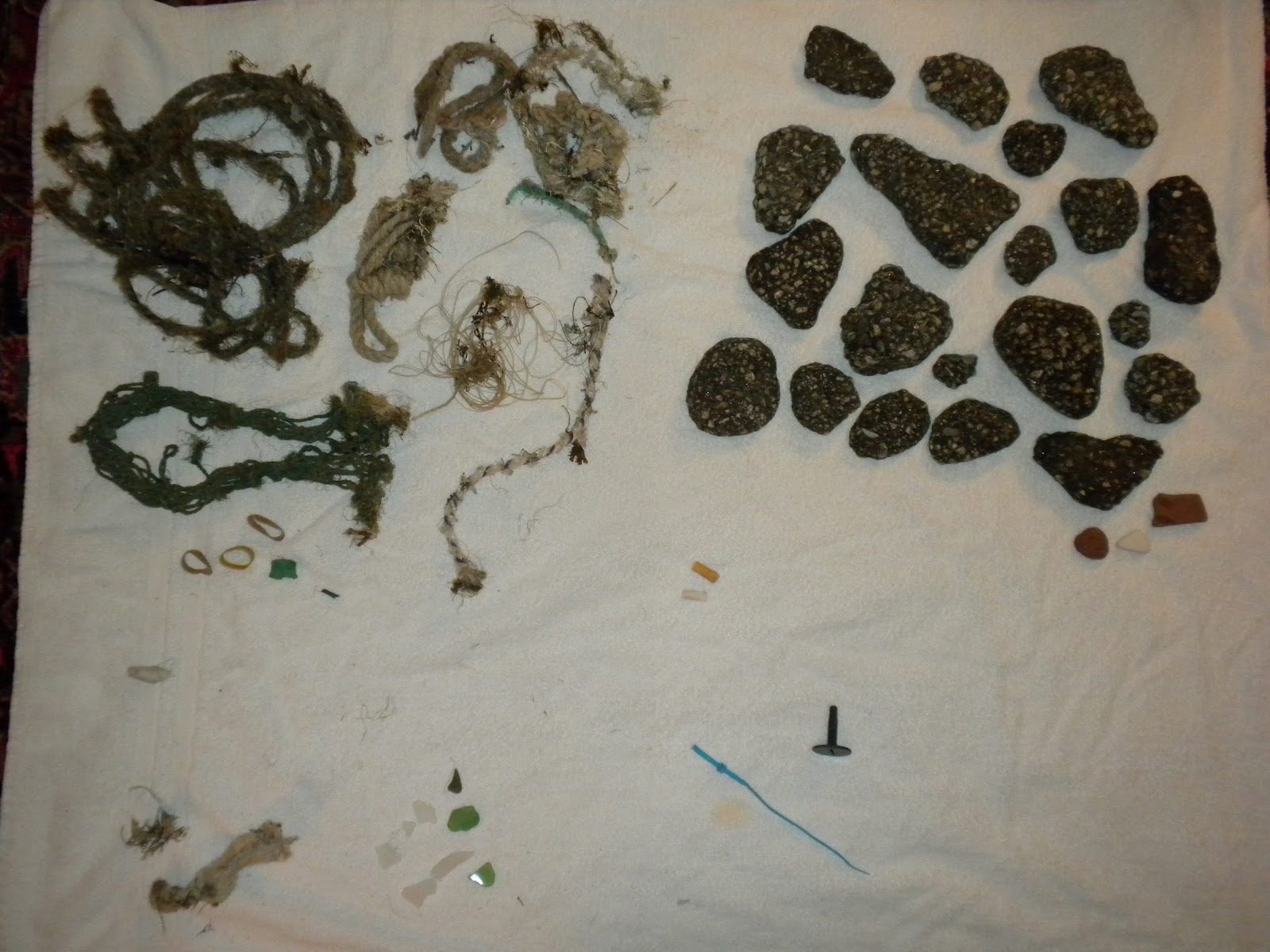
What a world. Anyway, the wracklines were about the same, and the finds among them seemed about the same. So with that prelude, on to them. Zone N:
52 finds:
  • Building materials: 23 (20 asphalt, 2 tile, 1 brick)
  • Foam/Styrofoam: 1
  • Fishing misc.: 13 (7 rope, 4 claw bands, 1 monofilament line, 1 trap vinyl coating scrap)
  • Food-related plastics: 0
  • Food-related metal/glass: 9 (seaglass)
  • Nonfood/unknown plastics: 2 (plastic plug, tieback)
  • Cigarette filters/plastics: 2
  • Paper/wood: 0
  • Misc./unique: 2 (fabric scraps)
Can't pretend there's much interesting here, except maybe the big haul of asphalt.

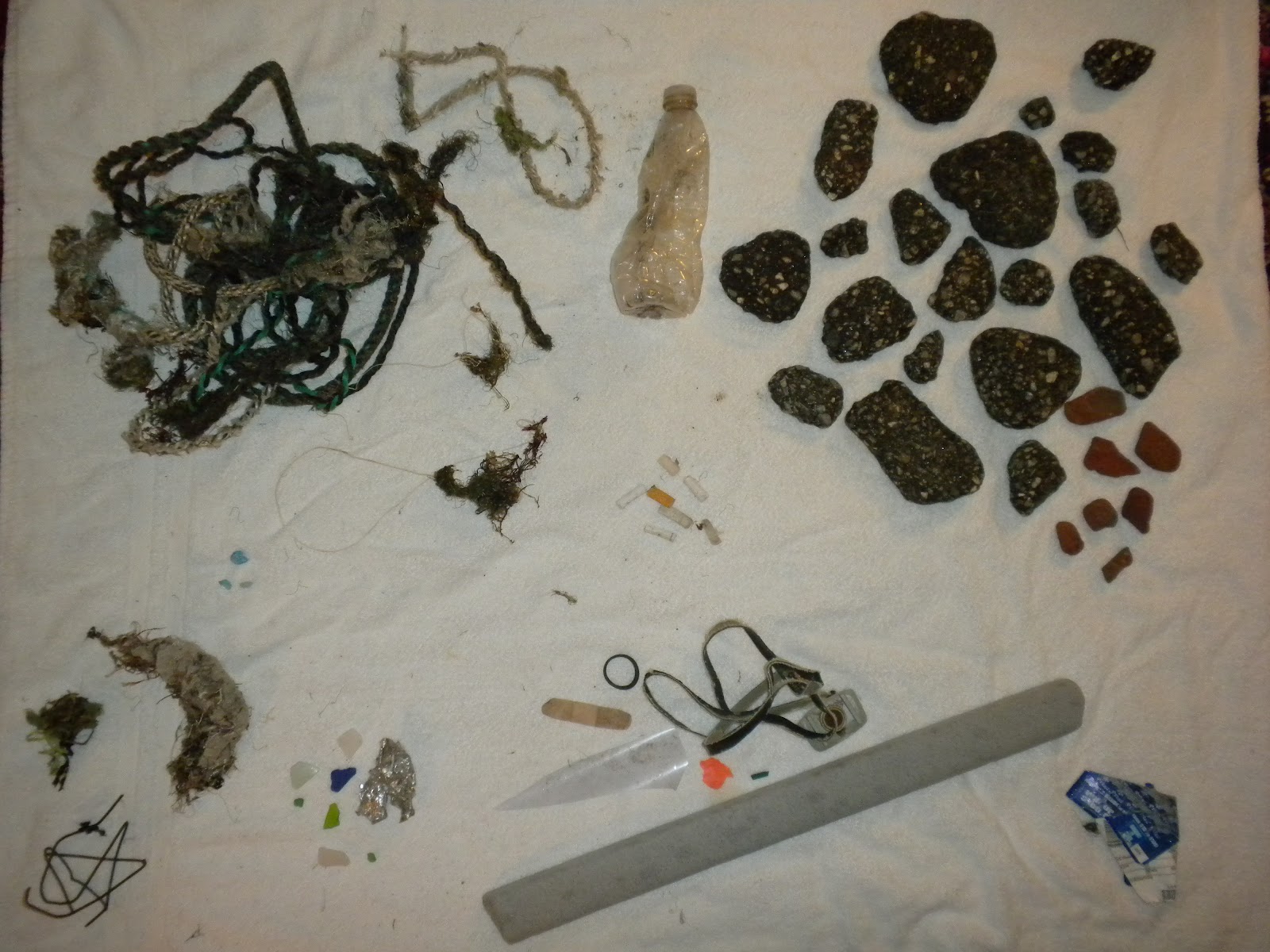
Down to Zone S:
63 finds:
  • Building materials: 27 (7 brick, 20 asphalt)
  • Foam/Styrofoam: 3
  • Fishing misc.: 5 (3 rope - 1 v large, 2 monofilaments)
  • Food-related plastics: 1 (bottle)
  • Food-related metal/glass: 8 (7 sea glass, foil wrapper)
  • Nonfood/unknown plastics: 8 (bandaid, plastic lumber, engine belt, 2 scraps >1", 3 scraps <1")
  • Cigarette filters/plastics: 7
  • Paper/wood: 1
  • Misc./unique: 3 (2 fabric scraps, metal fencing)
The badly tortured plastic bottle still had its cap on, but scrapes on its underside had opened it & filled it with sand. Surely a long-suffering wash-in. As were the very grubby and frayed bits of rope (which I also found in Zone N above). The seaglass was a treat, as it's still rare to find more than one or two, no matter what the sea state.

So a varied week. Dead waves, yet heavy seafloor energy -- heavy enough to bring up asphalt, brick, glass, stone. Curiously, no tubeworm casings. Wherever in the surf zone these little homebuilders live, they escaped the week's fury. As did the densest/heaviest of plastics -- the vinyls. Only one, maybe two examples. The plastic that did wash in was limited to less dense varieties, oddly.

And again, no seaweed. Which is the bellwether. If energy strikes the seafloor where there's sea colander & kelp growing, it churns it up. Along with the plastics stuck amongst it. The two go hand in hand. This week, the energy didn't hit the seaweed zone.

Why does seafloor energy hit different parts of the seafloor in different weeks? The answer seems to be one of the keys in predicting where & how debris will wash in. Oh well. Live and learn.

Thursday, April 21, 2011

Collection Report April 7, 2011

Welcome back to Bay View, Saco, Maine.
April 7, 2011, 9:10AM, 1 hr past low tide
"Welcome," I think?
Springtime!
Deadly algae aside, it was a beautiful, and odd, day. It had been another week of major storms, pounding surf, high seas. The beach slope had steepened noticeably. Big things had happened. Yet I found a grand total of 3 things floated in & beached.
This kelp is one of them
Storm, wave, wind -- nothing is bringing floatables into Saco Bay from the wider Gulf of Maine this spring. Compare that to the storms of Feb/March 2010 that got me started on this whole thing:
Ocean Park, Mar 19, 2010 - live clams & kelp
Back to the present, I've at least learned a key rule: Want to make the ocean laugh? Tell yourself that you know how it works. Prime example from April 7, 2011:
Zone S, the southern, more narrow area of beach
Now that's just weird. No kelp. No seaweed. No seashells. No plastic. Just tens of thousands of rocks & cobbles, neatly assembled into mounds. The northern stretch, Zone N, had lots of strewn rocks. But nothing like down here at Zone S, just 100 feet away. Massive, organized energy had to hit this stretch of beach to do this. And as I alluded in my last post, that energy isn't uniform. It crests & troughs up and down the shore. It's the same energy that carves out Bay View's sandy cusps. This time, it got a little more intense. (Oddly enough, these neat piles of rock didn't square up one-to-one with the cusps above them. Each tide seems to have its own frequency -- its own pattern.)

So, on to the collection. Zone N:
31 finds:
  • Building materials: 20 (15 chunks of asphalt, 3 brick pieces, wooden block, tile with rubberized backing)
  • Foam/Styrofoam: 2 (styrofoam scrap, blue sticky-back foam shape)
  • Fishing misc.: 0
  • Food-related plastics: 1 (chewing gum)
  • Food-related metal/glass: 2 (bottle cap, seaglass)
  • Non-food/unknown plastics: 0
  • Cigarette filters/plastics: 4 (all recently smoked)
  • Paper/wood: 0
  • Misc./unique: 2 (leather shoe sole, scrap of rubberized soundproofing/watershield)
And next, Zone S:
61 finds:
  • Building materials: 57 (40 asphalt chunks, 15 brick pieces, worn flowerpot base scrap, fence post)
  • Foam/Styrofoam: 0
  • Fishing misc.: 0
  • Food-related plastics: 0
  • Food-related metal/glass: 2 (seaglass)
  • Non-food/unknown plastics: 1 (tennis ball)
  • Cigarette filters/plastics: 0
  • Paper/wood: 0
  • Misc./unique: 1
By any angle, this blows the roof off of 10 months of trends. Only the shoe sole floated in. Everything else was local. Even the asphalt & brick. I don't think it was recently dredged up deep at sea. If it had been, the shore would be littered with clams, mussels, snails -- seafloor stuff. My hunch? It's material that's collected over the years down at the low-tide terrace, and is usually buried lightly by sandy outwash. This week, the storms blew away the sand, and blasted the rocks up the slope. In Zone N they scattered willy-nilly. In Zone S, they massed together into little islands. Same beach, same weather, two totally different worlds.
Zone N, low-tide terrace
I love this stuff.