Showing posts with label sand. Show all posts

Thursday, November 7, 2013

Collection Report - October 16, 2013

Wednesday, October 16. 1:30PM. A cpl hrs before low tide. Gray & overcast. No rain. 60 degrees. Slight breeze coming from the north. The back of the backshore was ringed by a mix of summery greens and autumnal oranges/reds. No freeze yet on the coast. Blackening wrack from last week's wash-ins lined the backshore of the beach.
Amid the blackening seaweed was the rotting "cliffs" of white sand at the back of the foreshore, also cut back by the previous weeks. Now aging and showing no new pulverizing.
Yet amid the cobbles on low foreshore, summer's algae blooms were dying back quickly on their exposed rocks. Strong (if low) waves had clearly been carving at them this week, ripping them from all except the largest of cobbles and boulders.

And this day brought me a new find at Curtis Cove:
My first ever sea urchin shell ("test") from Curtis Cove. A nice find.

So, low waves but high energy. What washed in?
25 pcs of rope, about 25 ft total
182 pcs of nonrope debris
207 finds:
  • Bldg material/furniture: 0
  • Foam/styrofoam: 0
  • Fishing rope/net: 25
  • Fishing misc.: 154 (127 lobster trap vinyl scraps, 15 trap parts, trap tag, bait bag, bumper, 5 claw bands, 3 balls of fishing line, o-ring from buoy)
  • Food-related plastics: 4 (cup scraps)
  • Food-related glass/metal: 1 (beer bottle, local drop)
  • Nonfood/unknown plastics: 4 (small scrap of window screen, 2 cords, old abraded button)
  • Scrap plastics: 16 ( 6 > 1" , 10 < 1" )
  • Paper/wood: 0
  • Non-plastic misc./unique: 3 (seaglass)
I found a surprising number of heavy metal lobster trap parts, as well as freshly washed-in rope. I also found lower-than-"normal" counts for trap vinyl coatings. That all points to an ocean changing with the seasons.

On to next week.

Running YTD counts:
  • Total pcs of litter -- 10268
  • Pcs fishing rope -- 1902
  • Vinyl lobster-trap scraps -- 6399

Monday, November 4, 2013

Collection Report - October 8, 2013

Tuesday, October 8. 8:00AM. Just after low tide. Bright tide, low-50s.
This was the day after big, sustained windstorm that ran most of the day on Monday. Evidence for the energy was widespread at the beach. The tides easily overtopped the old summer berms at the back of the foreshore, leaving clumps of large wrack behind.
The pounding surf cut & scoured out a big cliff into the soft sand & cobbles at the back of the foreshore.
The weather left very interesting patterns of sand and rain on the beach. It was obvious where the highest of high tides from mid-da Monday splashed all the way up to the back of the cobbles. These were pelted by rain drops as that tide receded Monday afternoon. But then after midnight Tuesday, when the next high tide came in, the rain had stopped. The winds were lower & the tide didn't reach as far. As it receded there were no more raindrops.
Quite striking to see multiple times & tides etched into the sand, and to be able to read it like a book.

All of Monday's activity, plus the coming cold, seems to have stirred up life at the beach. Down on the low foreshore, crab and snail tracks interspersed with gull footprints:
Higher & dryer on the backshore, another denizen of the dunes:
So with all the changes happening on the beach, and all the energy, what would that mean for the finds?
15 pcs of rope, about 20 ft total
198 pcs of nonrope debris
213 finds:
  • Bldg material/furniture: 0
  • Foam/styrofoam: 0
  • Fishing rope/net: 15
  • Fishing misc.: 163 (149 vinyl lobster trap coating scraps, vent, 2 bait bags, 4 trap parts, 7 claw bands)
  • Food-related plastics: 9 (4 small cup scraps, 2 food wrappers, locally-dropped yogurt tubs, six-pack ring, straw)
  • Food-related glass/metal: 3 (fresh aluminum beer cans, shotgunned)
  • Nonfood/unknown plastics: 9 (3 baggies, latex balloon, long red string, 2 cigarette packaging, umbrella base, fabric swatch)
  • Scrap plastics: 8 ( 4 > 1" , 4 < 1" )
  • Paper/wood: 0
  • Non-plastic misc./unique: 3 (2 sea glass, chunk of aluminum)
A strange day. For one thing, local stuff. Including three spiked-and-shotgunned beer cans:
As expected, big stuff did ride the high waves in. Trap vent, bait bags, chunks of rope. But I was surprised how much lobster trap vinyl there still was amid the masses.

Big day: broke the 10,000-piece mark for my Year 2 at Curtis Cove! And the year's just half over.

Anyway, time moves on and the sea is always changing.

Running YTD counts:
  • Total pcs of litter -- 10061
  • Pcs fishing rope -- 1877
  • Vinyl lobster-trap scraps -- 6272

Wednesday, January 2, 2013

Curtis Cove Report - Dec 15, 2012

Digging out from the Christmas deluge -- figuratively & literally -- to wish you all a Happy New Year! And to publish my last beach reports for 2012.

Saturday, December 15. 1:45PM, bright sun, mild offshore breeze, ~37 degrees. Shortly after high-tide, so I followed the waters down & down as I went back & forth.
Becalmed
The high-tide waters were incredibly calm. They lapped placidly with barely a ripple against the soaked sands. Small wonder why such fine muds and silts drop out of this water -- as well as so many tiny bits of plastic when the conditions were right. Curtis Cove is an amazing place.

Today was a day of velvet sand:
Tumbled & rounded beach stones on the high foreshore:
A totem from a vanished visitor:
And the coolest find, sand volcanoes:
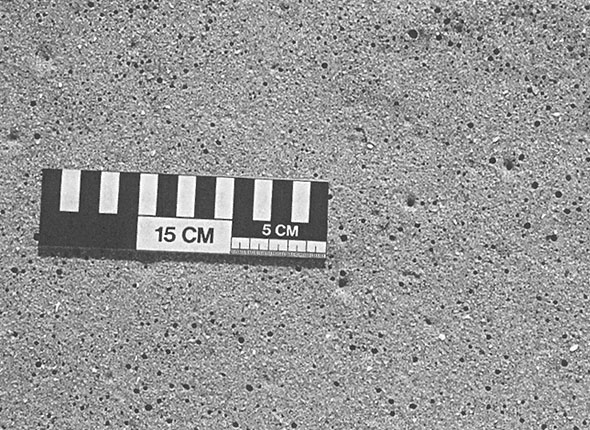
A sandy beach isn't solid, of course. There's actually a lot of space between the sand grains. Water trickles through, organisms make homes, and air percolates -- lots of air. On this morning, the thinnest veil of ice had formed on the sand's surface. By noon, the rising tide with its ~two million gallons of water was squeezing the air trapped within the sand, trying to force it out. Usually this results in thousands of tiny little dots in the sand, "nail holes," where the air rushes out. But this day, the icy sheen resisted the onslaught. Finally the air pressure built up so much that it bulged the sand up in hundreds of pockmarks before finally exploding through and out the top.

Nature is amazing.

Though I spent an hour+ watching the tide slowly recede, I couldn't get down to the lower foreshore where so much plastic gets left behind on calm pleasant days like this. So my haul was light:
81 pcs of rope, about 90 ft total
28 pcs of nonrope debris
109 finds:
  • Bldg material/furniture: 0
  • Foam/styrofoam: 0
  • Fishing rope/net: 81 (most found amid the high wrack)
  • Fishing misc.: 12 (4 bait bags, 3 trap bumpers, 3 trap vinyl coating scraps, 1 trap part, 1 trap tag)
  • Food-related plastics: 3 (bottlecap, skewer, cup scrap)
  • Food-related glass/metal: 2 (aluminum can bottoms-modern)
  • Nonfood/unknown plastics: 7 (3 packaging scraps, endpiece/coverplate, strap, plug/cap, brittle tube)
  • Scrap plastics: 3 ( 2 > 1" , 1 < 1" )
  • Paper/wood: 0
  • Non-plastic misc./unique: 1 (small fabric scrap)
I'm not sure how much more I would have found at the low foreshore. With low-tides running before dawn and after dark this week there wasn't much hope finding out.

Still, this turned out to be very much the calm before the storm. Wait til you see the photos from December 24.

Running YTD counts:
  • Total pcs of litter -- 11469
  • Pcs fishing rope -- 2891
  • Vinyl lobster-trap scraps -- 4691

Monday, December 31, 2012

Bookends

Two pieces of environmental news moved me the most this past year. Serendipitously, one occurred as the year began, the other as it ended.

In January, I came across an astonishing photo in a travelogue blog of Kuta Beach, Bali:
Source: http://www.changesinlongitude.com/
kuta-beach-bali-trash/
Bali, paradise on Earth, has no infrastructure for dealing with its resorts' tonnage of plastic waste. That waste just gets pitched into the sea, as has been traditional on Bali for centuries. Unfortunately, now it comes back. Worse, it's accepted. The sunbather in this picture -- for her, the fight already seems lost. Her world is one of waste & filth, and she nestles down amid it, to enjoy what she can of her surroundings.

The second "bookend" to my year came just a few days ago. A story I stumbled upon about an extremely rare gingko-toothed beaked whale that washed up in the Philippines.
Source: https://www.facebook.com/pages/D-Bone-
Collector-Museum-Inc/216407245052538
This whale is so rare that in the past 55 years precisely two have been spotted in the Philippines. Including this one. It died from a ~6-foot piece of plastic fishing rope lodged in its digestive tract. (Series of photos here; some of the necropsy. Fascinating but graphic, use discretion.) Basically, it starved.

It's all the same problem: connecting our actions on one day & place with outcomes that may be far away & a long time coming. Deluging developing nations with plastic products... A global fishing industry that loses countless tons of plastic gear daily... These actions have consequences, costs. And we're not paying them.

We're still just running up the environmental credit card. It will come due.


The Flotsam Diaries is often a study in manmade ugliness. And it's true, humans, alone in the world, have the capacity to utterly wreck our planet.

But, as far as we know, we are also the only ones who can appreciate that planet. No other creature sits on a lawn and admires the pinks and violets of an incredible sunset, for its own sake. No other species will visit a vacant seashore, sands sun-sparkled and smooth -- freshly washed by an outgoing tide -- and see it not in terms of threats or opportunities of the moment, but in awe. Only we can ponder footsteps of the past, and of the future, and truly know something of our place in this tiny moment of time & space that we each call ours.
So in spite of the ugliness, the Flotsam Diaries continues joyfully into 2013. Because the world is still a beautiful place, worth fighting for. And folks the world over know it.

Peace, and humble appreciation for all of your support and passion and kind words over the years.

Saturday, December 15, 2012

The Living Shore

Today at Curtis Cove, I saw a rare treat:
Air volcanoes! (Or more prosaically, "blisters.)

The sand piled up on any given beach isn't a static, solid block. It's utterly filled with spaces and gaps. When the tide goes out, the water that had been in those gaps is replaced by air from the atmosphere. When the tide comes back in, that air has to go somewhere. As the tide rises and the water table at the beach rises, the air gets compressed and forced upward. Usually it escapes easily, leaving thousands of tell-tale "nail holes" dotting the sand just behind the high-tide line:
From: http://coastalcare.org/educate/exploring-the-sand/
But in some conditions, the air can't escape so easily. If the surface of the sand is very fine, smooth, undisturbed, it can become "cemented" by salt crystals (or kissed by frost) -- making a (largely) impermeable sheet. The air becomes compressed, and actually forces & bulges its way upward as each wave slams against the shore. Eventually it bursts through in more pronounced nail holes, and leaves the blistered landscape behind.

Beaches -- and the science of beaches -- are amazing things.

For a great read on things you can look for at your beach, check out "Exploring the Sand" from CoastalCare.org and Dr. Orrin Pilkey.

Thursday, November 29, 2012

Curtis Cove Report - Nov 10, 2012

Saturday, November 10. 1:45PM, just past low tide. Beautiful slack water, with barely a ripple kissing the soft mud at the lowest foreshore.
A week now after Superstorm Sandy, and the high foreshore was still a cliff of wrack, wrack, and wrack.
But much of the storm's cast-up sand and mud was oozing back toward the sea. Burying many of the low foreshore cobbles, and leaving ephemeral beauty in its wake.
Higher up the slope, other things were left.
This was a week of high-energy waves meeting a steepened beach face, and the two trying to work out some new meeting of minds. Most of the debris had been dumped & pushed high up onto the foreshore, and was big & bulky like that SOLO cup. Very little small stuff managed to settle out, high or low.

Here's what I found:
124 pcs of rope, about 250 ft total
57 pcs of nonrope debris
181 finds:
  • Bldg material/furniture: 1 (toilet seat rim)
  • Foam/styrofoam: 0
  • Fishing rope/net: 124
  • Fishing misc.: 21 (10 bait bags, 5 trap tags, 3 trap parts, vent, bumper, vinyl coating)
  • Food-related plastics: 14 (old, dragged bottle, bottle cap, cap o-ring, cap seal, cap scrap, 3 PS cup scraps, 3 food wrappers, cookie tub, spoon)
  • Food-related glass/metal: 1 (bottlecap)
  • Nonfood/unknown plastics: 11 (7 baggies/scraps, sleeve/grommet, 2 strapping, crate seal)
  • Scrap plastics: 9 (6 > 1" , 3 < 1" )
  • Paper/wood: 0
  • Non-plastic misc./unique: 1 (fabric scrap)
This is the signature of a beach still in the grip of Sandy's aftermath. It's not the amount of debris, but the size of the pieces. And it's not the usual dense seabottom flecks, but lighter, bulkier, buoyant material hurled over the distant rocks at the head of the cove. 77% directly related to the lobstering industry. More of the Gulf of Maine's lasting legacy.

Running YTD counts:
  • Total pcs of litter -- 10667
  • Pcs fishing rope -- 2487
  • Vinyl lobster-trap scraps -- 4564

Monday, June 25, 2012

Collection Report May 30, 2012

Down to wire for Year 2 at Bay View. This installment: Wednesday, May 30. Noon. 60 degrees. Foggy, overcast skies.
I missed the previous week due to rain, rain... And in the interim, Memorial Day weekend had come and gone! Still, the beach didn't look that different. There was the same old wrack line of dried-out organics. Same steep shoreface. Dunegrass encroaching & spreading as it has all year. Sand cusps from the beached sandbar high & pronounced. Basically, all just as it had been all spring.


With a few exceptions -- signs that Memorial Day had in fact come and gone. Such as (1) The return of the Bait Tank cigarette butt bin:
(2) Buried beer bottle bingo:
(3) Flotsam forts:
(4) Thoughtless chain-smokers at the "thinking log":
(5) And a new found toy for the collection:
All proof that the lazy days of winter and spring were past, and unofficial summer had begun. Despite the cold & damp of the day. So what was left behind in the sands? Zone N:
116 finds:
  • Building materials: 0
  • Foam/Styrofoam: 59
  • Fishing misc.: 0
  • Food-related plastics: 15 (bottle, 4 bottlecaps, bottlecap o-ring, 4 food wrappers, 3 straw wrappers, 2 candy wrappers)
  • Food-related metal/glass: 2 (bottle, foil wine bottle top)
  • Nonfood/unknown plastics: 61 (3 packaging scraps, tape, string/cord, 2 scraps >1")
  • Cigarette filters/plastics: 24 (23 cigs, 1 packaging)
  • Paper/wood: 8 (paper scraps)
  • Misc./unique: 1 (swiffer cloth)
A local, summer signature. Except... so much foam. No idea where it all came from. Because looking at it, it's a little bit of everything! Insulation, coffee cups, coolers, squishy foam toys, clamshell packs... Just, everything. Some certainly washed/blown in. Portland, Maine is now considering banning styrofoam in the city. From my experience the past couple of years, I think it's high time.

On to Zone S:
66 finds:
  • Building materials: 1 (asphalt)
  • Foam/Styrofoam: 53
  • Fishing misc.: 0
  • Food-related plastics: 1 (candy wrapper)
  • Food-related metal/glass: 3 (glass jar, jar lid, foil)
  • Nonfood/unknown plastics: 3 (watergun plug, 2 scraps <1")
  • Cigarette filters/plastics: 5
  • Paper/wood: 0
  • Misc./unique: 0
The glass jar was a half-full jar of pasta sauce. Random! And then there's all the foam & styrofoam here too. Tons of it. Including many of the same-looking bits as Zone N, and bits that had clearly been nipped & pecked by wildlife (fish? crabs? seagulls?):
Not just ugly. Far worse than just being ugly.

So there we have it. May 30. Winter is over. Tourists are back, at least a little. Time circles back around. And the beach tells the tale.

Wednesday, July 7, 2010

Soda Can Experiment Update - July 7, 2010

So you may recall that I've found lots of corroded and rotted aluminum cans at the beach. And that I started an experiment to see if I could recreate the conditions that cause a can to rot. My last update was more than 3 weeks ago, so I wanted to drop another quick post.

A really quick post. What's changed in 3 weeks?
Not a lot.

New corrosion may be happening, but it's going so slowly that there's nothing really to show.
My hunch is that the exposed metal has oxidized, leaving very little surface area of fresh aluminum to react with the salt and corrode.

Thus, another rethink (or perhaps "threethink" at this point). I was so busy narrowing things down that I think I lost sight of the forest. The beach isn't one event, it's a system. It's sand, wind, salty air, wet times when the tide comes in, starkly dry times when it goes out. People kicking things around, burying them. It's dynamic, unpredictable. It's not a can sitting in a bucket of water on a countertop for a month.

So, my rethink: Make a soda can experience real beach conditions. A can should be drunk, crushed, shaken around in wet sand, shaken around in dry sand, tumbled, rolled, exposed to bright light, buried. Only by doing that will I be able to say whether it was a beach environment that causes a can to rot like those that I've collected.

More to follow!

Tuesday, June 1, 2010

Soda Can Experiment Update - The Plot Thickens

So it's been a week since I started my aluminum-can-in-seawater test. An update seems in order.
(Tues. June 1, 2010, 8:00PM)

I know, I know. I started with two cans and suddenly there are three! Explanation following. First, the originals: The left container is just seawater (refreshed once) and ginger ale can. There is no noticeable change to the water or the can. The middle is seawater (also refreshed once), ginger ale can, and iron nails -- working on the evidence that seawater helps iron to erode aluminum. This can too seems unchanged.

Back on 5/28 I thought about this, and did some more research. It turns out that aluminum cans are coated inside and out at the factory -- there's no aluminum actually exposed to the elements. So to truly test why the cans at the beach are so rotten and eroded, I had to think how nature could expose the aluminum.

Didn't actually have to think hard. Presumably, a beach is sandpaper at its most pure. Add some scouring action from wind & waves, and it's a fair guess that a soda can will have its outer coating scraped away naturally (though again, exactly how long is unknown). So I helped the process along with a third can, using a bit of fine (180 grit) sandpaper to expose some (but not all) of the actual aluminum.
Then I dunked this can in seawater with iron nails as a second test subject. It's now been sitting for 4 days straight (the far right can in the first picture above). So far, it's unclear if there's any change in it. It feels like it -might- be thinner & weaker when I touch it, but that may just be from the sanding. So the fun continues!

My prediction is that Can #1 (no iron) and Can #2 (iron & unsanded) will not change much even given weeks or months. Can #3 (iron & sanded) is what will make or break this test.

(Dating note: As of today, 6/1, the first two subjects are on Day 8 (having finished 7 days), and the third subject is on Day 5 (having finished 4 days). My notation for that is "Day 8-5," which is a system I'll keep until the experiment ends.)