Showing posts with label Saco Bay. Show all posts

Monday, July 9, 2012

Collection Report June 23, 2012

Saturday, June 23, 2012. 8:00AM Bay View beach, Saco, Maine.
Summer in Maine, back again
This day marked a very big milestone -- the completion of my second full year studying Bay View! Though there is much to reflect on, for now, into the collection.

The fierce storm of June 3 was already fading from Bay View's mind.
Much of the advance line of dunegrass survived; later tides & winds quickly resculpted the shore to brush over the erosion & damage. In fact, the storm & outwash actually created a nice, long flat terrace between the dunegrass & foreshore. The perfect place for summer crowds to pitch their tents. Nature is a marvel.

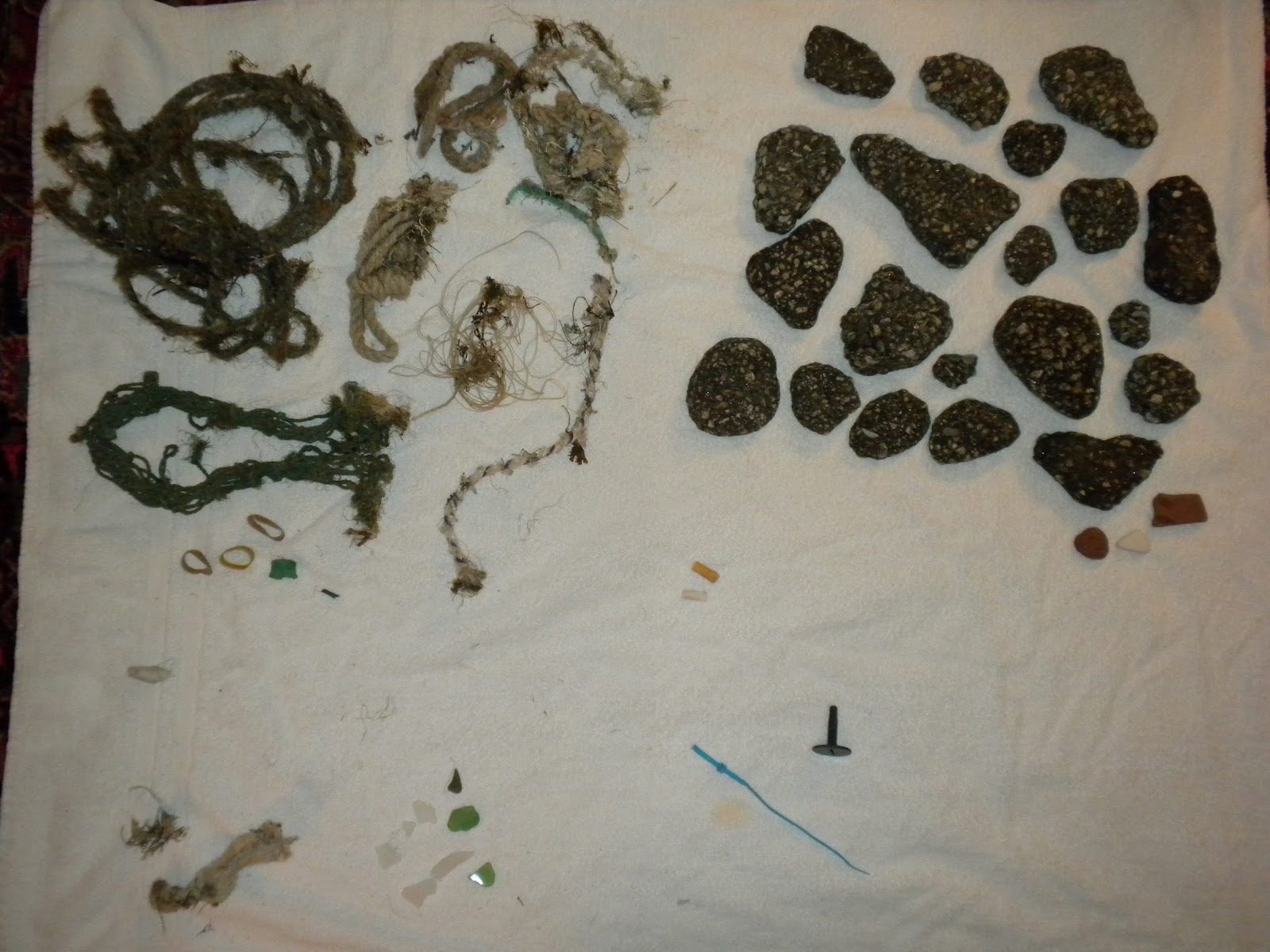
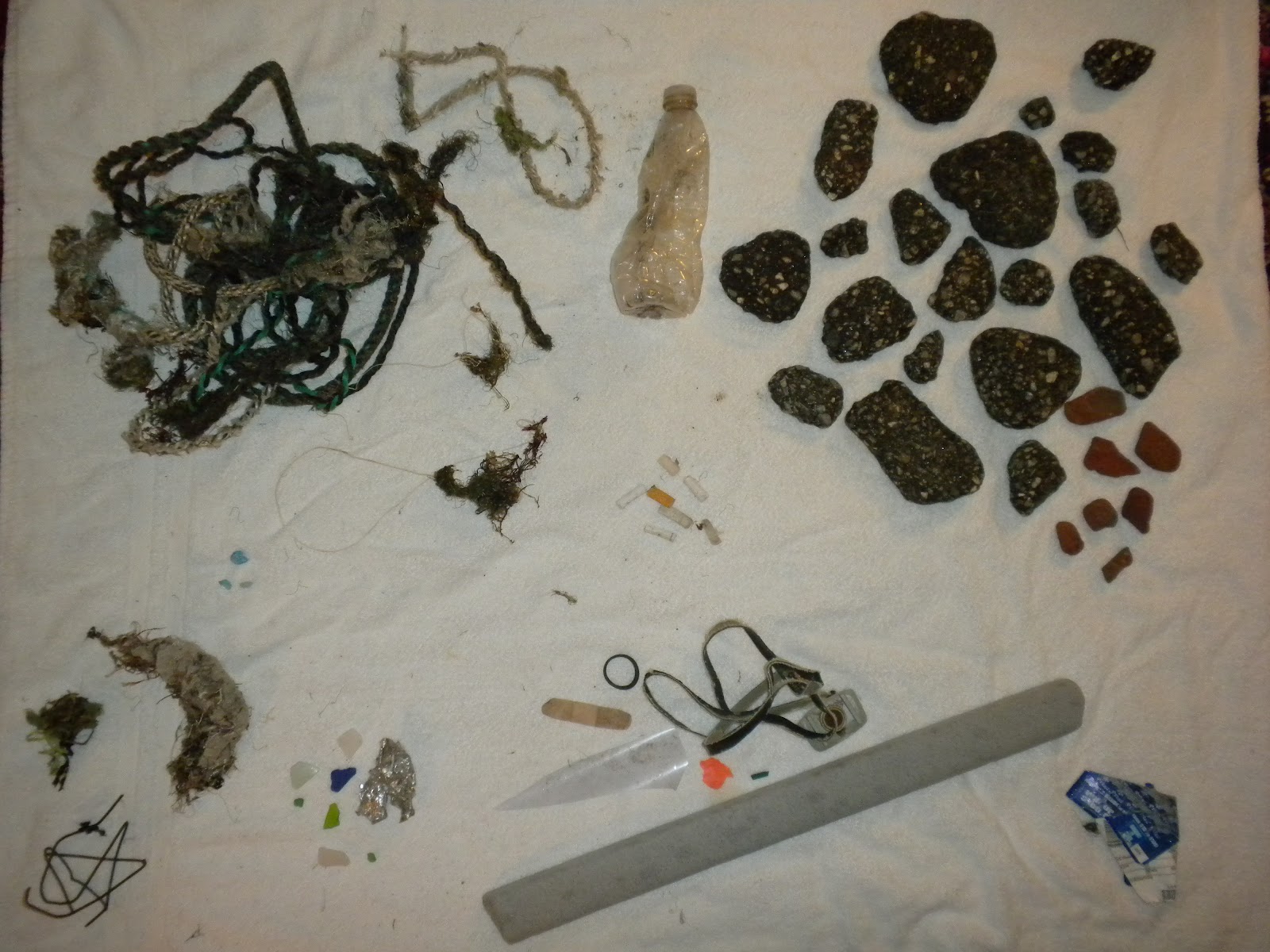
Speaking of summer crowds, they're back. The trash signature proved that. Zone N:
138 finds:
  • Building materials: 0
  • Foam/Styrofoam: 10
  • Fishing misc.: 6 (4 rope, claw band, trap tag)
  • Food-related plastics: 20 (2 bottles, 4 bottlecaps, 2 cup-top scraps, 11 food wrappers, straw)
  • Food-related metal/glass: 10 (bottle, bottlecap, 8 pcs foil)
  • Nonfood/unknown plastics: 34 (8 plastic bags/baggies, hairclip, 4 scraps <1", bucket handle, 2 figurines, sand rake, 2 lightsticks, shovel handle, 9 plastic packaging, lubricating oil tube, black tape, strapping, tarp scrap, mesh)
  • Cigarette filters/plastics: 34 (32 filters, 2 packaging)
  • Paper/wood: 22
  • Misc./unique: 2 (fabric scraps)
Yes, the summer crowds are back. And as always, they congregate at Zone N, leaving the southern area much freer of debris. Zone S:
49 finds:
  • Building materials: 0
  • Foam/Styrofoam: 7
  • Fishing misc.: 4 (rope, trap scrap, trap tag, shotgun shell)
  • Food-related plastics: 9 (bottle, 3 bottlecaps, 4 food wrappers, straw)
  • Food-related metal/glass: 3 (can, 2 sea glass)
  • Nonfood/unknown plastics: 12 (baggie, 3 balloons, balloon ribbon, bleach bottlecap, 3 scraps >1", 2 scraps <1", nonfood packaging)
  • Cigarette filters/plastics: 9
  • Paper/wood: 4
  • Misc./unique: 1 (fabric)
No surprises here. This is the debris that beachgoers leave at a sunny, summery beach. I saw it in summer 2010. And summer 2011. And now summer 2012. How many more summers, until we finally change the game?


And there we are. Full circle, again. Two summers, two falls, two winters, two springs. 14,000 pieces of trash, Hurricane Earl, TS Irene, the December Storm of 2010, and June's no-name beast. Ice crystals, sand dollars, rivulets, beach cusps. Dog walkers, wrack lines, sea glass, dunegrass. Sand bars, beached boat, demolished convent, seal carcass.

Bay View has been such an eye-opening place. It taught me that in a plastic world, there is no "away." Yet now I find that lesson coming home to roost about 5 miles south, at Curtis Cove. Where there are no tourists, but there's more garbage per foot than the worst day that Bay View threw at me. So much more to learn, and to share.

For the moment, I leave Bay View to rest, though probably to return now & then. Curtis Cove will keep me -- and sadly generations after me -- plenty busy.

Monday, June 25, 2012

Collection Report May 30, 2012

Down to wire for Year 2 at Bay View. This installment: Wednesday, May 30. Noon. 60 degrees. Foggy, overcast skies.
I missed the previous week due to rain, rain... And in the interim, Memorial Day weekend had come and gone! Still, the beach didn't look that different. There was the same old wrack line of dried-out organics. Same steep shoreface. Dunegrass encroaching & spreading as it has all year. Sand cusps from the beached sandbar high & pronounced. Basically, all just as it had been all spring.


With a few exceptions -- signs that Memorial Day had in fact come and gone. Such as (1) The return of the Bait Tank cigarette butt bin:
(2) Buried beer bottle bingo:
(3) Flotsam forts:
(4) Thoughtless chain-smokers at the "thinking log":
(5) And a new found toy for the collection:
All proof that the lazy days of winter and spring were past, and unofficial summer had begun. Despite the cold & damp of the day. So what was left behind in the sands? Zone N:
116 finds:
  • Building materials: 0
  • Foam/Styrofoam: 59
  • Fishing misc.: 0
  • Food-related plastics: 15 (bottle, 4 bottlecaps, bottlecap o-ring, 4 food wrappers, 3 straw wrappers, 2 candy wrappers)
  • Food-related metal/glass: 2 (bottle, foil wine bottle top)
  • Nonfood/unknown plastics: 61 (3 packaging scraps, tape, string/cord, 2 scraps >1")
  • Cigarette filters/plastics: 24 (23 cigs, 1 packaging)
  • Paper/wood: 8 (paper scraps)
  • Misc./unique: 1 (swiffer cloth)
A local, summer signature. Except... so much foam. No idea where it all came from. Because looking at it, it's a little bit of everything! Insulation, coffee cups, coolers, squishy foam toys, clamshell packs... Just, everything. Some certainly washed/blown in. Portland, Maine is now considering banning styrofoam in the city. From my experience the past couple of years, I think it's high time.

On to Zone S:
66 finds:
  • Building materials: 1 (asphalt)
  • Foam/Styrofoam: 53
  • Fishing misc.: 0
  • Food-related plastics: 1 (candy wrapper)
  • Food-related metal/glass: 3 (glass jar, jar lid, foil)
  • Nonfood/unknown plastics: 3 (watergun plug, 2 scraps <1")
  • Cigarette filters/plastics: 5
  • Paper/wood: 0
  • Misc./unique: 0
The glass jar was a half-full jar of pasta sauce. Random! And then there's all the foam & styrofoam here too. Tons of it. Including many of the same-looking bits as Zone N, and bits that had clearly been nipped & pecked by wildlife (fish? crabs? seagulls?):
Not just ugly. Far worse than just being ugly.

So there we have it. May 30. Winter is over. Tourists are back, at least a little. Time circles back around. And the beach tells the tale.

Wednesday, May 9, 2012

Collection Report April 25, 2012

Wednesday, April 25. 9:15AM. 55 degrees, bright sun, hour after low tide. Had been away for two weeks, as I spent the previous week visiting The Mouse with the family. First missed week on-site since June last year! So, what would the extra week's worth of tides bring in the way of flotsam?
This, and... well, not a lot more. This can was actually among the most interesting finds of the day. More on why down below. But as you can see by this shot...
...the beach was again a clean slate. The little wrack that did exist (mostly in Zone N) was old, dried reeds from 2011 still rolling around:
I've gone on for some months about the changes at Bay View over the past year. But with spring now "sprung," this image tell the story the best:
In an age of global sea-level rise and beach loss, the dunes at Bay View are actually advancing. 20 feet down the beach slope just in the past year! That can only happen if the energy of the sea lets it happen. A few bad waves, and you get this:
The energy coming in here is just weaker than it was a year ago. Waves aren't making it as high up the slope. And they're carrying far less detritus -- natural and manmade -- than before. The best logic behind this is that the seafloor is shifting. Sand bars have reared their heads at Bay View during very low tides. Natural buffers, absorbing the fury of the ocean -- and blocking seafloor debris. For how long? Don't know.

But for now, they cause this result. Zone N:
31 finds:
  • Building materials: 4 (asphalt)
  • Foam/Styrofoam: 4 (3 foam scraps, 1 cup bottom)
  • Fishing misc.: 0
  • Food-related plastics: 3 (2 wrappers, 1 straw)
  • Food-related metal/glass: 2 (can, can scrap)
  • Nonfood/unknown plastics: 6 (2 toys, tennisball, package scrap, 2 scraps <1")
  • Cigarette filters/plastics: 11
  • Paper/wood: 1 (paper scrap)
  • Misc./unique: 0
A few locally lost toys for my daughter's collection. A few scraps. A few thoughtless smokers. A rotted can...

Quickly over to Zone S:
9 finds:
  • Building materials: 0
  • Foam/Styrofoam: 2
  • Fishing misc.: 3 (fishing line, shotgun shell, shell wadding)
  • Food-related plastics: 1 (bottlecap)
  • Food-related metal/glass: 0
  • Nonfood/unknown plastics: 0
  • Cigarette filters/plastics: 2
  • Paper/wood: 1 (bedpost finial)
  • Misc./unique: 0
A bedpost finial? Really?

So the game here has changed. But back to that aluminum can.
You've surely seen those enviromentalist site lists, showing how long things take to break down:
If you say "It takes 200 years for an aluminum can to break down!" and I can find one that's rotting away after ~6 months, you risk losing me for everything else you try to say. We all love round numbers; but we're a little more partial to our own eyes.

Sunday, April 1, 2012

Collection Report March 19, 2012

Monday March 19, 11:00AM. An hour or so after high-tide. After a ridiculously warm weekend, signs of a heavily used beach.
Augh.

Yet in spite of the disaster at the can, the beach itself weathered the onslaught well.
Another ridiculously weak tide:
Barely made it up the slope
And another dead, glassy sea:
Smooth enough to skate on
But a few items still managed to beach:
Vent released from derelict lobster trap
This vent is made of polyethylene or polypropylene -- light plastic that floats easily on the sea. The little fresh wrack that I found also was mostly floatable, with air bladders to stay on top of the ocean. Light plastic & light wrack -- both rare at Bay View this winter, but here this week. Is it because the air warmed so much that the difference between it and the chilled seawater is firing up internal waves? Sending energy through the ocean even when it's not visible on the surface? I wish I understood the mechanics better. At any rate, something's changed this week.

On to the count. Zone N:
50 finds:
  • Building materials: 14 (8 asphalt chunks, 4 brick, 2 roof tiles)
  • Foam/Styrofoam: 3
  • Fishing misc.: 6 (rope, trap tag, 3 vinyl trap scraps, claw band)
  • Food-related plastics: 4 (3 wrappers, old knife)
  • Food-related metal/glass: 2 (2 can scraps)
  • Nonfood/unknown plastics: 10 (balloon, golfball, packaging, makeshift funnel, wallet insert, 3 scraps >1", 2 scraps <1")
  • Cigarette filters/plastics: 6 (4 filters, 2 packaging)
  • Paper/wood: 4 (3 scraps, 1 packaging)
  • Misc./unique: 1 (grotty fabric/clothing)
Given the 70-degree weekend, the "local" plastic finds are really low. Even the knife was a wash-in.
Biofouling
Not sure how long that knife kicked around the sea. But most likely since at least the last good beach day of 2011. Plastic silverware is #6 plastic -- polystyrene that sinks gently in seawater. So the energy coming in to Bayview was both surface & seafloor energy this week.

Now down to Zone S, where a few other interesting things washed in:
49 finds:
  • Building materials: 7 (6 asphalt chunks, 1 roof shingle)
  • Foam/Styrofoam: 2
  • Fishing misc.: 21 (2 rope, trap vent, 15 vinyl trap scraps, trap tag, shotgun shell, very old claw band)
  • Food-related plastics: 0
  • Food-related metal/glass: 6 (3 can scraps, 1 sea glass, 2 foil wrappers)
  • Nonfood/unknown plastics: 7 (baggie, packaging, large tire scrap, 2 rubberbands, tubing, 1 scrap >1")
  • Cigarette filters/plastics: 5
  • Paper/wood: 0
  • Misc./unique: 1 (leather offcut)
The trap vent floated in on top, as did the trap tag. The large chunk of rubber tire may also be fishing-related, perhaps as part of a bumper on the side of a boat.

And there was a whole batch of vinyl scraps from lobster traps along the wrackline. Vinyl is quite dense and sinks to the bottom of the ocean, so rolled & bounced its way up to shore. And this stuff is insidious.
As these scraps break down smaller & smaller, they bounce in front of animals with smaller & smaller brains, and are no doubt eaten by them. Vinyl is toxic to make, toxic to burn, and no doubt toxic inside a gut. At the untouristed cove I also study about 5 miles away, this is what greets me in the tide pools at low tide:
One of these things is not like the others...
Each lobster trap can shed 1,000 of these bits as it rusts away. With at least half a million derelict lobster traps likely on the seafloor, the number of vinyl scraps we, our kids, and our great-grandkids will have to deal with is staggering.

The beach is different every week I visit it. Yet one thing's is constant. In nearly two years of beachcombing the same exact shoreline, the number of times that I've come away with zero pieces of manmade litter: Zero.

Monday, March 12, 2012

Collection Report Feb 13-15, 2012

February 13, 2012. 2PM, an hour or so before high-tide. Yet another bright, sunny day. A very cold morning, so I left my collection bags at home, figuring everything would be iced hard to the ground. I figured wrong.
No ice here!
Oh well. I stuck around to survey the landscape. There had definitely been energy here, at least judging by the pebbles sculpted & blasted up onto the beach face. But...
Lake Placid?
...Where on earth was that energy? All the way out to the horizon, the sea surface on this day was as glazed and dead as it's been all winter.

The answer is fairly simple. The energy's been where it's been all winter, when it's been around at all. On the seafloor. The swash zone (where the high tide waves break and splash up the slope) was littered with shell, pebbles, gravel -- all heavy, dense seafloor debris.

What isn't typical about this week is one way that energy manifested itself on the 13th:
The artist at work
The ocean has cast up pebble mounds before. But always in even rows, spaced consistently down the beach. Never one massive headland of cobbles and pebbles sitting all on its own! Yet again, nature amazes.

At any rate, given the lack of bags on my person on the 13th, I came back on the 15th. About 9:45AM, an hour after low-tide. In one sense the view was the same:
This actually is a different pic from the first,
look at the tide!
In another sense it was quite different:
That's where the rock pile was two days before;
by the 15th, blown utterly out of existence
What a world. Anyway, the wracklines were about the same, and the finds among them seemed about the same. So with that prelude, on to them. Zone N:
52 finds:
  • Building materials: 23 (20 asphalt, 2 tile, 1 brick)
  • Foam/Styrofoam: 1
  • Fishing misc.: 13 (7 rope, 4 claw bands, 1 monofilament line, 1 trap vinyl coating scrap)
  • Food-related plastics: 0
  • Food-related metal/glass: 9 (seaglass)
  • Nonfood/unknown plastics: 2 (plastic plug, tieback)
  • Cigarette filters/plastics: 2
  • Paper/wood: 0
  • Misc./unique: 2 (fabric scraps)
Can't pretend there's much interesting here, except maybe the big haul of asphalt.

Down to Zone S:
63 finds:
  • Building materials: 27 (7 brick, 20 asphalt)
  • Foam/Styrofoam: 3
  • Fishing misc.: 5 (3 rope - 1 v large, 2 monofilaments)
  • Food-related plastics: 1 (bottle)
  • Food-related metal/glass: 8 (7 sea glass, foil wrapper)
  • Nonfood/unknown plastics: 8 (bandaid, plastic lumber, engine belt, 2 scraps >1", 3 scraps <1")
  • Cigarette filters/plastics: 7
  • Paper/wood: 1
  • Misc./unique: 3 (2 fabric scraps, metal fencing)
The badly tortured plastic bottle still had its cap on, but scrapes on its underside had opened it & filled it with sand. Surely a long-suffering wash-in. As were the very grubby and frayed bits of rope (which I also found in Zone N above). The seaglass was a treat, as it's still rare to find more than one or two, no matter what the sea state.

So a varied week. Dead waves, yet heavy seafloor energy -- heavy enough to bring up asphalt, brick, glass, stone. Curiously, no tubeworm casings. Wherever in the surf zone these little homebuilders live, they escaped the week's fury. As did the densest/heaviest of plastics -- the vinyls. Only one, maybe two examples. The plastic that did wash in was limited to less dense varieties, oddly.

And again, no seaweed. Which is the bellwether. If energy strikes the seafloor where there's sea colander & kelp growing, it churns it up. Along with the plastics stuck amongst it. The two go hand in hand. This week, the energy didn't hit the seaweed zone.

Why does seafloor energy hit different parts of the seafloor in different weeks? The answer seems to be one of the keys in predicting where & how debris will wash in. Oh well. Live and learn.

Thursday, March 1, 2012

Collection Report Feb 6-7, 2012

Monday, Feb. 6, 3:30PM. Low-tide. Brilliant late sun with its long shadows:
A whole lot of bright blue sky, and a whole lot of nothing else. The only thing to see was a dry "wrack" line of landborne reeds. The final gasp of the large sand-dump from two weeks before lay as a very faint sandbar just seaward from the foreshore. Otherwise, the beach was back to normal. No rocky strewn-field, no starfish, no tube-worm casings by the thousands. Just soft sand spread along from dune to terrace.

A lovely day for a walk, but dismal for collecting flotsam.

On a hunch, I stopped by again Tuesday. The difference a day makes. Noon, an hour past high-tide. Mostly cloudy, 40s again, slight onshore breeze, and another weak, low high-tide line. But... fresh seaborne wrack!
Overnight the Bay dumped a batch of fresh, seafloor "sea colander."
See? It sinks
All winter long there has been nothing floating into Bay View. Everything that gets kicked up is from different parts of the seafloor. In that regard, this week was the same as the past two months. But at least this week some combination of magic churned up the seabed and dragged in a few things of interest from the watery grave. First, Zone N:
78 finds:
  • Building materials: 9 (7 brick, 2 asphalt)
  • Foam/Styrofoam: 25
  • Fishing misc.: 9 (5 rope scraps, 2 clawbands, lure bag scrap, shotgun shell wadding)
  • Food-related plastics: 6 (2 bottlecap o-rings, 2 Solo cup scraps, food wrapper, fork)
  • Food-related metal/glass: 1 (can scrap)
  • Nonfood/unknown plastics: 17 (plastic glove, swiffer scrap, 2 toy scraps, battery/cartridge cover, silk flower, toggle weight ?, 5 scraps >1", 5 scraps <1")
  • Cigarette filters/plastics: 10 (9 cigarettes, 1 packaging)
  • Paper/wood: 0
  • Misc./unique: 1 (fabric swatch)
A lot of foam, but none of it showed signs of sea voyage. Probably bits and pieces blown in from up and down the shore, out of garbage cans or freed from dunes. The other, non-foam plastics showed signs of being ocean-borne. And like I said, they were all dense, sunken plastics tossed up from the seabottom.

Zone S:
30 finds:
  • Building materials: 9 (6 asphalt, wood offcut, tile, concrete)
  • Foam/Styrofoam: 6
  • Fishing misc.: 2 (rope scrap, bait bag)
  • Food-related plastics: 4 (bottlecap o-ring, 3 food wrapper scraps)
  • Food-related metal/glass: 1 (can)
  • Nonfood/unknown plastics: 5 (balloon w/ string, 2 large vinyl upholstery scraps, 2 scraps >1")
  • Cigarette filters/plastics: 0
  • Paper/wood: 1
  • Misc./unique: 2 (cloth strip, leather offcut)
Those upholstery scraps were some of the most brutalized, tortured pieces of vinyl I've ever seen. Whatever their story, I'm sure it's a doozy.

Still, flotsam-wise there really is no comparison between Winter '11 and Winter '12. The same can be said weather-wise. Are the two related? Does warmer air shut down the systems that normally drag thousands of bits of plastic into the bay? Does less snow/rain = less river runoff = changed circulation patterns? I don't know. But it's worth looking into.

Wednesday, December 28, 2011

Collection Report Dec 12, 2011

Monday, December 12. 1:42 PM, chilly & bright with a dazzling low sun, and a light breeze from the SW. A little more than an hour after high-tide -- if it could actually be called "high tide." The tideline was barely above the terrace, a sign of a remarkably feeble & low-energy week.
The weak waves preserved a slightly trampled message from the night before.
Ryan + Harry. Awwww...
A nice display of youthful enthusiasm, the perfect tonic to my first beach collection as a middle-aged 40-year-old! I wish good things to Ryan & her Harry.

As expected, cold skies & subdued tides brought in only the slightest flotsam. So why did one of the few pieces have to be another one of these?
Enough already!
Down to the numbers. Zone N:
28 finds:
  • Building materials: 6 (3 asphalt, brick, tile, fence slat)
  • Foam/Styrofoam: 5
  • Fishing misc.: 3 (rope)
  • Food-related plastics: 3 (1 bottlecap o-ring, 2 food wrapper scraps)
  • Food-related metal/glass: 2 (can scrap, sea glass)
  • Nonfood/unknown plastics: 2 (tampon applicator, 1 scrap >1")
  • Cigarette filters/plastics: 7
  • Paper/wood: 0
  • Misc./unique: 0
It seems that November's beachings combined with December's weak waves have left Bay View with a little breathing room. More weeks like this would be nice!

On to Zone S:
6 finds:
  • Building materials: 1 (asphalt)
  • Foam/Styrofoam: 0
  • Fishing misc.: 3 (2 scraps of lobster trap vinyl coating, claw band)
  • Food-related plastics: 0
  • Food-related metal/glass: 1 (sea glass)
  • Nonfood/unknown plastics: 0
  • Cigarette filters/plastics: 1
  • Paper/wood: 0
  • Misc./unique: 0
Yes. More weeks like this would be nice.

I'm writing this on December 28, a couple weeks after the fact. Last night a major gale blew through southern Maine, knocking over a few smaller trees and toppling recycling bins & trash cans. I wonder what the beach looks like right now?

Wednesday, November 9, 2011

Collection Report Oct 31, 2011

Monday, Oct. 31, 11:00AM. Sunny skies, calm (if chilly) air. Just one day after a very wacky storm.
We actually got off comparatively light here in coastal Maine. Seabreezes kept much of the snow at bay, and quickly melted what did land. But the storm still left its mark. The beach felt like quicksand -- saturated gravel squished underfoot; the heaviest of the gravel slumped down the foreshore and collected at the base of the low-tide terrace. Deep briny pools formed just in front.
Alien landscapes
The weekend's weather brought a carpet of odd flotsam, especially from the sea floor...
Razor clams, slipper shells, and wrack
Of course, amid the shell, wood, rock, and wrack, plenty of bits that had no business being there.
Somewhere, a lobster trap lies rusting 
More than plenty. A beach load. Zone N:

155 finds:
  • Building materials: 20 (8 asphalt chunks, 7 brick, 2 tile, 2 wood, roof shingle scrap)
  • Foam/Styrofoam: 29
  • Fishing misc.: 25 (6 rope, 3 claw bands, 14 vinyl trap coating scraps, 2 rope twine)
  • Food-related plastics: 9 (bottle, 2 bottle caps, "Red Devils" cup scrap, 3 food wrappers, gum, knife)
  • Food-related metal/glass: 5 (bottle cap, 3 sea glass, foil wrapper)
  • Nonfood/unknown plastics: 33 (cap, flip-flop, glove, 2 firecrackers, shoe-rack hook, Hooksett disc, 7 scraps >1", 19 scraps <1")
  • Cigarette filters/plastics: 28 (27 filters, Skoal pack)
  • Paper/wood: 2
  • Misc./unique: 4 (wire, cloth, leather swatch, sock)
The spike in asphalt & brick is telling. Usually deeply buried by sand on top, the week's weather left many chunks exposed. The flip-flop and soda bottle speak of local action. But this odd, discolored retail-store shoe hook doesn't.
This one's a first
Here's a wild one. A faded ketchup packet. Unused & unopened, just roughed up; the ketchup is long gone, replaced by wet sand. Surely washed in from the deep, where it had spent ??? months/years.
Would you like fries with that?
And any time dense vinyl scraps like this float in, you know the seas are agitated. Vinyl sinks, so this one spent plenty of time scraping along the seafloor before reaching Bay View.
Seat cover, maybe?

Zone S was odd this time. Usually void of much of Zone N's richness (both natural & manmade), this day it was chock-a-bloc with razor clams, snail shells, slipper shells, and a prominent wrackline. Here's what came out of it:

79 finds:
  • Building materials: 15 (6 asphalt, 4 roof shingle scraps, 5 brick)
  • Foam/Styrofoam: 15
  • Fishing misc.: 10 (rope scrap, shotgun shell, 2 claw bands, 5 vinyl trap coatings, rope twine)
  • Food-related plastics: 1 (gum)
  • Food-related metal/glass: 4 (Schlitz can top, 2 sea glass, foil)
  • Nonfood/unknown plastics: 20 (balloon w/ long string, 3 caps, 3 package scraps, tape measure case, glasses earpiece, tennis ball, o-ring, 2 scraps >1", 7 scraps <1")
  • Cigarette filters/plastics: 11
  • Paper/wood: 0
  • Misc./unique: 3 (leather sole fragment, 2 fabric scraps)
Still less than Zone N, but in a season where 20-30 Zone S finds is the norm, finding 79 is worth noting. Also worth noting is one particular piece.
Go for the gusto!
This is the aluminum top to a steel beer can, an old-style pull-tab Schlitz beer can. In fact, some research showed that this style was only used from 1972 to 1975. The Gulf of Maine harbored this little piece of the past for at least 36 years. Until finally releasing it back to the light.

What else awaits in the deep?