Digging out from the Christmas deluge -- figuratively & literally -- to wish you all a Happy New Year! And to publish my last beach reports for 2012.
Saturday, December 15. 1:45PM, bright sun, mild offshore breeze, ~37 degrees. Shortly after high-tide, so I followed the waters down & down as I went back & forth.
 |
| Becalmed |
The high-tide waters were incredibly calm. They lapped placidly with barely a ripple against the soaked sands. Small wonder why such fine muds and silts drop out of this water -- as well as so many tiny bits of plastic when the conditions were right. Curtis Cove is an amazing place.
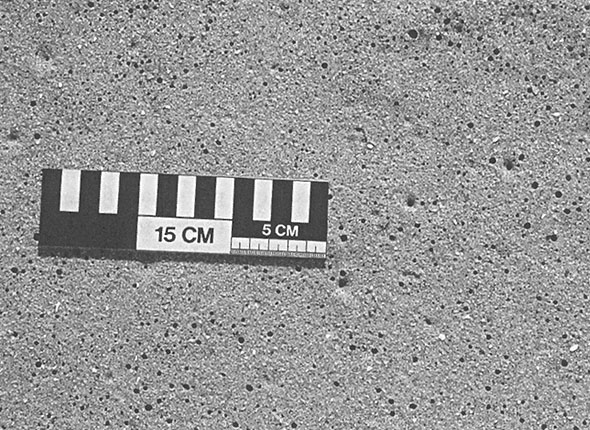
Today was a day of velvet sand:
Tumbled & rounded beach stones on the high foreshore:
A totem from a vanished visitor:
And the coolest find, sand volcanoes:
A sandy beach isn't solid, of course. There's actually a lot of space between the sand grains. Water trickles through, organisms make homes, and air percolates -- lots of air. On this morning, the thinnest veil of ice had formed on the sand's surface. By noon, the rising tide with its
~two million gallons of water was squeezing the air trapped within the sand, trying to force it out. Usually this results in thousands of tiny little dots in the sand, "
nail holes," where the air rushes out. But this day, the icy sheen resisted the onslaught. Finally the air pressure built up so much that it bulged the sand up in hundreds of pockmarks before finally exploding through and out the top.
Nature is amazing.
Though I spent an hour+ watching the tide slowly recede, I couldn't get down to the lower foreshore where so much plastic gets left behind on calm pleasant days like this. So my haul was light:
 |
| 81 pcs of rope, about 90 ft total |
 |
| 28 pcs of nonrope debris |
109 finds:
- Bldg material/furniture: 0
- Foam/styrofoam: 0
- Fishing rope/net: 81 (most found amid the high wrack)
- Fishing misc.: 12 (4 bait bags, 3 trap bumpers, 3 trap vinyl coating scraps, 1 trap part, 1 trap tag)
- Food-related plastics: 3 (bottlecap, skewer, cup scrap)
- Food-related glass/metal: 2 (aluminum can bottoms-modern)
- Nonfood/unknown plastics: 7 (3 packaging scraps, endpiece/coverplate, strap, plug/cap, brittle tube)
- Scrap plastics: 3 ( 2 > 1" , 1 < 1" )
- Paper/wood: 0
- Non-plastic misc./unique: 1 (small fabric scrap)
I'm not sure how much more I would have found at the low foreshore. With low-tides running before dawn and after dark this week there wasn't much hope finding out.
Still, this turned out to be very much the calm before the storm. Wait til you see the photos from December 24.
Running YTD counts:
- Total pcs of litter -- 11469
- Pcs fishing rope -- 2891
- Vinyl lobster-trap scraps -- 4691