Showing posts with label downcycling. Show all posts

Thursday, March 17, 2011

Deconstructing a Greenwash

Amid the tragedy unfolding in Japan this week, a press release from PepsiCo caused some buzz.
Full text at: http://www.pepsico.com/PressRelease/PepsiCo-
Develops-Worlds-First-100-Percent-Plant-Based-
Renewably-Sourced-PET-Bott03152011.html
Sounds wonderful. Plant-based packaging! Great, right? That's about as "green" as it gets?

No. Not even close. Let's deconstruct this.

Claim #1: This "enable[s] the company to manufacture a beverage container with a significantly reduced carbon footprint."

Reality: According to the plastics lobby itself, the natural gases used to make plastic are a byproduct of petroleum drilling/refining. By not capturing these gases as plastic, instead they'll either be flared off or burned as another fossil fuel. Sourcing plastic from plant matter does not appear to lower the amount of fossil fuels currently being drawn from the earth or reduce the carbon footprint of production.

Claim #2: "PepsiCo's 'green' bottle is 100 percent recyclable and far surpasses existing industry technologies."

Reality: The plastic made by this new process is #1 polyethylene terephthalate, the same exact #1 plastic that currently goes into these bottles. As explained in the "Triangle Is a Lie" trilogy, #1 plastic recycling is a downward spiral. Walk down your neighborhood grocery aisle. Look at all the #1 bottles of soda/water/juice. Find -one- that says "Made Using Recycled PET." Recycling a plastic bottle back into a food-worthy mirror of itself is extremely hard, because of contamination and the breakdown that happens to PET when it is crushed, remelted, and remolded. Recycling a "plant-based" PET bottle doesn't change this. For every single bottle of PET bought, 100% new virgin PET usually has to be created to replace it on the shelf. Plastic recycling is not a closed loop. It was never meant to be. It only offers a very cheap feedstock for recyclers (mostly in developing nations) who want to create lower-quality products from the free labor of citizens who recycle.

Claim #3: "By... using its own agricultural scraps as feedstock for new bottles, this advancement should deliver a... win for the environment."

Reality: PepsiCo wishes to take organic plant material and turn it into plastic. Switchgrass, pine bark, corn husks -- and eventually orange peels, potato peels, and oat hulls. All of these are compostable materials -- materials that can break down back into the building blocks needed to renourish depleted soils. But instead of maintaining a healthy and natural soil cycle, Pepsi wants to strip much of these building blocks away from nature and turn them into nondegradable plastic, which will persist in the environment for centuries or millennia. If it's ecologically unfriendly to use fossil fuels as plastic, it is folly to use nature's own perfect fertilizers as plastic.

Pepsi is correct about one thing, however. This is a momentous achievement. Because it now means that, even if some future society has been able to wean itself completely from fossil fuels, companies will still be able to keep churning out all the plastic our oceans can handle.

Business as usual.

Sunday, December 5, 2010

The Downward Spiral, or "The Triangle is a Lie"

Becoming a Flotsam Diarist has meant opening my eyes. Even when what I see makes me want to close them again.

Most of the man-made debris that washes up at Bay View beach is plastic. The reason is simple.

Look at this.
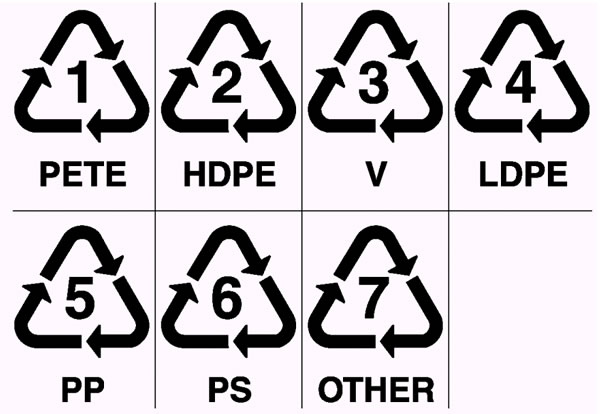
from http://crossplastics.com/domestic_recycling_symbols.shtml
Wonderful isn't it? Makes it look like plastic recycling is a closed loop. You pitch your jug or wrapper into the recycling bin, the truck hauls it off, and it's renewed.

Sadly, it's not true. Because of this.
From http://www.fda.gov/Food/FoodIngredientsPackaging/
FoodContactSubstancesFCS/UCM155197
This is a "Letter of No Objection" (LNO) from the U.S. Food & Drug Administration. Want to recycle plastic into food packaging? You need this letter. It's extremely valuable, and extremely rare.

Why? Contamination. Take your #1 plastic juice bottle. #1 plastic is the sturdiest and most easy/cheap to fully recycle.* Yet to recycle one into another food-grade #1 plastic bottle requires:
  • Separating out all other plastics before remelting. One stray #6 plastic out of 1,000 is enough to contaminate the lot.
  • Cleaning the plastic to remove all food/waste/oil/toxin residue.
  • Sorting all the strains of #1 plastic to avoid contamination.
  • Running the cleaned material through the FDA's gauntlet.
  • Finally, finding a distributor willing to buy the expensive product.
How much plastic actually meets strict recycling standards? Look for yourself. Walk down a grocery aisle. Look at all the plastic packaging. How much do you see that says "X% post-consumer recycled (PCR) material"?
Row upon row of plastic
I thought so.

2.54 million tons of virgin #1 plastic are made each year in the U.S. alone. In 2009, the world's largest #1 bottle-to-bottle recycler opened in Spartanburg, SC. One day it may turn 50,000 tons of #1 plastic back into food-grade recycled material. That's two percent. If we're lucky.

What happens to the rest? Downgraded, downcycled into junkier items, ultimately landfilled. And new, virgin #1 plastic must be created to keep up with the demand.

Take a different plastic, #4 film. The stuff in grocery bags. In 2008, the U.S. produced 7 billion lb. of #4 plastic. Even after 20 years of recycling initiatives, only 12% was recycled. Worse, only 4% of that 12% actually gets turned back into any kind of new film.
image copyright: American Chemistry Council
http://www.americanchemistry.com
The rest goes into deck materials, downgraded plastic uses, or is shipped overseas.** From there, into landfills - or the ocean.
Grocery bag on the beach
This means that, out of the 7 billion lbs of #4 made each year, one-half of one percent will become film again. The next year, 6.95 billion more lbs of virgin #4 plastic will be brought into the world to keep up with demand. And the next year. And the next year...

**************************************

The story is the same from #1 to #7. The vast majority of plastics can only be recycled once, maybe twice, before becoming worthless. What's stocking the aisles of your grocery store, big-box retailer, etc.? Almost all virgin plastic.*** Almost every bottle you recycle? Replaced by another virgin-plastic bottle, which is added to an already overloaded world.

There's hype about plastic recycling. And then there's the truth: Every year, the U.S. plastic industry adds 50 million tons of new plastic to the world. The only way that plastic will die is in the fires of an incinerator. The only way.

So when you dutifully place that milk bottle or HandiSnacks wrapper in the recycling bin, remember, it's almost certainly going on a one-way trip. It will, one way or another, either end up in a landfill, or your local stream, or the ocean, before it is done.
Just look down, you'll find it
Why is there so much plastic soup in the oceans? On the beach? In the gutters? In the ditches? In our bloodstream?

Because the triangle is a lie.


* Though generally considered safe, it's also traditionally been made with been found contaminated with BPA, a man-made chemical now found in the bloodstreams of 90% of humans. Its possible toxicity is gaining more & more attention. Which is another story, and another post.

** The American Chemistry Council loves to talk up the value of plastic recycling. Look for their symbol on many recycling Web sites. Also look for them as sponsors of recycling initiatives nationwide. But their own fact sheets dispell the myth. 50+% of recycled #4 plastic was sold to developing nations in 2008. Many have much lower standards for their plastics and permit very contaminated plastics to be melted together and used in food packaging. Each grocery bag you recycle may be poisoning a family somewhere on the other side of the world.

*** Don't believe the spin that this is from the waste by-products of oil refining. It's made from the same kinds of natural gas that are being harnessed and used as energy the world over. It could find a perfectly good non-plastic life.