Thursday, February 24, 2011

Acidification and Disintegration, Part II

Yesterday, I set up the issue: the ocean is increasingly acidic, thanks to ever more CO2 in the atmosphere. It's already affecting creatures as far away as Antarctica, and is decimating the wild oyster in the northwest U.S.

Learning this, and how natural carbonic acid in rain dissolves beached shells, I decided to do an experiment of my own. Just what does an acid really do to a shell, and how long does it take? Plus, with all the plastic waste swirling in the ocean, how might ocean acidification affect plastics?

So off to work I went. First, the ingredients:
Distilled white vinegar, 2 Atlantic surf clams, 1 blue mussel,
1 #4 plastic, 1 #5 plastic, 1 #6 plastic, and unk plastic bucket
As mentioned before, the pH scale measures acidity/alkalinity, 0 being most acid, 14 being most alkaline, 7 being neutral. Pure water should have a pH of 7. By mixing with CO2 in the air, rainwater tends to have a pH of about 5.6. What's the pH of distilled white vinegar? Anywhere from 2.0 - 3.4. The best way to tell? Test it yourself:
The litmus test
Seems suppliers might be a little bit cheap with the vinegar these days - the paper looks more like 4.0 than 3.4. Still, 3.4 is very mild -- about as acidic as an apple. (Lemon juice is 2.3, a can of Coke is 2.5.) Certainly nothing dangerous to a person. But what about a shellfish? Let's see. Here's the moment I first put all the ingredients into the bucket:
Instant reaction
Like Alka-Seltzer in a glass of water, the shells immediately started reacting with the vinegar.

A quick word about seashells. As, say, a clam is growing, it develops a thin "skin" around its outside, called the periostracum. It's like a tiny membrane that wards off the outside world - including weak acids. But it's delicate, fragile, and usually worn away as the creatures lurch back and forth in tides, or burrow into the gritty sand on the seabed. In most cases, periostracum will not help a mature bivalve fend off an acid attack.

Back to the experiment. I poured enough vinegar into the bucket to cover the shells. Twice a day, I fished out the larger of the two surf clam shells and photographed it. Each morning I topped off the vinegar, and I replaced the vinegar twice through the length of the experiment. The pH of the solution ranged anywhere from ~3.4/4.0 to about 6.0 depending on how fresh the vinegar was. Here's what happened:
Start of experiment --
shell intact, periostracum worn in places
After 1 day -
periostracum darkened, bubbling
After 2 days
After 3 days
After 4 days
After 5 days
After 6 days
After 6 1/2 days
After 7 days
After 7 1/2 days
That's it. Gone. After just over a week, the Atlantic surf clam that had been half a foot long... is gone. In fact, all 3 of the shells I put in were gone. Leaving nothing behind but shreds of their empty skin. What do you think happened to all the various plastics? Long-time followers of the Flotsam Diaries will hardly be surprised by the answer:

Of course the oceans aren't predicted to drop to a pH of 3.4. Or even 6.0. They don't have to. The tiniest drop, from 8.1 to 7.8, causes a cascade of crises - some shellfish devote so much time to building & repairing their shells that they don't have the energy to devote to muscles, movement, immune systems, or procreation. A drop of just .2 killed half the copepods in a test group in a week. One chilling experiment showed that a drop of .4 killed 99.9% of a species of brittlestar larvae in 8 days.*

This isn't a small problem, or a made-up issue. This is reality, happening now. These are foods not only eaten by people, but are also the base foods for many of the other major foods we eat.

But who knows. Creatures have adapted before -- though it took them millennia, not decades. Perhaps they'll be able to get their energy from the plastics swirling in the water. Because, as we all know, plastic is forever.
Day 7 1/2 - The end


* See this Scientific American article of August 2010 for these and many other examples.

Wednesday, February 23, 2011

Acidification and Disintegration, Part I

Anyone who's strolled a beach has seen signs of nature's recycling all around them.
Kennebunk Beach, Maine
Sand & wave help wear shells down, sure. But the most important agent of recycling is carbonic acid. Surprisingly, all rain is mildly acidic. As raindrops pass through the air, they smack into CO2 molecules and create a very weak carbonic acid.

Seashells are made up of calcium carbonate, an alkali. When an acid and an alkali get together, they react. A rained-on seashell slowly disintegrates. In months or years, that shell will completely dissolve away, releasing the building blocks for new organisms. It's been the way of the world for at least 570 million years.

So what?

Simple. Most shelled creatures need an alkaline world, acid kills them. You've heard of the pH scale: 0 to 14, 0 is most acidic, 14 is most alkaline, 7 is neutral. Historically, the ocean's average pH was 8.179. Today, it's 8.069. Doesn't sound like a big change. But that's a 28.8% increase in the concentration of hydrogen ions (the things that make an acid acidic), in just 250 years. It's all because there's more CO2 in the air. Acidic rain, combined with mixing of air & surface ocean water, is driving down the pH of the oceans. Antarctic ice cores show that CO2 levels are higher now than they've been in at least 800,000 years.

Shelled sea organisms make their shells by creating calcium carbonate. Acids attack and destroy calcium carbonate. As the pH of the ocean sinks, shelled creatures will have a harder & harder time creating and keeping the shells they need to survive. It's happened before. It's happening now. Good luck finding a wild oyster in the waters off the NW U.S. They haven't bred for 6 years now, thanks to a local pH of about 7.7. That's right. An ancient animal -- and major food source -- can no longer survive in its ancestral waters.

This isn't some "Children of Men" dystopian future. This is now.

With all this in mind, a couple weeks ago I started a little experiment to show just what happens to a seashell in an acidic world. For fun, I decided also to show what happens to plastics in an acidic world.
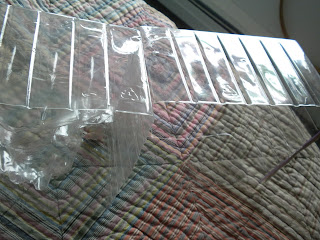
2 surf clams, 1 blue mussel, 1 #4 plastic,
1 #5 plastic, 1 #6 plastic
It was eye opening.
Recycling


Wednesday, February 16, 2011

Crossroads

I've never lived farther than an hour from the ocean. Among my earliest memories are long, lazy days digging in the sand at Colonial Beach, Virginia. From there, through adolescence in Florida, young adulthood in Massachusetts, and now parenthood in Maine, it's part of who I am. I will probably always live near a shore. Especially now that I've rediscovered it through my daughter's eyes.

Yet for all that, it never seemed, well, "precious." I mean, the ocean just -is-. Right? The crash of surf and tickle of spray and scent of salt and visions of sand and shell and seaweed have always carried one beyond the workaday world. Beyond oneself. That's been the eternal way of things.

Then, on March 8, 2010, I went to the beach. I looked down at my feet. And on that day, something changed inside me.
30 minutes on a quiet Maine beach in winter
Ever since, I've been learning -- and growing -- in directions I'd never before considered.

I know that:
* I can hold 640 million years in a handful of Maine sand.
Half of all the oxygen I breathe was created in the ocean.
* The deepest place in the world is 36,000 feet below the waves.
* That place holds life.
* Treasures on the shore come in all shapes and sizes.
* The ocean now teems with things never seen in its 3.8 billion yrs.
* The garbage patch isn't as big as Texas. It's as big as the ocean.
* Despite "recycling," industry adds 50M tons of new plastic each yr.
This number is growing.
* My world runs on stuff used 10 minutes & persistent 10 lifetimes.
* The shore is no longer an escape from the workaday world.
* The workaday world poisons the globe's most remote paradise.
* It poisons my own beach.

And, ultimately, I know that this knowledge has changed me.

Hence the crossroads. The Flotsam Diaries started as a spark of indignance. One man angry about one beach on behalf of his one young daughter. It's grown into an understanding of scope & scale beyond my imagining. Of the raging power & beauty of nature. Of its fragility. Of its importance. It's taken dark turns that have made me re-evaluate things I've been taught to believe for years.

And I'm forever grateful for it.

Last March, I took the red pill. And there's no going back. Now I have to decide what the Flotsam Diaries will mean, going forward. I believe we're here to make a difference. And, somehow, I know this is a place where I can make a difference.

What do you want your child to see when you visit
the beach one sunny morning on the edge of Spring?

Thursday, February 10, 2011

Collection Report Feb 5, 2011

Finally! After 2+ weeks of single-digit weather and multiple snowstorms, Saturday, Feb 5 gave a tiny window for beachcombing. In the morning the ground was frozen. At noon it was high-tide. But now, at 3:30PM, just before dusk, I had a chance.
The drifts by the dunes were easily 2 ft high
For the first time since Jan. 14 it (a) wasn't storming and (b) was above freezing! I opened a bag and started trolling. The conditions seemed right for finding more washed-up bits & bobs:
Where there's pulp, there's plastic
But just about then, Mother Nature turned mean. Again. We had been promised an "evening storm." (Which is one reason I wanted to get out and get this collection done while I could.) Well, the evening storm started at -- you guessed it -- 3:30PM.
Really?
The race was on. Every flake of snow was sticking, obscuring the view. I rushed through Zone N because I just couldn't abide another lost week. It wasn't thorough, but at least it was something. Sadly, by the time I got to Zone S, this was the view:
Hopeless
Foiled again. Admitting defeat, I went grumpily home.

Then I got good news. Things were looking up for the next day. It was supposed to be sunny and warmer. A clear sun might melt that snow, and I could pick up where I'd left off. So I came back on a bright, 36° F morning at 9:30, low tide. And the sun was already melting the snow. In fact, it was turning out to be the nicest day we'd had in weeks. A fact not lost on several other Mainers:
36 degrees?? Beach party!!!
I found a parking spot in the remarkably busy lot, and triumphantly reached the shore. And then I saw this:
Footprints in exchange for flotsam
Where did all those lines of debris go!? Out with the overnight tide. It had been what I've dubbed a "Scour Tide." Through the mystical mechanics of tide height, air temperature, wind, and wave energy, the ocean literally stripped back everything from the surface of the beach, like a natural Zamboni. Up and down the shore, all that remained was clean sand and footprints. Oh, and one piece of debris, far down at the water's edge:
A bone was thrown
It was a very short trip. There was, quite simply, almost nothing to see. I apologized to Mother Nature for believing I'd gotten the best of her. I know now: she always wins. Nonetheless, I had managed to collect a bit before the snows & scouring came. Here's Zone N:
71 finds:

  • Building materials: 2 (chunk of asphalt, grooved wooden limb/leg)
  • Foam/Styrofoam: 0
  • Fishing misc.: 37 (rope bit, 2 trap bumpers, 3 monofilaments, 3 "rope guts", scrap of net, trap vent with net attached, long trap frame base (not collected, photo taken), 9 claw bands, 16 bits of lobster trap vinyl coating)
  • Food-related plastics: 4 (2 cap seals, twist-tie, Bud Light label)
  • Food-related metal/glass: 7 (4 can scraps, bottlecap, 2 sea glass)
  • Non-food/unknown plastics: 19 (inc. bag, J-hook, Johnson & Johnson cap, rubber ball scrap, Xmas tree scrap, vinyl upholstery scrap, brush scrap, hinged/hooked clear plastic thing, umbrella base, bead (?), balloon)
  • Cigarette filters/plastics: 0
  • Paper/wood: 0
  • Misc./unique: 2 (cord, small stamped leather scrap)

It's not all that was there, I know. But it's all I could do. Still, it tossed out a few head-scratchers.
J-hook pipe hanger
Brutalized plastic (I think!) brush end
Odd trap/net arrangement
(For more finds pictures, check out the Flotsam Diaries Facebook page.)

Zone S was... well, interrupted:
11 finds:

  • Building materials: 0
  • Foam/Styrofoam: 0
  • Fishing misc.: 4 (1 monofilament with textile attached, 3 vinyl trap coatings)
  • Food-related plastics: 1 (Heineken label)
  • Food-related metal/glass: 2 (sharp bottle scraps)
  • Non-food/unknown plastics: 3 (rubber band, two tiny hard scraps)
  • Cigarette filters/plastics: 0
  • Paper/wood: 0
  • Misc./unique: 1 (scrap of leather)

Annoying. Still, from even this stunted "collection" there was one interesting item:
Monofilament fishing line w/
towel/shirt scrap attached?
And there we go. 82 finds from between Jan. 14 and Feb. 6. Sounds nice & low. Almost... "clean." But as the pictures show, it's all about the tides (and ice). What was there on Saturday was gone on Sunday. It may have been back Monday. I'll never know. What will be there when next I return? Nobody knows. All I know is, there will be something.

And probably, someone.
Like I've said, there is no off-season

Saturday, February 5, 2011

Collection Report Jan 14, 2011

Friday, January 14, 11:30AM. Brrr!
Brr..
This day was calm, and very peaceful. Almost no wind at all, and the tide was out. But a big Nor'easter had come through on Wednesday 1/12, and left its mark.
Snow strata and bowed grass
Sand-snow-sand sandwich
And wait. Something's missing. All that kelp from the Christmas storm. My first hunch was that the storm had swept much back to sea. After all:
Look, a carpet of debris clearly
being swept back to sea*
Then again, a few kicks at the sand-ice layer cake higher up revealed:
Fresh kelp, buried & frozen solid
So, what would I find? As always, questions led to answers, which only led to more questions. A quick look at tide-line showed plenty of plastic bits. But a few kicks up in the ice banks showed more bits of plastic buried & locked up tight. Anyway, enough build-up. On to the collection. Here's Zone N:
107 finds:
  • Building materials: 1 (bit of plastic house siding)
  • Foam/Styrofoam: 1
  • Fishing misc.: 64 (13 claw bands, 42 trap coatings, wooden trap base, 8 bits of rope)
  • Food-related plastics: 7 (3 bits of gum, package corner, 2 cap seals, straw wrapper)
  • Food-related metal/glass: 6 (bottle cap, glass neck, 3 can scraps, wrapper)
  • Non-food/unknown plastics: 22 (inc. tube, 3 rubberbands, 2 bandaids, lighter, electrical tubing, 2 "blobs", bottlecap with "V" on top, green square base)
  • Cigarette filters/plastics: 0
  • Paper/wood: 3 (fence slat, turned plug, painted chip)
  • Misc./unique: 3 (leather scrap, cord scrap, paperboard embedded with twine)
Fishing debris won the day in Zone N. But what also struck me was the huge variety in the non-plastic bits. And how long some of them had obviously been floating.
that's a lot of sun/surf damage
When lobster traps die, slowly
A frayed knot
As always, Zone S was a very different picture. For one thing, the beach here is narrower and steeper than Zone N. That's clearly having some kind of effect on what gets deposited/swept away - and how. But I'm still in learning mode with figuring it out. At any rate, its visible/reachable haul was much less than Zone N:
33 finds:
  • Building materials: 1 (chunk of asphalt)
  • Foam/Styrofoam: 0
  • Fishing misc.: 13 (claw band, 7 trap coatings, trap bumper, jagged edge scrap, 3 bits of rope)
  • Food-related plastics: 2 (bottlecap seals)
  • Food-related metal/glass: 7 (2 sea glass, 4 can scraps, wrapper scrap)
  • Non-food/unknown plastics: 7 (rubber scrap, sewn disc, 2 bag scraps, stamped vinyl scrap, 2 very brittle scraps)
  • Cigarette filters/plastics: 0
  • Paper/wood: 0
  • Misc./unique: 3 (stamped leather scrap, leather disc, glove)
That's not all that was there. But it -was- all that I could get my hands on. Including one piece I didn't want to get my hands on.
Ouch
(Starting with this report, I'm going to post extra finds pictures to the Flotsam Diaries Facebook page. I'd love to see you there!)

So. I'd love to be happy that my final count was back down to 140. But I know that the storm and the frigid weather pushed debris high up the shore and locked it into ice. Sadly, a very active & cold weather pattern descended on Maine after this collection. As of today, Feb. 5, I haven't been able to get back and do a proper collection since Jan. 14. So that's a couple weeks missed. Frustrating.

But I'm sure of two things: (1) When the ground thaws and I get back, there will be plenty to find; and (2) as cold and unforgiving as the shore may be in a Maine winter, I'll never be alone:
There is no off-season

* I love the "carpet" picture. If you follow a river from the mountains to the sea, you notice something. The sediment at the top, the fastest part of a river, is rocky, chunky, big. As the river gets closer to the ocean, and the land slopes more gently, it slows down. So the size of the sediment it can carry gets smaller too. Boulders to cobbles... cobbles to pebbles... pebbles to sand & silt. The same thing happened here. The waves, crashing back, lost the biggest bits of debris at the highest part of the beach. Each line down the shore is smaller & smaller. More of nature's own engineering, right in front of my eyes.

Friday, January 28, 2011

Recycling the Myth

When I hit the beach, and the plastic confetti of life hits me, I stop. And I think, why? Why is there so much plastic in the sea, in the world? Why is it everywhere? In everything we do, everything we touch, everywhere we turn?

One word: "Recycling"

As I've shown here and here, little of the plastic that we "recycle" actually returns again as the same kind/quality of plastic. It's just a downward spiral. But it only recently dawned on me what that means. I mean, the true scale of what that means. It hit me last week, when I saw this on the side of a toy package:
#1 plastic, polyethylene terephthalate, "PET"
This is the packaging for a set of Zoobles -- silly little plastic creatures with magnets inside. They fold down into spheres and "pop" back up into animals when you put them on another magnet. My daughter had a Target gift card from Christmas/Hannukah, and she picked them out. She played with them for 5 minutes.

Zoobles are made in China. The packaging is made in China. In 2011, this is no surprise. But the #1 stamped on the side was a surprise. Remember, #1 plastic is held up by the industry as a shining symbol. Buy a bottle of soda, recycle it, get another bottle of soda. Yay!

So what's it doing in this cheap package? Maybe this chart can help.
Natl. Assn. for PET Container Resources 2009 report, p. 4
Accessed at http://www.napcor.com/pdf/2009_Report.pdf
Since 1999, the amount of #1 plastic bought by U.S. reclaimers has gone up 9.2%. The amount bought for export (mostly to China -- p. 3 of the NAPCOR report) has gone up 438%. That's right. All that extra recycling we're doing, all those marketing campaigns? They've created a bumpercrop of #1 plastic, the vast majority of which is now being shipped off overseas.

And that exported plastic is not becoming new #1 bottles. The reason: the LNO (see "The Triangle Is a Lie"). The U.S. FDA's "Letter of No Objection" is only given to plastic recyclers who meet the strictest quality controls. It costs a lot, there's a lot of regulatory hurdles. As this FDA list shows, a total of -7- companies in the world received an LNO in 2010; none were developing nations.

FACT: High-quality plastic is very, very hard to recycle into a new version of itself. Even #1, the golden child. It's extremely rare. But don't take my word for it. Here's a summary of the "Best Practices and Industry Standards in PET Plastic Recycling," from NAPCOR's Web site.*
  1. Non-bottle PET items, like laundry scoops, or microwave trays, should be excluded. These materials introduce contaminants or create technical or economic problems.
  2. Pigmented PET bottles and containers... can cause technical or economic problems.
  3. Lids, caps, closures... [and] safety seals... introduce aluminum and plastic materials that are not made from PET and can contaminate or add cost to the PET recycling process.
That's 3; there's 4 more.

Moreover, food plastics that aren't bottles shouldn't be recycled either. Check this out:
"Made with 100" Recycled PET from Post Consumer Bottles"
This is a "clamshell" tub of blueberries in my fridge. Score, right? 100% recycled PET, the system works, hooray?

No. This particular kind of #1 has been "thermoformed." Its shape, makeup, and susceptibility to contamination means that, in NAPCOR's own words, "a variety of technical issues have prevented existing PET bottle reclaimers from including PET thermoforms in the bottle stream" (same report, p. 10). A lot of the so-called "bottle-2-bottle" recycling ends up actually making stuff like this clamshell. From there? Mostly a dead-end. Tubs like this will, at best, become part of the cheap "mixed stream" of junk recycled plastic.

Funny, isn't it. Companies know the tiniest bit of contamination means a batch of #1 isn't good for food anymore. Yet more and more plastics manufacturers are stamping a big #1 on their detergent, cleaner, oil bottles, etc. What possible benefit can there be to confusing Joe Consumer about what to put in his bin?

What possible benefit can there be to a company in China stamping a big #1 on the side of a cloudy, gunky Zooble package? It's junk. Its only path is down.

And there's the answer. The Downward Spiral. Here, again, on NAPCOR's site is the list of things they like to make from your recycled #1 plastics:
How much of -that- will ever be recycled again?
The point of plastic recycling isn't to close the loop. It never was. The point is to provide free labor and a cheap resource. The industry has spent the past 30 years thinking up ever newer ways to repackage and resell plastic to us. All the while they've been thinking up ever newer ways to repackage the idea of recycling as somehow earth-friendly.

And we've bought it.

So now we have plastic Zoobles packed in plastic packages, wrapped in plastic wrappers, shipped with plastic strapping, carted through the aisles in plastic shopping carts, sent home in plastic bags. We sit down to play with our daughters on plastic chairs, thumbing through their plasticized books. We eat fresh, healthy yogurt from plastic tubes and drink from plastic sippy cups. We tap away on plastic-bodied computers with plastic keys. We admire the plastic plants we don't have to water and the plastic picture frames on the wall. We buy plastic jackets (polyester is just another variety of #1 PET plastic) and plastic gloves to keep off winter's chill. We put on our boots with plasticized rubber soles, so we can walk down the plastic composite steps of our plastic-sided condo, and step into our plastic cars, gently pulling their plastic door handles closed. When we get home we scrape our feet on the plastic welcome mats so that we don't track dirt into our polyester carpets (also made from recycled #1 PET). Maybe in the summer we go to the beach and buy plastic shovels and plastic pails and wear plastic sunglasses and throw plastic frisbees to each other. We open a plastic tub of cheese & crackers by peeling off the plastic cover. We dip our chicken nuggets into a plastic sauce pack and drizzle ketchup from another plastic pack onto our fries. We get home and brush our teeth with plastic toothbrushes, run a plastic comb through our hair, click the plastic remote control and turn on the plastic TV set. We order a pizza with that stupid little plastic "crush protector," and a metallized plastic bag of chips. We pre-wash our dishes with a plastic scrub brush, then pull the plastic handle of our dishwasher to open it. In the evening we play with our kids again, this time maybe the plastic model train set with the plastic Stop signs we want to paint using plastic brushes. Before bed we take a shower in our plastic tub-and-shower surround. We squirt out shampoo from a plastic bottle, shave with a plastic razor. When we're done, we step out, put our towel up on the plastic countertop, put on deodorant from a plastic tube. We toss our plastic recycling into the plastic recycling tub. And at last we lie down on our nice, polyester Blank-o-Pedic mattresses.

And we wonder why there are plastic oceans and plastic beaches.
photo by Rick Loumis
part of "Altered Oceans" series
The triangle is a lie.

* This document was originally crafted in 1996-97, but it appears that it has never been bettered. It has been updated with modern URLs, and is still listed as the best practices at many plastic advocacy sites.