We think of the passage of time in a very, well, human way.
(How could we not?) A day ago-- pretty recent. A year ago-- less so. A hundred years-- a dim echo of grainy filmclips and sepia portraits. A millennium? Ancient history.
It's little surprise if we bring this same view to the beach. Our grasp on time is framed by the Victorian house overlooking the dunes, the rotted pilings from some forgotten pier.
Yet, in reality, we're standing on one page of a story that stretches back, and back, and back to the uttermost past. Literally. The sand that makes up Bay View beach, Saco, Maine began life about
600 million years ago. This is a brief story of one grain of that sand.
600 million years ago, North America was a different place, a young continent named Laurentia (or the non-poetic "North American Craton").
 |
| I bet coastal Kentucky was lovely |
Where's Maine? It didn't exist yet! Since the world was young, land masses have been born, eroded away, crashed together, rifted apart. Many times. The sturdy roots of North America have been here for a billion years or more. But Maine is a relative late-comer.
600 million years ago, a grain of quartz eroded out of the exposed face of a vanished granite hillside, and was washed downward by a vanished river. When it finally reached the
Iapetus Ocean (the precursor to our modern Atlantic), it settled down to the sea-floor and was buried by other sediment. There it lay for millions of years, buried & compacted, becoming chemically attached to other grains around it, forming a sandstone.
By 500 million years ago other lands were converging on Laurentia. The Iapetus Ocean was shrinking & dying, succumbing to
plate tectonics forcing continents together. 450 million years ago, volcanic islands off Laurentia's east coast were squeezed back onto the coast, an event called the
Taconic orogeny. Our little grain of sand was swept up in the fury, as the stone it lay in bent, buckled, and shot upward out from under the disappearing sea. Over the next 200 million years, more and more islands, mini-continents, and even supercontinents crashed into Laurentia, crushing the old offshore sandstones & mudstones together. This was the
birth of the Appalachian Mountains, and the birth of Maine as an above-ground landmass.
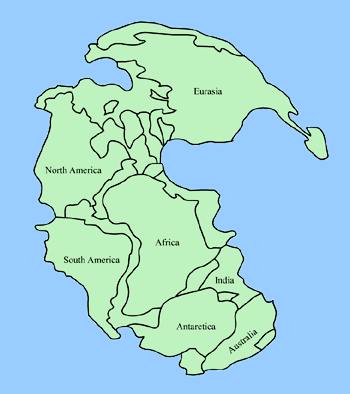
By 250 million years ago, all the continents of the world were welded together into one land,
Pangea.
 |
Know how Africa & S. America look like
jigsaw puzzle pieces? There's a reason! |
The young Appalachian mountain range probably towered
5 miles into the sky, as high as the modern Himalayas! Maine was a land-locked metamorphic mass-- the farthest thing from coastal. Our grain of sand now lay in a metamorphosed stone known as
quartzite. Though it was now a mile up, it was still buried by layers of hardened lava from volcanic eruptions.
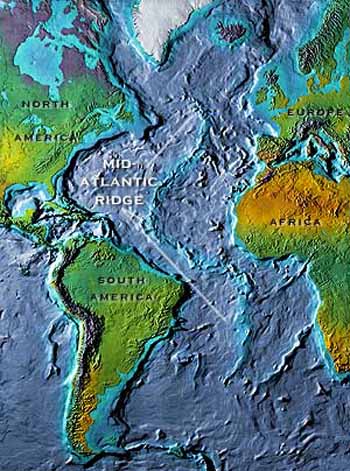
Slowly, over millions of years this overburden eroded away, running down other vanished rivers. Where did all that sediment go? Into the newly born Atlantic Ocean! ~200 million years ago, the forces that pulled the continents together now ripped them apart. North America broke free from Europe & Africa, and the Atlantic was born. Our tiny grain of sand now lay 150 miles away from Maine's brand-new coastline, still trapped high up in the towering Appalachians.
(The Atlantic Ocean is still widening today. Every year Maine gets about an inch further from Europe, thanks to the action of
the mid-Atlantic Ridge.)
 |
| The Atlantic Ocean - work in progress |
~50 million years ago, erosion finally exposed the quartzite rock holding our grain of sand. But quartzite is tough. It erodes, but only slowly. Our sand grain held out in its cozy home, as the weaker stone around it eroded away. Eventually it lay within a tall, weathered quartzite lump -- a last reminder of the majesty of the early Appalachians. But Mother Nature had another trick. 1.8 million years ago, the earth began entering a series of
glaciations (misleadingly called "ice ages"). 20,000 years ago, glaciers reached their greatest extent, covering all of Maine in a wall of ice a mile high!
Glaciers aren't static, silent blocks of ice. With their terrible weight, they move, grind, torture, and pulverize the rocks beneath them. This last glacier rode up and over the denuded mountain holding our sand grain. And it ground it down. As it ate its way across the surface, it finally freed our grain of sand. It then moved the sand down and down, south & east. When the glacier finally receded 10,000 years ago, it left the sand grain on lowlands 50 miles west of the coast in a mass of clay, boulders, and debris a tenth of a mile deep.
Since then, the Saco River has been slowly eroding away the banks of all this debris, washing it down to the Gulf of Maine. Eventually -- maybe 5000 years ago, maybe last year -- the grain of sand fell out of the eroded rubble bank, plunged into the Saco River, and rolled & bounced its way the last 50 miles to the ocean. The ocean then churned & tossed it up onto Bay View beach. Where I scooped it up in my hand last week. Along with 10,000 other grains that all have their own tale to tell.
The world is an incredible, beautiful, and wondrous place. It would be nice if we kept it that way.